Wine Stories · Part II · Chapter 53
Spain — The Country That Always Had More Than It Showed
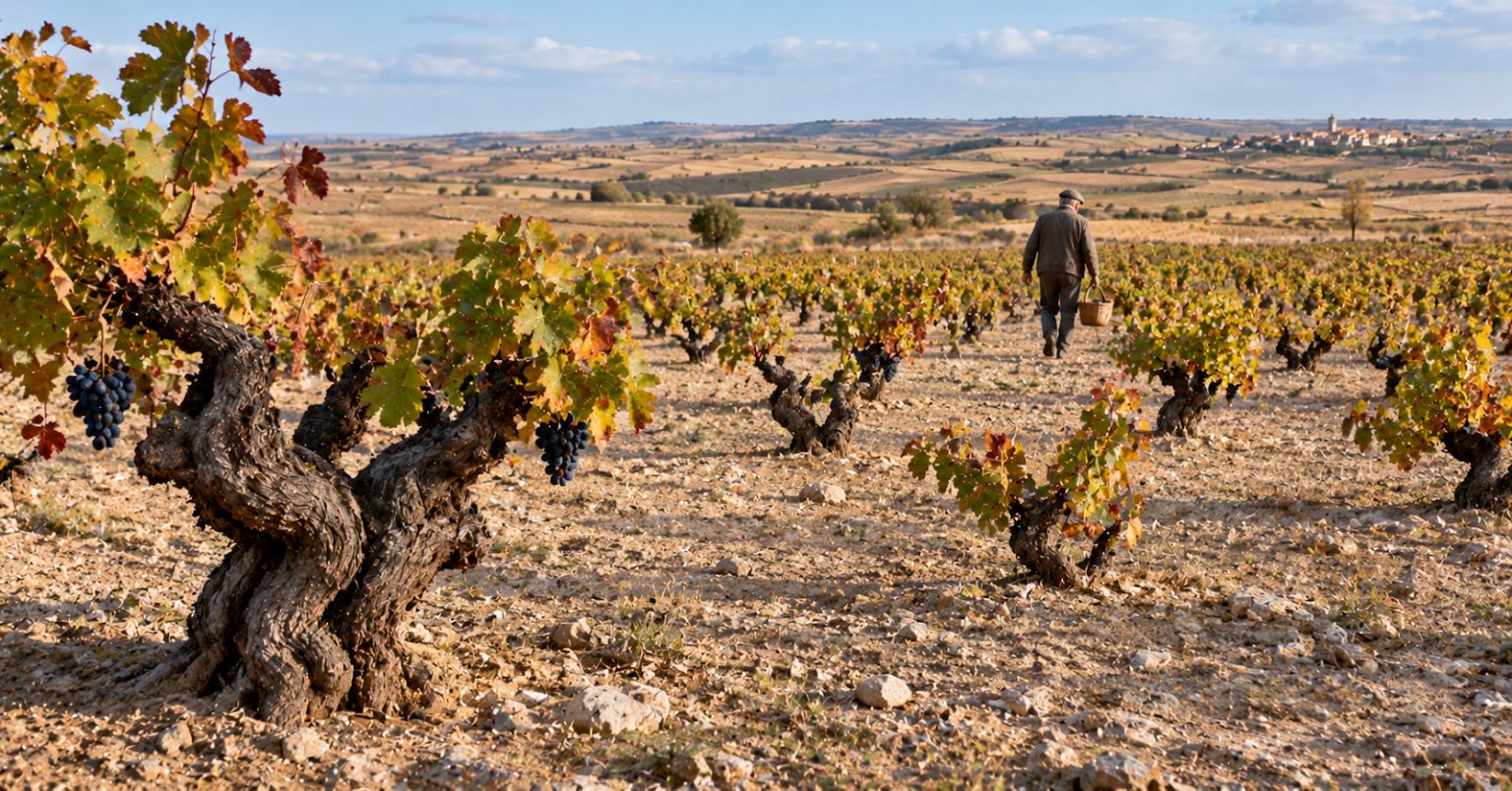
For decades, Spain made wine like someone guarding a secret without realising they were guarding one. It had more land planted with vines than any other country on the planet, grape varieties that existed nowhere else, a winemaking history that predates Rome by more than a thousand years — and still, the world knew it by a single name.
That name was Rioja. And for a long time, for anyone drinking wine outside Spain, Rioja was Spain. The rest — Castile, Galicia, Catalonia, Andalusia — existed, but went unseen. Not for lack of quality. For lack of anyone telling the story.
I arrive in Spain after ten chapters spent learning to admire Italian multiplicity, and I find a country that solved the same problem — how to stay true to itself without dissolving into a single formula — in a radically different way. Italy shouted its diversity to the world. Spain, for most of the twentieth century, chose silence.
In this chapter, I propose entering the world of Spanish wine through its simplest and most forgotten truth: it is the country with more vineyard planted than any other on the planet, it holds some of the oldest grape varieties in Europe, and it spent much of the twentieth century underestimated for exactly the reason that now makes it fascinating — it never felt the need to explain itself in a hurry.
More Land Than Any Other
In 2025, according to the latest figures from the International Organisation of Vine and Wine, Spain had nine hundred and nineteen thousand hectares under vine — more than France (seven hundred and forty thousand), China (seven hundred and thirty-three thousand) or Italy (seven hundred and twenty-six thousand). It is a considerable margin, and not a recent one: Spain has held this position for decades.
The fact always surprises those who equate leadership with production volume. But Spain is not the world’s largest wine producer — that contest belongs to Italy and France, year after year. Spain leads in something else, quieter and more revealing: area. Its vines are more widely spaced, grown on drier land, planted as dry farming, where scarce rainfall forces every vine to claim a larger territory just to survive. Producing little per hectare, in Spain, is not inefficiency. It is the only way to grow vines across half the country.
There is a lesson here worth holding onto before we go further: low yield in a vineyard is not, by itself, a sign of quality — I know plenty of widely spaced, low-yielding vineyards around the world that never produced a memorable wine. But when that scarcity is imposed by nature, generation after generation, with no one choosing it as a strategy, it ends up producing something no cellar technique can replicate: deep roots, a water balance learned over decades, a relationship of mutual dependence between plant and place that only time can teach.
Eight Hundred Memories, One Hundred and Eleven Voices
If Italy’s register of grape varieties runs close to six hundred entries, Spain has its own inventory, less talked about but just as vast. A survey conducted by the El Encín agricultural research centre catalogued eight hundred and seventy traditional varieties scattered across the Peninsula — many of them surviving in isolated plots, unrecognised beyond the village where they grew.
Today, only two hundred and thirty-five are still cultivated. Of those, one hundred and eleven are recognised as suitable for winemaking and distributed across the country’s more than seventy Denominations of Origin. The rest are split between minority varieties at risk, traditional grapes still without legal status, and a small group of authorised foreign varieties — mostly French and German — that arrived later, already in the twentieth century.
This is not an inventory of curiosities. It is proof that, even in the years when Spain exported wine in bulk and without a name, its genetic diversity never stopped existing — it simply stopped being sought out.
It is also the starting point of one of the most interesting movements in contemporary Spanish wine, which we will return to closer to the end of this block: a new generation of producers combing through that forgotten inventory, region by region, in search of marginalised varieties no one had the patience to vinify on their own. Not all of them will deserve to survive the scrutiny of the glass. But some are already changing the way the rest of the world pronounces the name of Spanish wine.
Vines That Time Never Brought Down
Phylloxera entered Spain in the 1870s, through doors in the south and northeast — Málaga, Girona, and the border with Porto. It devastated much of the country, as it had devastated France a decade earlier. But it did not reach everywhere.
The vineyards of the Canary Islands, protected by Atlantic isolation, escaped it entirely. And in pockets of sandy soil scattered across Castile, sand acted as a natural barrier: the insect that attacks vine roots does not survive well in it. In Toro, this geological quirk preserved vines of Tinta de Toro — a local clone of Tempranillo — that were never grafted. Vega Sicília today vinifies, at Bodegas Pintia, centenary ungrafted plots planted before the plague had even reached Spain.
There is something admirable in this survival by geological accident rather than human decision. It is the same lesson Etna taught us in Italy, in a different accent: sometimes, what preserves a vineyard is not the will to preserve it, but a geography that makes it difficult to destroy.
A Heritage Older Than Rome
Long before Roman legions reached the Peninsula, the Phoenicians of Tyre had already left their mark. Around 1100 BC, according to tradition — archaeology only confirms layers from the ninth century BC onward — they founded a trading post on the southern coast which they called Gadir. Today it is Cádiz, and it disputes, with few other cities in Western Europe, the title of the continent’s oldest still-inhabited settlement.
The Phoenicians did not bring the vine to Spain: wild vines had already grown there for millennia, as across most of the Mediterranean. But they turned wine into an organised commodity, and some Spanish grape varieties today carry, in their genetic makeup, the distant trace of the vines that arrived on their ships.
Further north, on the Catalan coast, Greeks from Phocaea founded Empúries in 575 BC — another trading post linking the Peninsula to the rest of the Mediterranean, long before there was a Catalonia, a Spain, or any notion of a border between the two. Carthaginians followed their example later, settling the same coasts the Phoenicians had opened. When Rome arrived, it did not invent Spanish wine. It found it already mature, waiting to be organised on an imperial scale.
Seventeen Countries Within One
Spain is organised into seventeen autonomous communities, each with its own legislative power, each with its own particular relationship to the vine. This political fragmentation — deeper than Italy’s, because it is institutionalised by law, not only shaped by history — helps explain why the Spanish system of denominations, which we will explore in more detail later in this block, never worked as a single structure. It is instead an archipelago of more than seventy denominations, each deciding, within its own borders, what counts and what does not.
For now, one idea is enough to hold onto: in Spain, the law arrived late and organised little. The territory always did the defining — and, increasingly, so does the producer willing to question what the law took for granted.
From Rioja to Galicia
The journey that begins in this chapter crosses a range few European countries can offer with the same intensity. From Rioja, where Tempranillo learned to live alongside American oak, to Ribera del Duero, where the altitude of the Castilian plateau makes it more concentrated and more mineral. From Priorat, resurrected on black slate soils after decades of abandonment, to Atlantic Galicia, where Albariño speaks a completely different language from the rest of the country.
Between these extremes lies Jerez, with its solera system and its generous wines shaped by time into a pyramid — perhaps the most misunderstood Spanish wine heritage outside Spain, and one of the most admirable. And running through nearly all these regions, from north to south, is a single grape variety — Tempranillo — which adapts to terroir with a flexibility few other varieties in the world can match, yielding elegant wines in the Atlantic north and sturdier ones in the Castilian interior.
The Winemaker Before Spain
I look at Spain with a mixture of recognition and productive discomfort.
Recognition, because few countries have preserved so much genetic heritage and so many old vines despite — not because of — any deliberate strategy. Discomfort, because I know how easy it is to mistake invisibility for protection, and to forget that in markets where no one tells a region’s story, that region eventually ends up being told through someone else’s.
For anyone making wine in Portugal — another country of old vines, native grape varieties and decades of international anonymity — Spain is a particularly uncomfortable mirror. It shows both the wealth that time and isolation can preserve and the price paid for taking too long to show that wealth to the rest of the world. The difference between the two countries, perhaps, is one of scale: Spain has more vineyard, more grape varieties, more regions still to discover than Portugal ever will. Which makes it all the more urgent, for us, not to repeat the same mistake for any longer than necessary — the mistake of letting quality speak for itself, in a language the rest of the world has not yet learned to hear.
A Journey That Begins in Rioja
Before crossing the whole country, one has to choose where to enter. And there is one region that, more than any other, taught the world to pronounce the name of Spanish wine.
That is where we go in the next chapter — to Rioja, where the tension between tradition and renewal produced some of the country’s most honest and enduring wines.