Wine Stories · Part II · Chapter 52
Transition — Italy and the Lesson of Multiplicity
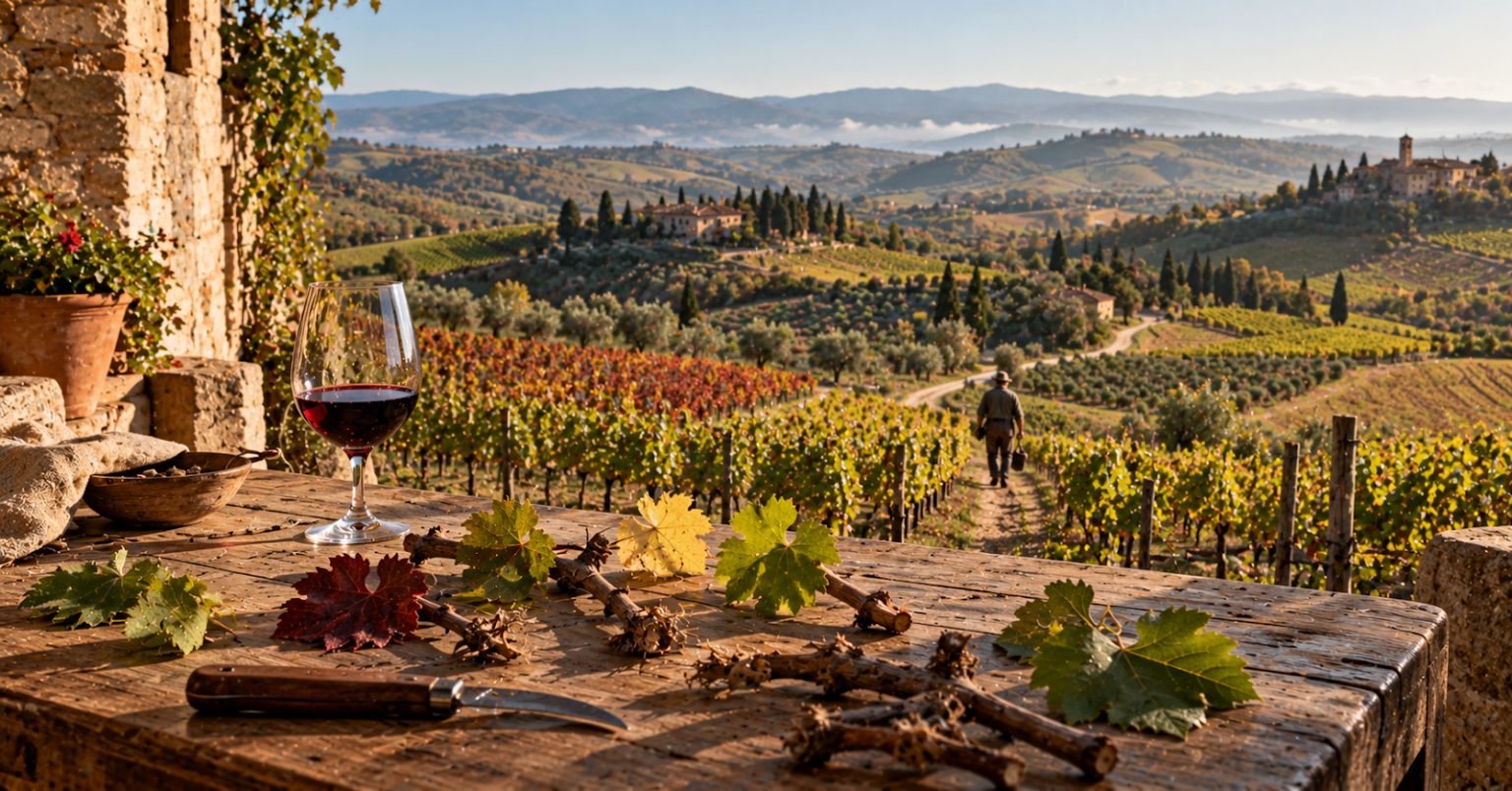
Throughout this block, Italy refused, again and again, to give a single answer. Instead, it offered hundreds — one for every valley, every native grape, every culinary dialect that never felt the need to explain itself to a distant capital.
There is no Bordeaux in Italy to serve as a model to copy, nor a central body deciding, from Rome, what counts and what does not. There is, instead, a country that turned its own historical fragmentation into heritage — and that proves, glass by glass, that diversity can be as solid a strategy as uniformity.
The Thread Running Through This Block on Italy
If we look back at the chapters that make up this Block III, we do not find one Italy, but several — all equally Italian, and none of them reducible to the other.
In Piedmont, Nebbiolo demanded decades of patience before Barolo became what it is today, and the same land that gave it its rigour also gave it the white truffle that accompanies it at the table. In Tuscany, Sangiovese knew how to reinvent itself without losing its soul, opening up to the experimentation of the Super Tuscans without ceasing to be, at bottom, the grape that defines the region. In the Veneto, we learned the most uncomfortable paradox of all: that volume and quality are not opposites, and that the same territory capable of flooding the market with Pinot Grigio also holds, on its hillsides, Amarone. In the south and the islands, we watched an entire generation of producers refuse the role of anonymous bulk-wine supplier, and restore dignity to grapes such as Aglianico, Primitivo and Nero d’Avola. On Etna, the land was even more literal about itself: lava of different ages, century-old vines that phylloxera never managed to reach in the volcanic sand, an identity that is not explained so much as measured — in altitude, and in the year of the eruption.
And then, in the chapter on the DOC and DOCG system, we saw the price Italy paid for this refusal of uniformity: a legal structure more complex, more contradictory, unable to rigorously separate the essential from the incidental — but also more faithful to the country that wrote it than any perfect copy of the French model could ever be. And in the chapter on gastronomy, we closed the circle: we realised that all this multiplicity only makes full sense once it reaches the table, because it was there, in the regional kitchens, that grape and territory learned to speak the same language before any law gave them a name.
The Legacy of Italian Multiplicity
Having come this far, the legacy Italy leaves behind is not a single lesson, but a set of certainties that reinforce one another.
The first is that having more than 350 native grape varieties is wealth, not confusion. A country that had decided, at some point in its history, to simplify that heritage down to a handful of international grapes would have gained market efficiency and lost everything else — the genetic memory of centuries of adaptation to place, which no marketing campaign can recreate.
The second is that each region can be true to itself without needing to measure itself against its neighbour. Piedmont does not compete with Tuscany for the same kind of prestige, nor does Sicily try to resemble the Veneto. This absence of internal comparison, which in another country might read as a lack of ambition, is in Italy exactly the opposite: the confidence of knowing that one’s identity does not depend on the identity next door.
The third is that a wine only exists fully when it has a table in front of it — and that table is born of the same territory as the wine, not of some later exercise in pairing. It is the hardest lesson to export to other markets, because it cannot be bought or decreed: either a country’s food culture treats wine as part of the land, or it treats it as a product sold alongside it.
The fourth, and perhaps the most uncomfortable of all, is that a system of laws, however well designed, never replaces decades of a producer’s work proving, bottle after bottle, the worth of their own name. Italy built its pyramid of denominations in earnest, but it was always the producer — the Biondi-Santi family of Brunello, Benanti of Etna, the Incisa della Rocchetta family of Sassicaia — who decided, in practice, what the law would only later come to confirm.
The Winemaker Before Italy
I write this block aware that I make wine in a far smaller country, and I recognise in almost every one of its chapters a mirror of dilemmas we also live with in Portugal: the temptation to standardise in the name of efficiency, the tension between law and quality, the difficulty of exporting a regional identity without diluting it in the process.
The difference, perhaps, is one of scale and time. Italy had centuries, and three hundred and fifty grape varieties, to learn that multiplicity pays off. Portugal has a fraction of that time — which makes it all the more urgent not to repeat the mistake Italy, whether by luck or by instinct, avoided: treating diversity as a problem to solve, rather than an asset to protect.
It would be naïve, however, to celebrate this multiplicity without acknowledging its price. An importer in London or New York can explain Bordeaux in a single sentence; explaining Italy takes an entire afternoon just to get started. That complexity, which internally is wealth, is also commercial friction — which is why so many markets still know Italy through three or four names, Chianti, Prosecco, Barolo, while the rest of the country still waits, to this day, for someone to pay it attention. It is a lesson I carry back to Portugal with more discomfort than comfort: the regional diversity we prize so highly — Dão, Douro, Alentejo, Bairrada — only becomes a brand asset once someone invests the time to make it legible to those who have never tasted it. Without that translation, multiplicity and invisibility are, more often than not, the same thing seen from the outside.
Looking Beyond the Border
Italian diversity, however, is not an isolated case in the Old World.
On the other side of the western Mediterranean, a large country quietly held an even greater territorial wealth. It is the country with more vineyard planted than any other on the planet — not the largest producer, but the one with the most land given over to vines, some of it still ungrafted, surviving phylloxera, rural abandonment and drought, by sheer geographical chance rather than any deliberate policy of preservation.
For decades, that country was known abroad by a single name — and that anonymity, which could have been a disadvantage, worked instead as a shield: its native grape varieties survived precisely because there was not enough commercial pressure to replace them with international ones. It is a story of invisibility that preserves more than it destroys, and that echoes, in a different accent, the very lesson Italy has just taught us.
We now leave Italy, which made multiplicity its answer to the world, and enter Spain — the country that, for far too long, showed less than it always had.
In the next block of chapters, we cross the Mediterranean towards Rioja, Ribera del Duero, Priorat and Atlantic Galicia: a territory only now beginning to tell the rest of the world the story it always had to tell.