Wine Stories · Part II · Chapter 51
Food and Wine in Italy — The Inseparable Union
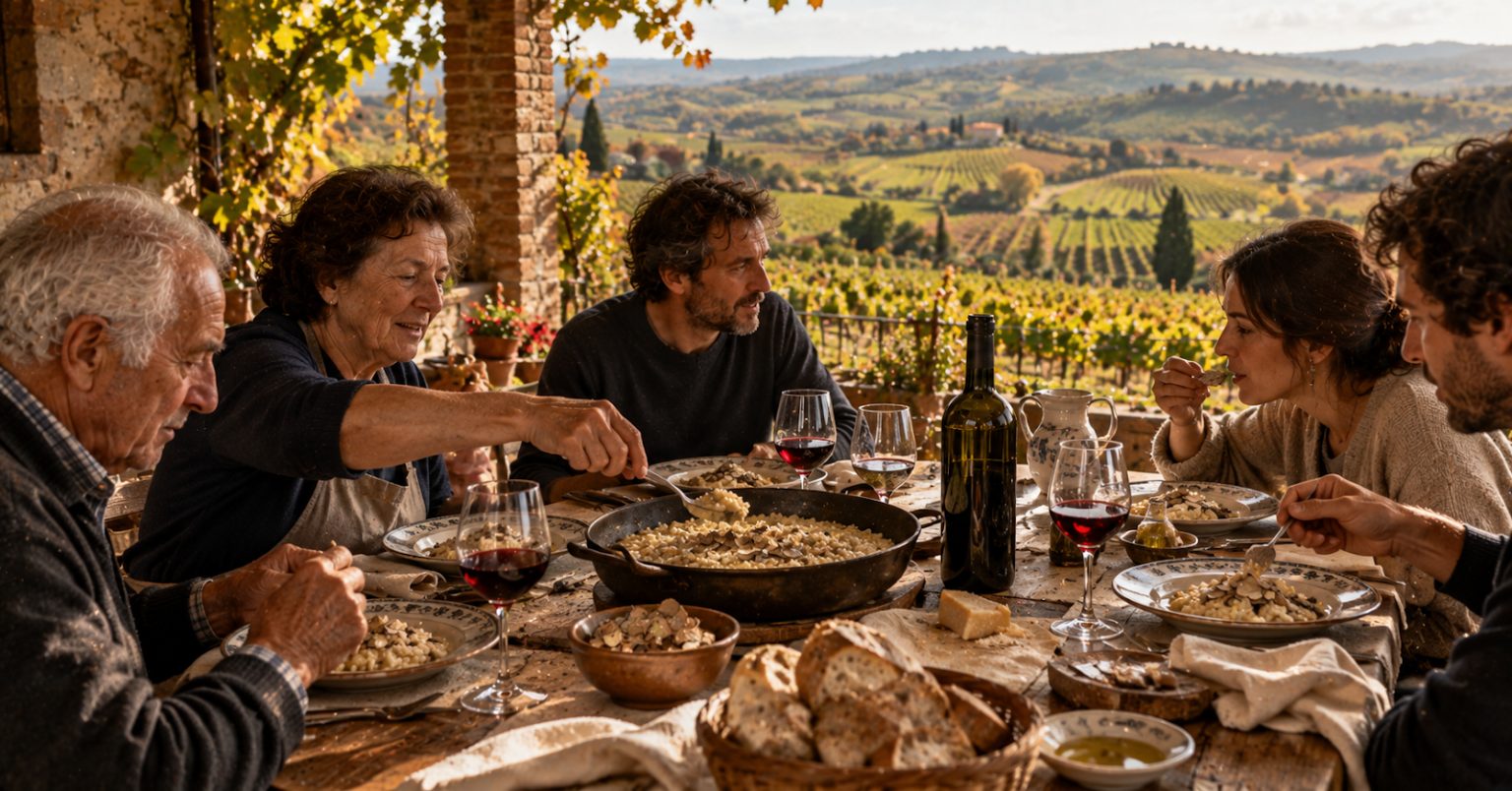
In Italy, wine and food never met each other. They grew up together, on the same hillside, under the same sun, served by the same hands. There is none of the deliberate gesture we practise elsewhere — the exercise of pairing, after the fact, a wine and a dish that happen to get along. In Italy, more often than not, the wine and the dish were never apart to begin with.
It is a distinction that sounds subtle and is not. Pairing assumes two things drawing closer together. In Italy, the norm is one single thing with two expressions — the grape and the garden, the glass and the pot, born of the same territory and shaped by the same people, across generations who never thought of it as a concept, only as daily life.
In this chapter, I trace that connection between territory, grape and regional cooking — and two of its clearest proofs, neither of which was born from wine, yet neither of which can be understood without it: the Slow Food movement and the recognition of the Mediterranean diet as a heritage of humanity.
From the Hills of Alba to the White Truffle
In the Langhe, in Piedmont, the land that gives the Nebbiolo of Barolo and Barbaresco is the same land that, underneath, hides the white truffle — the rarest and most expensive tuber in Italian cooking, hunted with trained dogs among oaks and lime trees, between October and December.
It is not a coincidence of geography. It is the same combination of chalky soil, microclimate and humidity that makes those hills rare for the vine that also makes them rare for the fungus that grows there. Since 1929, Alba has held its Fiera Internazionale del Tartufo Bianco — the International White Truffle Fair —, a fair that, more than selling truffles, celebrates the fact that there, in that one precise patch of Italy, the land decided to be generous in two ways at once.
Serving Barolo alongside a risotto shaved with white truffle is not a sommelier’s exercise. It is serving two harvests from the same place at the same table.
The Grape as a Dialect of Regional Cooking
What happens in the Langhe repeats itself, with a different accent, across all of Italy. In Liguria and Sardinia, Vermentino was born to go with the fish that comes out of the same sea that touches the vines — fresh, saline, with no wood to compete with the simplicity of a seafood dish. In Campania, Fiano and Greco di Tufo grew up alongside the vegetable garden and the wood-fired oven that gave the world Neapolitan pizza. In the Veneto, the concentration of Amarone, made from grapes dried for months, always called for the slow stews and game dishes of the Venetian winter — not because anyone decided it should, but because that is what you eat when the wine is that.
This is the true lesson of Italian multiplicity applied to the table: there is no national grammar of pairing, because Italy never needed one. Each region wrote its own sentence, with its own grape and its own dish, without consulting its neighbour.
Slow Food — A Reaction to a World Eating Too Fast
In 1986, when word spread that McDonald’s was about to open a restaurant near the Piazza di Spagna, in Rome, a group of Italian intellectuals and activists, led by Carlo Petrini, decided this deserved a response. Not an isolated protest, but a movement. Slow Food was born — a philosophy that championed the pleasure of the table, food biodiversity and the time it takes to eat well, against the logic of speed and uniformity.
There is something rarely underlined in this story: Slow Food set up its headquarters in Bra, in Piedmont — the same region as the Langhe, as Barolo, as the white truffle. That is no minor detail. The movement that would go on to champion, across the world, the bond between product, territory and time was born precisely in the region where that bond had been, for centuries, the rule rather than the exception. Petrini did not invent the idea. He looked around him and gave it a name the world could understand.
The Mediterranean Diet as a Heritage of Humanity
On 16 November 2010, UNESCO inscribed the Mediterranean diet on its list of the intangible cultural heritage of humanity — not as a recipe, but as a way of life: a way of producing, cooking, sharing and celebrating food, passed down from generation to generation around the Mediterranean. The original nomination brought together four emblematic communities — Cilento, in Italy; Soria, in Spain; Koroni, in Greece; and Chefchaouen, in Morocco.
That Italy chose Cilento, in Campania, to represent that diet is not indifferent to anyone writing about wine. It is a region of old vineyards, of olive oil, of vegetable gardens and shared tables — the exact portrait of what this recognition set out to protect: not a single dish, but the whole set of gestures surrounding food, of which wine was always a part — not as an accompaniment, but as an ingredient of social life itself at the table.
The Winemaker Before the Italian Table
I look at this bond between Italian wine and food with a mixture of admiration and productive envy. Admiration, because few countries have so well preserved the idea that a wine only exists fully when it has a dish in front of it — and that dish, in turn, only exists fully when it comes from a territory that recognises itself in it. Productive envy, because I know how hard it is to deliberately recreate what Italy never had to invent: a food culture that treats wine as part of the land, rather than as a product sold alongside it.
In Portugal, we have our own version of this union — Vinho Verde and sardines, Dão and kid goat, Colares and the mussels and shellfish of the Sintra coast. But the Italian lesson is less about getting the pairs right than about proportion: about how much room a culture gives to the idea that eating and drinking well take time, territory and company — and about what is lost when we let haste decide, in our place, what is worth savouring.
From the table that never separated wine from food, the next stage of this journey looks back at Italy as a whole — not through its parts, but through the lesson its multiplicity has to offer any country still searching for a single right answer.