Wine Stories · Part II · Chapter 48
The South and the Islands — The Wine the World Took Time to Discover
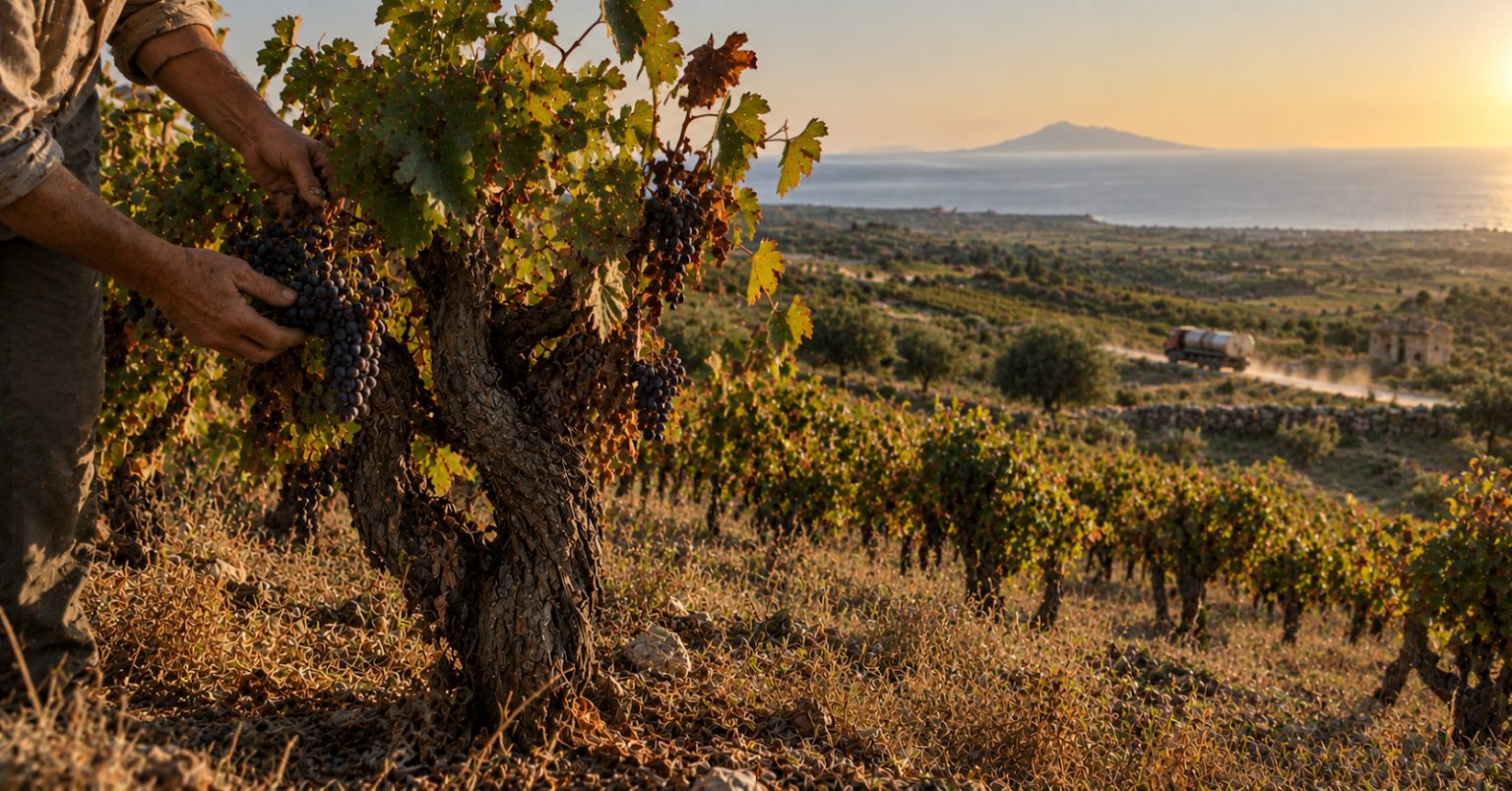
For most of the twentieth century, southern Italy had no face. It had volume.
Every autumn, tanker trucks travelled north from Puglia, Sicily and Calabria towards Piedmont, Emilia, Burgundy and even Germany, loaded with dark wine, generous in alcohol and colour, produced for a single purpose: to give body to paler blends from the north. No one asked which grape it was made from, or which hillside it came from. It was vino da taglio — blending wine — and blending wine does not need a name. It simply needs to exist in sufficient quantity.
Then, within a few decades, something was reversed. Producers with knowledge, capital and patience looked at those same hills — volcanic, limestone, exposed to two seas — and saw not a problem of excess, but a heritage of grape varieties that no one had ever had much reason to uproot. Aglianico, Primitivo, Nero d’Avola, Nerello Mascalese, Negroamaro: names that meant almost nothing to most people a generation ago, and which today rank among the most discussed in European wine.
In this edition, I explore the renaissance of southern Italy and its islands — one of the most fascinating movements in contemporary wine, precisely because it was born not from imitating someone else’s model, but from the patient rediscovery of what had always been there.
The Burden of Bulk Wine
For much of the twentieth century, Puglia was Italy’s industrial wine cellar. Its warm, reliable climate ensured easy ripening and high yields; the absence of a strong tradition of estate bottling meant that almost everything left the region in bulk, sold by weight and alcoholic strength rather than by name.
It was an economic model that made sense in its time — it supported families, provided work for cooperatives and sustained an entire trade between south and north — but it rested on a premise that today sounds almost insulting: that this territory had no wine of its own to offer, only raw material for other people’s wine.
The change began when a handful of producers decided to reverse the question. Instead of asking, “How much can we produce?”, they began asking, “What can this land do better than anywhere else?”
The answer, as so often in Italy, lay in a grape that had already been growing there for centuries.
One Grape, Two Names, and an Origin No One Expected
If there is one episode that sums up the arrogance with which the wine world treated southern Italy for decades, it is the story of Primitivo.
It was called Primitivo, the story went, because it ripened before the region’s other varieties — primitivo, the early one. And during the second half of the twentieth century, it was accompanied by a simple narrative: this was the Italian grape that, centuries earlier, had crossed the Atlantic and given rise to California’s Zinfandel.
California, for its part, had always treated Zinfandel as something more than a grape variety — almost a symbol of national identity, “the American grape”, planted by immigrants in the nineteenth century and transformed into a cult wine from the 1970s onwards.
Both versions were partly right and, at the same time, incomplete. A USDA researcher at Davis had already noticed, in the late 1960s, visual similarities between Primitivo vines in Puglia and Zinfandel vines in California — but visual observation was not enough to establish genetic identity, and the question remained unresolved for decades.
The definitive answer came only with DNA.
Between 1998 and 2000, geneticist Carole Meredith of the University of California, Davis, joined Croatian researchers Ivan Pejić and Edi Maletić of the University of Zagreb in a systematic search for old vines along the Dalmatian coast. In September 2000, Pejić and Maletić located an almost forgotten variety in a Croatian vineyard called Crljenak Kaštelanski. In December 2001, DNA analysis in Meredith’s laboratory confirmed what no one had yet proved: Californian Zinfandel and Italian Primitivo were genetically the same grape — and that grape was originally neither American nor Italian.
It was Croatian.
I retain this story because it imposes a humility that wine occasionally needs to demand of those who drink it. California did not invent Zinfandel, nor is Puglia the original birthplace of Primitivo. Both inherited, by different routes and centuries apart, the same Dalmatian vine — and both built upon that borrowed inheritance identities that today seem entirely their own.
The authenticity of a wine, I realise ever more clearly, does not depend on where the grape was born, but on what a territory learned to do with it after receiving it.
In Puglia, what emerged was Primitivo di Manduria, recognised as a DOC in 1974 and, in its Dolce Naturale version — made from partially dried grapes — elevated to DOCG in 2011. It is an early-ripening wine, high in sugar and generous in tannin, producing dense reds and, in its dry form, alcohol levels that frequently exceed fourteen per cent without any effort in the cellar — the grape itself already provides what is needed.
Salento Learns to Sign Its Own Name
Alongside Primitivo, another grape carried the burden of Puglia’s anonymity for decades: Negroamaro, whose very name — black and bitter, according to one possible interpretation, or perhaps simply a corruption of Greek and Latin roots for “black” — already suggests a character that makes no apologies.
It is the backbone of Salice Salentino, in the heart of the Salento peninsula, an appellation long known mainly for its fresh rosés and simple reds served in neighbourhood bars, but which today also produces Riserva wines capable of ageing with dignity.
Negroamaro’s transformation follows the same pattern as that of the rest of the region: the grape never changed; only the ambition of those working with it did. Lower yields, greater respect for old vineyards instead of uprooting them, and a style of winemaking that ceased to treat colour and alcohol as its only objectives.
Puglia as a whole perhaps summarises, better than any other Italian region, the central lesson of this block of chapters:
identity is neither imported nor bought.
It is recovered from what was already there.
Basilicata’s Forgotten Volcano
If Puglia suffered the stigma of bulk wine, Basilicata suffered something worse: almost complete oblivion.
It is one of Italy’s least populated and least visited regions, without a significant coastline for mass tourism and without a city that serves as an international showcase. And it is precisely there, isolated among the mountains, that Monte Vulture rises — an extinct volcano whose volcanic slopes produce one of the country’s most serious and least-known red grape varieties: Aglianico.
The origin of the name is itself a clue to the variety’s antiquity: it almost certainly derives from Ellenico, a reference to the Greek settlers believed to have brought it to southern Italy between the seventh and sixth centuries BC. Remains of a Roman-era wine press have been found in the region, and the poet Horace, born near Venosa, sang of the wines of this land. In the Middle Ages, King Charles of Anjou ordered them in quantity in 1280, and Florentine merchants competed for them.
None of this prevented Aglianico del Vulture from spending most of the twentieth century in the shadows. It received DOC status only in 1971, and its Superiore version was not elevated to DOCG until 2011 — the only guaranteed designation in the whole of Basilicata, and one of the later Italian wines to receive that recognition.
The delay does not reflect the quality of the wine, which rivals the finest reds of the south in structure and ageing potential. It reflects only the absence of market, capital and narrative that kept this region invisible for decades.
For me, Aglianico del Vulture is now one of the clearest examples of how isolation can act as an unintended form of conservation: no one was in a hurry to uproot the old vineyards of a region no one visited.
Campania and a Loyalty That Endured for a Century
No southern region illustrates the value of continuity better than Campania — and no family illustrates that continuity better than the Mastroberardinos.
Founded in Avellino in 1878, Mastroberardino survived phylloxera, two world wars and the diaspora that emptied much of inland Campania towards the Americas, without ever abandoning the region’s indigenous varieties.
While neighbours across Italy were uprooting old vineyards to plant Cabernet Sauvignon and Merlot — the easiest response to pressure from international markets in the 1970s and 1980s — the Mastroberardino family worked with ampelographers to identify, preserve and replant Aglianico, Fiano, Greco, Piedirosso and Sciascinoso.
It was not a commercially risk-free decision. For many years, into the early 1990s, it was virtually the only estate exporting Taurasi abroad.
That loyalty eventually bore legal fruit. Taurasi, made from Aglianico, received DOC status in 1970 and was promoted to DOCG in 1993 — the first red wine from southern Italy to achieve that category, earning it the recurring and, to some extent, justified comparison with Barolo: the same demand for time, the same tannic structure that asks for patience rather than immediacy.
Ten years later, in 2003, Irpinia’s two great whites — the floral, mineral Fiano di Avellino and the more structured, volcanic Greco di Tufo — also received DOCG status, completing a trio that today places Campania among the most coherent wine regions of southern Italy.
The Wine Reborn Beneath the Ash
Within this story of loyalty lies an episode that borders on archaeology.
In 1996, the same Mastroberardino family launched the Villa dei Misteri project, with the aim of recreating the wine of ancient Pompeii — the city buried by the eruption of Vesuvius in AD 79.
The work began with archaeology, not oenology. Researchers studied the traces left in the soil by the roots of Roman vines, combining this evidence with DNA analysis of grape seeds discovered during excavations in an attempt to identify the varieties planted there two thousand years ago.
The findings pointed mainly towards Piedirosso and Sciascinoso — two varieties that Mastroberardino itself had already been cultivating and preserving for decades, without yet knowing that they shared roots with the vineyards buried beneath the ash.
The vineyards were replanted within the archaeological site at densities close to those described by Latin authors such as Columella — around eight thousand vines per hectare — and trained using systems inspired by Roman techniques. The first commercial bottles were sold at auction, with the proceeds helping to fund further archaeological research at the site.
It is a project that only Campania, with its unique combination of volcanic soil, living archaeology and a family willing to take both seriously, could have produced.
And it is also the most eloquent argument against the idea that southern Italy was a land without a wine history of its own.
The history was there.
It simply needed to be excavated.
The Sicily That Refused to Be One Thing
Sicily carries, on its own scale, the same story as the rest of the south: decades as an anonymous supplier of bulk wine — often destined to increase the alcoholic strength of wines from northern Europe — followed by a reinvention led by producers who recognised the potential of an island with a diversity of soils and elevations rarely found within a single territory.
The creation of Sicilia DOC in 2011 was the institutional gesture that sought to give substance to that reinvention: a region-wide appellation designed to cover the entire island and give a legal identity to a volume of production that had previously remained hidden under the generic IGT category.
Within that appellation, Nero d’Avola quickly became the flagship variety, marketed almost as a brand in itself — generous, dark, sun-drenched, easy to explain to an international consumer looking for a Sicilian red without first having to learn its geography.
But reducing Sicily to that convenient formula would impoverish it.
On the slopes of Etna, in the north of the island, an entirely different grape — Nerello Mascalese, planted in lava soils at more than a thousand metres above sea level — is building a reputation that already extends far beyond the island itself.
It is a story with enough weight and complexity to deserve a chapter of its own.
And that is where we go next.
What the World Took So Long to See
Looking back, it is difficult to understand how the wine world ignored southern Italy and its islands for so long.
It had ancient grape varieties, rare volcanic soils, unexpected elevations and a Mediterranean climate that few other European regions can offer with the same generosity.
What was missing was not potential.
It was people willing to treat it as such, rather than turning it into anonymous volume.
The lesson this south teaches — and one I carry with me as a winemaker from a country that knows the burden of international anonymity well — is that identity is rarely invented from nothing.
It is recovered.
It was always there, in the soil, in the grape, in the memory of those who never stopped cultivating in the old ways, even when no one was willing to pay more for it.
The achievement of this generation of producers was not to create something new.
It was to have the patience to stop being ashamed of what already existed.
From the continental south and its volcanic landscapes, we now climb towards a single volcano, still active, where this same logic of rediscovery reaches perhaps its most radical expression:
Etna, and the vineyard that chose to grow where the earth still breathes fire.