Wine Stories · Part II · Chapter 49
Etna — The Vineyard on the Volcano
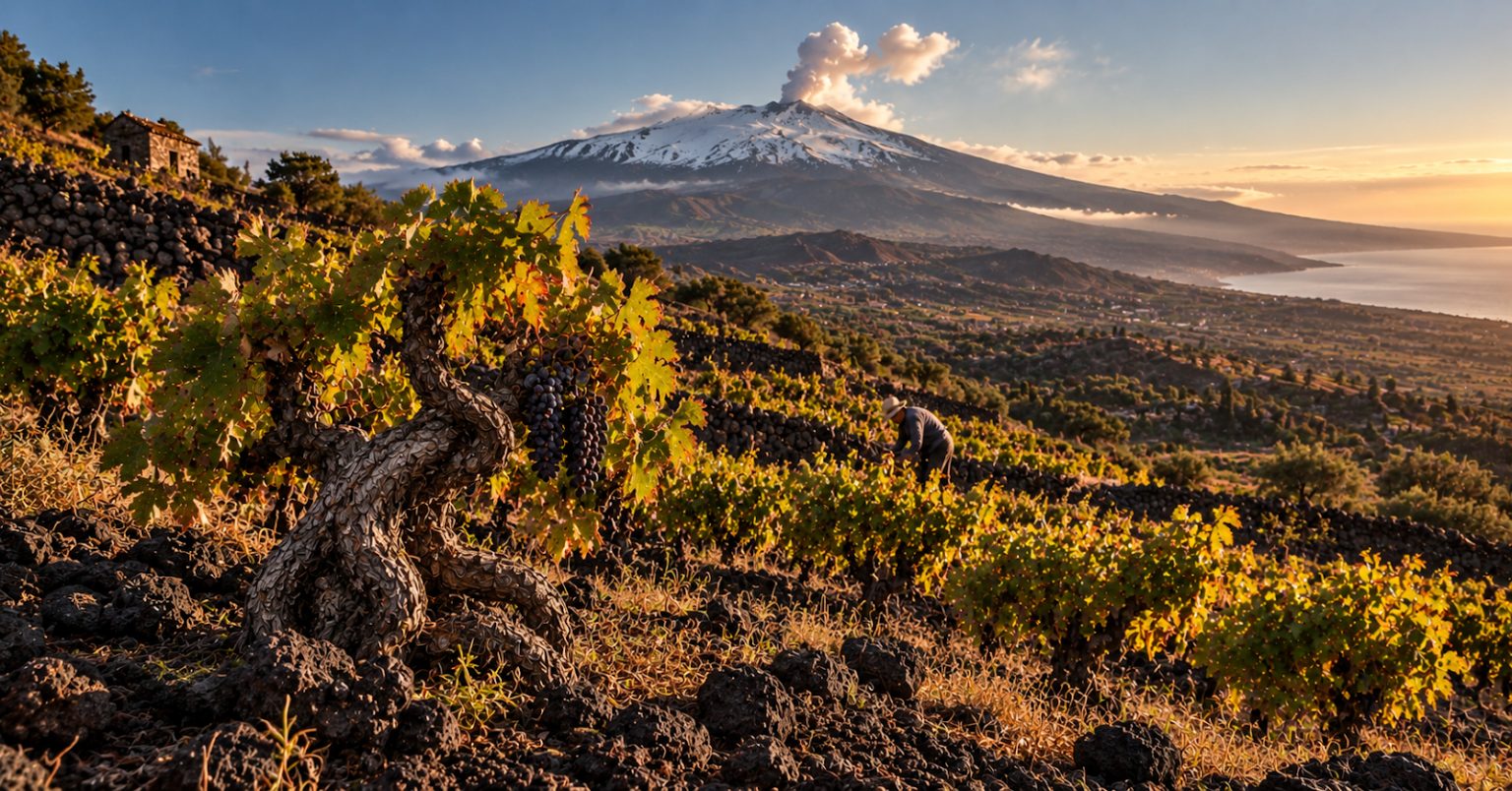
Etna is not a landscape. It is an organism that breathes.
Seen from a distance, the cone looks still — crowned with snow for much of the year, a thin plume of white smoke rising slowly against the blue of the Mediterranean. Up close, it is clearly alive. It trembles, releases gas, opens new fissures almost every year, and covers with fresh lava slopes that, until recently, held vines. Planting vines on Etna is an act of faith renewed with every harvest: the same earth that gives the wine can, without warning, swallow it.
No other active volcano in Europe carries, on its slopes, a wine culture so old and so alive. And no other Italian region forces me, as a winemaker, to think so hard about what terroir actually means — not as a catalogue word, but as a geological fact that changes, literally, from eruption to eruption.
In this edition, I tell how Etna became a symbol of a new Italian sensibility — less decorative, more mineral, more honest — and how the old free-standing vines, trained low to the ground, quietly kept an identity that the twentieth century nearly erased.
A Mosaic Written in Lava
Etna DOC was created in 1968, Sicily’s first denomination of origin and one of Italy’s oldest. Its territory spans the volcano’s northern, northeastern and southern slopes, between 450 and 1,100 metres of altitude — with the most sought-after Nerello Mascalese plots concentrated between 600 and 900 metres, on the northern side, where the warmth of the south meets the cold nights of altitude.
What makes this geography unrepeatable is not altitude alone. It is the fact that the soil has never stopped writing itself. Each eruption left a different lava flow, of a different age, with a different mineral composition — iron, copper, phosphorus, magnesium in proportions that shift from slope to slope. A vineyard planted on lava from 1865 gives a different wine from one planted two hundred metres higher, on lava from 1669. It is this layering of flows, broken down over centuries into ash and volcanic sand, that fragmented Etna into a mosaic of plots with their own personality — the contrade.
Today more than a hundred and thirty contrade are recognised, most of them on the northern, northeastern and southeastern slopes, around towns such as Randazzo, Castiglione di Sicilia and Linguaglossa. The comparison with Burgundy’s climats is tempting, and partly fair: here too, the name of the place says more than the name of the producer. But the parallel needs care. Burgundy mapped its parcels over centuries of monastic observation; Etna only formalised its contrade in the DOC regulations starting with the 2011 harvest. The map is barely more than a decade old. The memory of the place, that is far older — it simply hadn’t yet been written into law.
The Sand That Stopped Phylloxera
There is one geological detail that, on its own, explains why Etna holds onto some of Europe’s oldest vines.
When phylloxera reached Italy, documented from 1879 onward, it devastated Sicily: the island’s cultivated area shrank from around 320,000 to 175,000 hectares within a few decades. But the insect, which travels through the soil to attack the roots, struggles to survive in loose volcanic ash and sand — and it barely managed to climb above 400 metres on the volcano’s slopes. Most of Etna’s vineyard sat, and still sits, well above that line.
The result is a rare privilege: ungrafted vines, never grafted onto American rootstock, some more than a century old and still productive. Trained in alberello — the low, bush-shaped vine, with no wire or trellis, exactly as the Greeks brought it to Sicily — these century-old vines give tiny yields and a concentration no young vineyard can match. They are not a museum curiosity. In many cases, they are the backbone of the best Etna Rosso being bottled today.
The Wine That Crossed the Sea
Etna did not need discovering in the twenty-first century. It had already been discovered, and powerfully, in the nineteenth.
The 1844 Bourbon land survey shows vines covering roughly half the plains and nearly seventy percent of the slopes in the area known as the Contea. Production peaked around 1860, on the order of a million salme — more than six hundred thousand hectolitres. Riposto, Etna’s port, became one of Sicily’s main outlets for wine and spirits exports, alongside Marsala. Etna wine, high in alcohol and good acidity, was described as “seaworthy” — able to survive a sea crossing without spoiling — a quality that also made it valuable for reinforcing weaker blends from northern Italy and the rest of Europe.
It was a genuine period of prosperity, not a romanticised one. And it was also brief.
The Silence of the Twentieth Century
The twentieth century was not kind to Etna. Wars, the fragmentation of estates, and the exodus to the mainland and the Americas emptied entire slopes. Holdings were small, the gradient demanded manual labour, yields per hectare were low and production costs high — all of this at a time when the market wanted wines lighter and cheaper than anything Etna could offer. Urbanisation did the rest: vines that had survived phylloxera were replaced by citrus groves, by construction, by simple abandonment.
Within a century, Etna’s vineyard shrank from tens of thousands of hectares to just over two thousand — of which only nine hundred and ten now lie within the DOC area. But what survived, survived well. Protected by altitude and by the sheer inaccessibility of its terraces, a legacy of century-old vines waited, in silence, for someone to look at it seriously again.
A Pharmacist Who Replanted the Faith
That someone was named Giuseppe Benanti.
A pharmaceutical entrepreneur, owner of SIFI in Lavinaio at the foot of the volcano, Benanti was neither a winemaker nor a farmer by training. But in 1988 he founded Tenuta di Castiglione, in Viagrande — the winery that would later simply become Benanti — and did something few had done before: he treated Etna’s old, abandoned vines as heritage worth studying, not as rustic curiosities. He partnered with researchers such as Rocco Di Stefano, from the oenological institute in Asti, and Jean Siegrist, from France’s INRA in Burgundy, alongside the Sicilian agronomist Salvo Foti, to understand scientifically what those old parcels had to offer.
The results arrived in the 1990s, with landmark wines such as Etna Rosso Rovittello and Etna Bianco Superiore Pietramarina — single-vineyard bottlings that showed, for the first time in a long while, what Nerello Mascalese and Carricante could become when taken seriously. Giuseppe’s son, Salvino Benanti, sums up his father’s vision in a phrase I keep close: Etna as an “archipelago within the island” — a single volcano that is, in practice, dozens of distinct territories.
Salvo Foti, for his part, became the most stubborn guardian of Etna’s tradition. He founded the I Vigneri project, named after the old guild of Sicilian winegrowers, dedicated to preserving alberello training, vinification in palmento — the old stone presses scattered through the volcano’s villages, where generations trod grapes long before any modern winery existed — and a way of working the land that respects the rhythm of the old vine rather than correcting it.
The Foreigners Who Saw What Was Missing
The second wave of revival did not come from within Sicily, and that too is part of the story.
In 2000, Andrea Franchetti — a Tuscan, already known for his Tenuta di Trinoro estate — arrived on Etna’s northern slope and found abandoned vineyards at altitudes and temperature swings no other Italian region offered. He founded Passopisciaro and steered his work towards the elegance and transparency of the place, rather than the concentration he had pursued in Tuscany. In 2001, Marc de Grazia — for decades an importer and selector of Italian wines in the United States — founded Tenuta delle Terre Nere, and in 2002 released Etna Rosso Guardiola, considered the first Etna wine to be explicitly labelled by contrada. It was de Grazia who pushed hardest, with producers and the international press, for the language of place as the central selling point — the same logic that decades earlier had crowned Burgundy.
Around the same time came Frank Cornelissen, a Belgian, with a radically minimalist approach: vineyards farmed organically from the outset, fermentations with native yeasts, neutral vessels, intervention kept to an absolute minimum. And Alberto Graci, a former investment banker, bought land in prestigious contrade in the early 2000s and founded the winery that now bears his name.
None of these producers invented Etna. They found it — century-old, ungrafted vines that twentieth-century economics had left behind precisely because they weren’t easy money. Etna’s good fortune was that this very marginality protected what, in any more prosperous region, would have been pulled up decades earlier.
The White Wine Still Waiting to Be Named
To speak of Etna through Nerello Mascalese alone is to commit the injustice this book always tries to avoid: reducing a territory to its most visible face.
The white grape Carricante, with its bright acidity and almost saline character, dominates Etna Bianco DOC — a minimum of sixty percent, complemented by Catarratto. But it is in the municipality of Milo, on the eastern slope, cooler and more humid, facing the sea, that Carricante reaches its most precise expression, recognised under the Etna Bianco Superiore category, exclusive to this territory — a kind of appellation communale within the DOC, in the French manner. Barone di Villagrande, with vines in Milo since 1727, is one of the few estates to have spanned nearly three centuries in the same place, a reminder that Etna’s white-wine vocation is no recent invention.
The Winemaker Before Etna
What interests me most about Etna is not its meteoric rise over the past two decades — everyone already tells that part. It is the more uncomfortable lesson: for most of the twentieth century, this heritage sat in plain sight, and almost no one wanted to look at it.
The century-old vines never hid. They simply stayed exactly where they had always been, trained in alberello, on lava of different ages, giving grapes that no one valued enough to pay for the cost of hand-harvesting them on steep terraces. It took a pharmacist with no training in wine, an agronomist stubborn about his grandparents’ stone presses, and a handful of outsiders willing to buy land no one else wanted, for the world to notice the obvious again.
There is a warning here for anyone working with viticultural heritage anywhere in the world, Portugal included: identity rarely disappears completely. It simply waits for someone who knows how to read it before it gets replaced with something easier to sell.
From the volcano that never settles, we now descend to the driest ground of the entire Italian journey — the laws, the acronyms and the regulations Italy tried to impose on itself, with results as contradictory as the country that wrote them.