Wine Stories · Part I · Chapter 17
The Decline and the Silence of the Vineyards
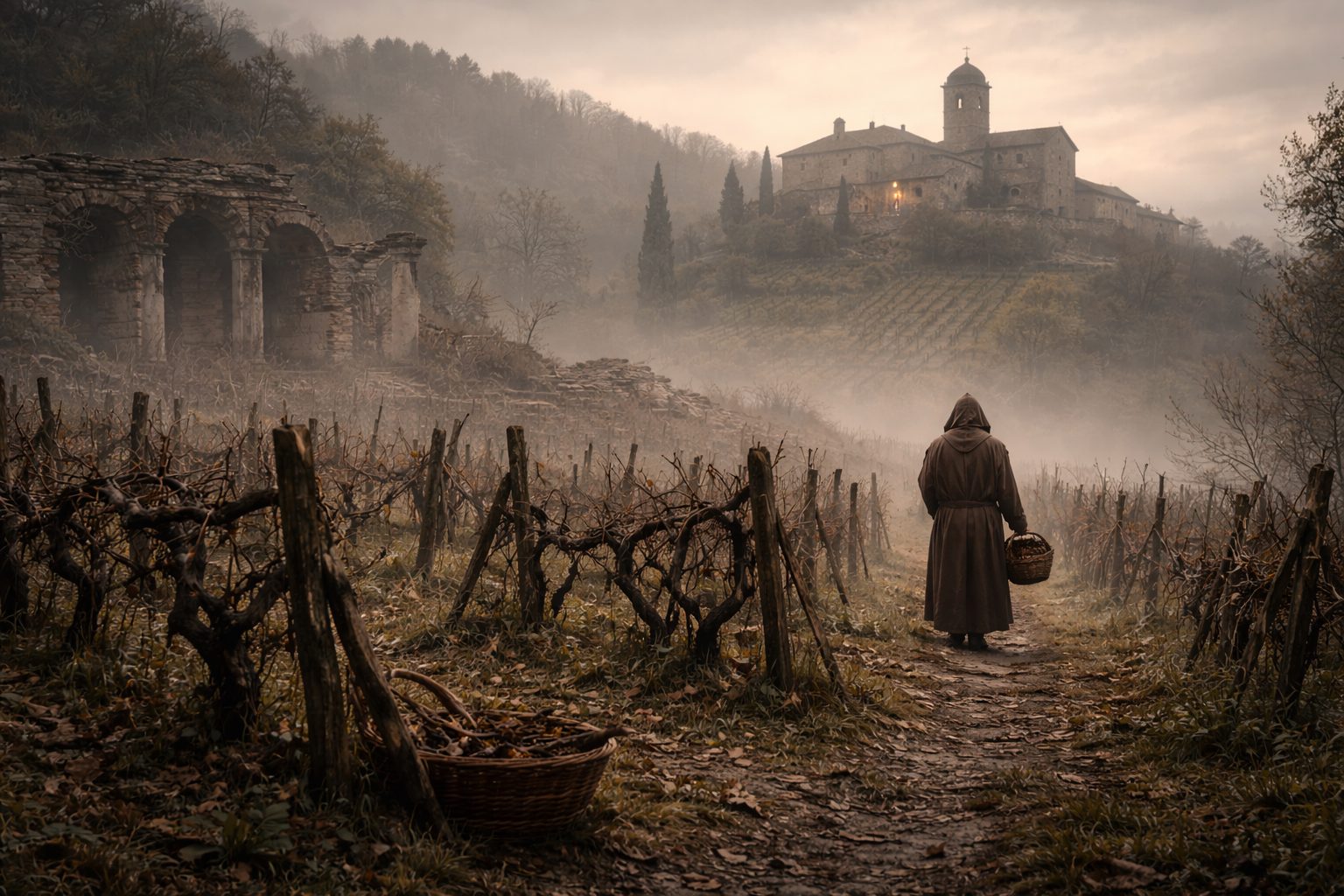
With the fall of the Western Roman Empire in the 5th century, the order that had sustained ancient Europe fragmented. Roads were no longer maintained, trade routes became unsafe, cities lost population, and the organized economy collapsed.
Wine, once a symbol of empire and a structural element of urban life, found itself deprived of the infrastructure that had sustained it.
Large commercial vineyards were abandoned. Long-distance trade virtually disappeared. Amphorae no longer crossed the seas with their former regularity. A time of silence set in.
But wine did not disappear. It withdrew.
Mas o vinho não desapareceu. Recolheu-se.
—
The End of Roman Order
Rome did not fall in a single day. It was a gradual process of political, economic, and military erosion. As central power weakened, the provinces became vulnerable to invasion and instability.
Without secure roads, transporting wine became risky. Without stable urban markets, large-scale production lost its purpose. Without organized administration, viticulture ceased to be a strategic priority.
The vine, a plant that demands continuity and care, suffers deeply in unstable contexts. Abandoned for even a few years, it deteriorates. Neglected, it loses productivity. The Roman wine map began to fragment.
—
Retreat to the Local
With the decline of major trade routes, wine ceased to circulate as an imperial commodity. It survived only where local production met local consumption.
Viticulture became a rural activity, confined to specific communities. In many regions of northern Europe, vineyards virtually disappeared, unable to endure without logistical and technical support.
Wine ceased to be universal and returned to being territorial. This contraction marked the beginning of a period of viticultural obscurity, often referred to as the “Dark Ages.”
In reality, however, it was a time of silent transformation.
—
Refuge in the Monasteries
As cities declined and trade routes faded, a new structure of stability emerged: the monastery. Monastic communities became centers of organization, labor, and prayer in a fragmented continent.
For Christian liturgy, wine was indispensable. Without wine, there could be no Eucharistic celebration. Thus, even in times of scarcity, the vine had to be preserved.
Monks became guardians of ancient vines and of the agricultural knowledge inherited from Rome. They cultivated vineyards not for commerce, but for religious use and communal sustenance.
In this discreet act, they ensured the continuity of centuries of knowledge.
—
Preserving Knowledge
In monasteries, ancient manuscripts were copied, including Roman agricultural treatises. Texts by Cato, Columella, and Pliny were preserved and studied. Technical knowledge was not lost — it was protected.
Monks observed climate, soil, and vine cycles. They learned through practice, adjusted methods, and recorded results.
Viticulture ceased to be an imperial instrument and became a spiritual discipline. Working the vine was part of the balance between prayer and labor — ora et labora.
In this context, wine was no longer a symbol of power, but of continuity.
—
The Vine as Spiritual Discipline
Caring for a vineyard demands patience, constancy, and humility — qualities aligned with monastic life.
It is no coincidence that so many monasteries invested in viticulture. The vine taught rhythm and dependence on time.
The harvest became a moment of gratitude and recollection. Fermentation became a metaphor for inner transformation. Wine ceased to be spectacle and became service.
—
Regions That Survived
Not all of Europe lost its vineyards.
In regions such as central Italy, southern Gaul, the Iberian Peninsula, and parts of the Rhine Valley, viticulture persisted, albeit on a reduced scale.
These areas became nuclei of resistance. Production was not abundant, but it was sufficient to maintain tradition and practice.
Gradually, as stability returned, these nuclei became centers of future expansion.
—
Wine as an Element of Cohesion
In a politically fragmented continent, wine maintained a role of cultural cohesion. Liturgical celebration was common across different territories and languages. Wine united dispersed communities under a shared spiritual practice.
Even when kingdoms divided, the Mass remained. And with it, wine.
This shared element helped preserve a common European identity, even if diffuse.
—
From Ruin to Renewal
As the Middle Ages advanced, signs of economic reorganization began to appear.
Monasteries prospered, villages consolidated, and new trade routes emerged. Viticulture followed this movement. Monks, already experienced in cultivation, began improving techniques, selecting sites, and organizing parcels.
The silence of the vineyards was not death — it was incubation.
In the 9th and 10th centuries, regions such as Burgundy and the Rhine began developing systematic viticulture under monastic influence.
The vine was returning to the center of the landscape.
—
A Transformation of Meaning
If in Antiquity wine had symbolized imperial power, in the Middle Ages it became a symbol of spiritual perseverance.
It survived not because it was profitable, but because it was necessary. This change of context profoundly altered its meaning. Wine ceased to be an instrument of expansion and became an element of interiority.
Paradoxically, it was this interiority that allowed it to be reborn.
—
The Legacy of Silence
The post-Roman period is often seen as decline — and in many respects, it was. But regarding wine, it was also a time of invisible consolidation.
Without the monasteries, much viticultural knowledge would have vanished. Without monastic discipline, many vines would have been forgotten. The silence of the vineyards was the price of survival.
—
The Wine That Outlived Empire
The Roman Empire fell. Its structures collapsed. But wine did not disappear.
It withdrew from the great roads and settled in cloisters. It left palaces and found refuge within walled gardens.
It lost scale, but gained depth.
This capacity for adaptation is one of the reasons wine has endured for millennia.
—
The Seed of the Future
At the close of this chapter, we understand that wine does not depend solely on power or trade. It depends on human continuity.
When everything seemed lost, there were those who planted, tended, and preserved.
The vine, silent, waited. And from that silence emerged the medieval rebirth of wine — a new phase in which technique, spirituality, and territory would meet once again.
Wine survived the ruin of empires because it was always more than empire.
It was — and remains — culture rooted in time.