Wine Stories · Part I · Chapter 16
Wine in Ancient Religion
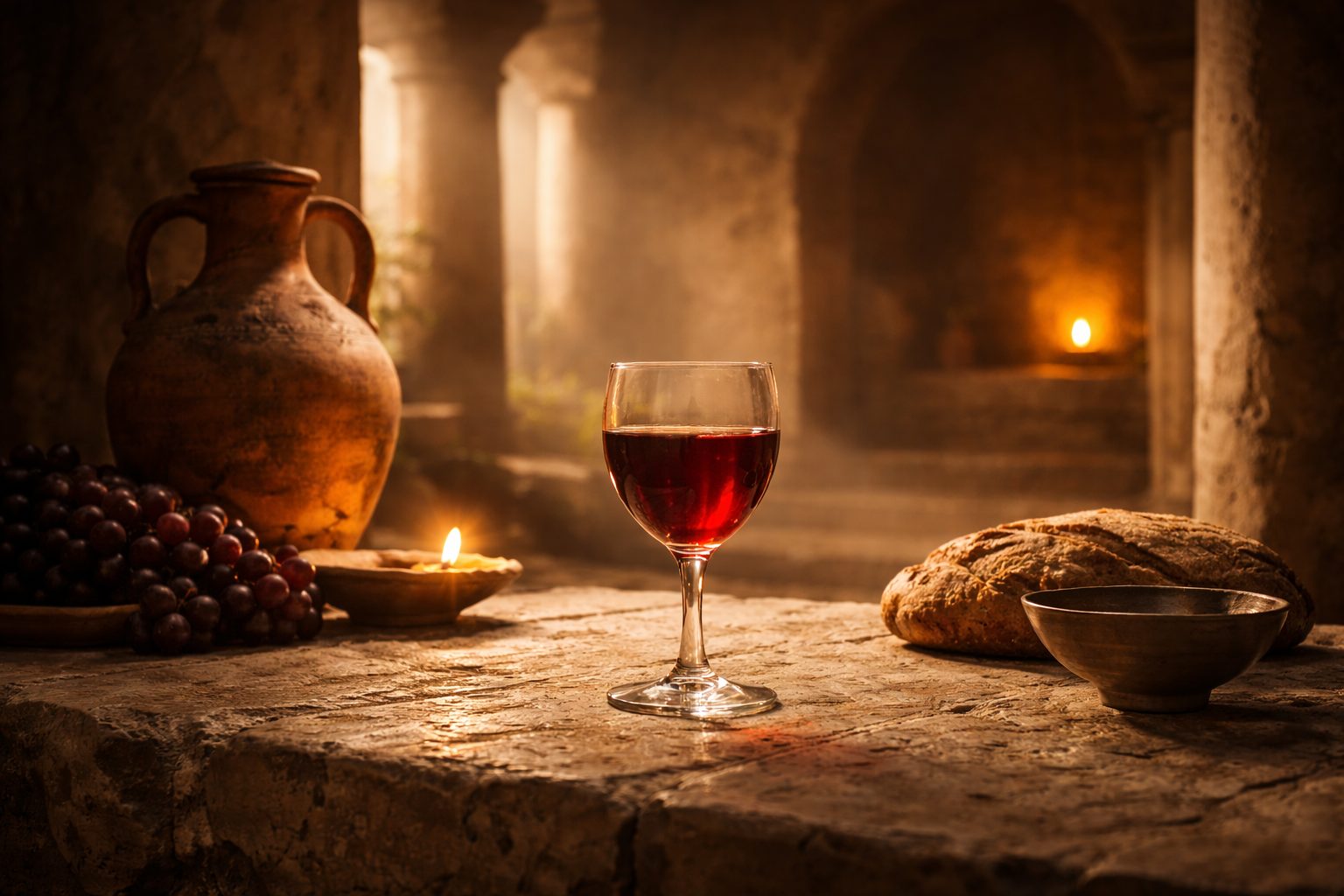
In every ancient culture, wine was more than nourishment or pleasure.
It was a bridge between the human and the divine. Its transformative character — fruit becoming drink, time becoming intensity — made it a privileged substance for symbolizing what transcends ordinary experience.
In Dionysian cults, it represented ecstasy and revelation. In the Jewish tradition, it became a sign of blessing and covenant. In early Christianity, it would assume an even more radical meaning: the symbolic blood of redemption.
As it moved across civilizations, wine did not lose its identity. It gained layers of meaning, crossed spiritual frontiers, and became a universal language of faith.
—
Wine as a Sacred Substance
The sacred nature of wine arises from its very essence. Unlike water, it is not a simple natural element. It is the fruit of transformation. It requires harvest, crushing, fermentation, and waiting. It undergoes an invisible process that profoundly alters its substance.
For ancient peoples, this transformation could not be merely material.
It was a sign of higher intervention, of mystery, of a force operating beyond immediate understanding.
To drink wine was, in a way, to participate in that transformation. It is no surprise, therefore, that wine occupied a central place in rites of passage, agricultural celebrations, and ceremonies of consecration.
—
Dionysus: Ecstasy and Revelation
In Greece, Dionysus was not only the god of the vine but the god of broken boundaries — between reason and emotion, order and freedom, the everyday and the extraordinary. Dionysian cults included wine as a means of reaching altered states of consciousness.
This was not merely uncontrolled drunkenness, but ritual in which wine facilitated the suspension of social conventions.
In this context, wine symbolized:
– inner liberation;
– contact with the divine;
– revelation of hidden truth;
– temporary dissolution of hierarchies.
Dionysian ecstasy was not escape, but an experience of intensity.
Wine was the instrument of that passage.
Yet even in these cults, there were rules. The ritual was framed, guided, prepared. Wine was mediator — not a substitute for consciousness.
—
Wine in the Jewish Tradition
In the Jewish tradition, wine takes on a distinct dimension. It is not ecstasy; it is blessing.
Not rupture; covenant.
Wine is present in Shabbat, in religious festivals, and in family ceremonies.
The blessing over wine — Kiddush — sanctifies the moment, separating it from ordinary time.
Here, wine symbolizes:
– legitimate joy;
– gratitude for the harvest;
– recognition of providence;
– celebration of life.
The vine appears in biblical texts as an image of the people themselves — tended, pruned, protected. It represents belonging and responsibility.
In this context, wine is a sign of spiritual order. Its presence marks sacred moments, yet it is never detached from ethical discipline.
—
From Symbol to Sacrament: Early Christianity
It is in Christianity that wine reaches one of its deepest meanings. At the Last Supper, wine is presented as the symbol of blood — not merely metaphor, but a sign of offering, sacrifice, and salvation.
By assuming this role, wine enters definitively into the religious history of the West. It ceases to be only offering or blessing; it becomes sacrament.
Christian liturgy consecrates wine as a central element of worship. Without wine, there is no Eucharist. Without the vine, there is no symbol of renewed life.
This gesture directly connects Christianity to the agricultural and viticultural tradition of the Mediterranean. Faith takes root in the land.
—
Wine as a Common Language
Despite theological differences, a common thread runs through ancient traditions: wine as a means of connection.
Connection between:
– humanity and divinity;
– community and transcendence;
– celebration and responsibility;
– life and sacrifice.
In none of these traditions is wine treated with indifference. It may be regulated, controlled, or symbolized, but never trivialized. Wine acquires a dimension beyond consumption. It becomes language — a way of expressing what words alone cannot contain.
—
Ambivalence and Awareness
It is important to recognize that wine in ancient religions was never free of ambivalence. The same substance that elevates can degrade. The same drink that consecrates can disorient.
This ambivalence is acknowledged in sacred texts. Wine is blessing when consumed with measure; it becomes danger when balance is lost.
Awareness of this tension helped shape an ethic of consumption. It was not about denying wine, but integrating it responsibly.
The sacred does not eliminate risk; it guides it.
—
From Empire to Monastery
With the expansion of Christianity in the Roman world, wine became linked not only to liturgy but also to cultural preservation.
Monasteries became guardians of vineyards and agricultural knowledge. Wine ceased to depend exclusively on imperial commerce and came to be cultivated as a spiritual necessity.
Religion ensured technical and territorial continuity. The vine became part of the Christian European landscape.
Without this religious transition, the history of wine would have been different.
—
Wine as Spiritual Memory
Across centuries, wine maintained its symbolic strength. Even in contexts where consumption was restricted, its metaphorical value endured.
Wine became an image of:
– legitimate joy;
– redemptive sacrifice;
– fraternal communion;
– promise of renewal.
This persistence reveals that wine, more than an agricultural product, became a profound anthropological symbol.
—
Between Earth and Transcendence
What makes wine unique in religious history is its ability to unite two planes:
it is born of the earth, yet points toward heaven.
It is not abstract. It is concrete, tangible, cultivated. Yet at the same time, it carries meanings that transcend the physical.
This dual nature explains its permanence in spiritual traditions.
—
A Language That Crosses Frontiers
As it moved across cultures — from Greece to Judea, from Persia to Rome — wine adapted without losing its essence. Rituals changed, specific meanings shifted, words evolved.
But the central idea remained: wine as mediation between the human and the divine.
No other beverage has played such a consistent role in such diverse spiritual traditions.
—
Wine as Incarnate Faith
The religious history of wine shows that ancient faith was never detached from matter. Spirituality expressed itself through concrete gestures: planting, harvesting, crushing, fermenting, sharing.
Wine became symbol because it was already, in itself, the result of care and time.
By consecrating it, ancient religions recognized something essential within it: the possibility of transforming the everyday into meaning.
And perhaps that is its deepest legacy — reminding us that the sacred can be born of the earth, and that in the simplicity of a transformed fruit, one may find language for the invisible.