Wine Stories · Part I · Chapter 18
The Vineyards of the Monks
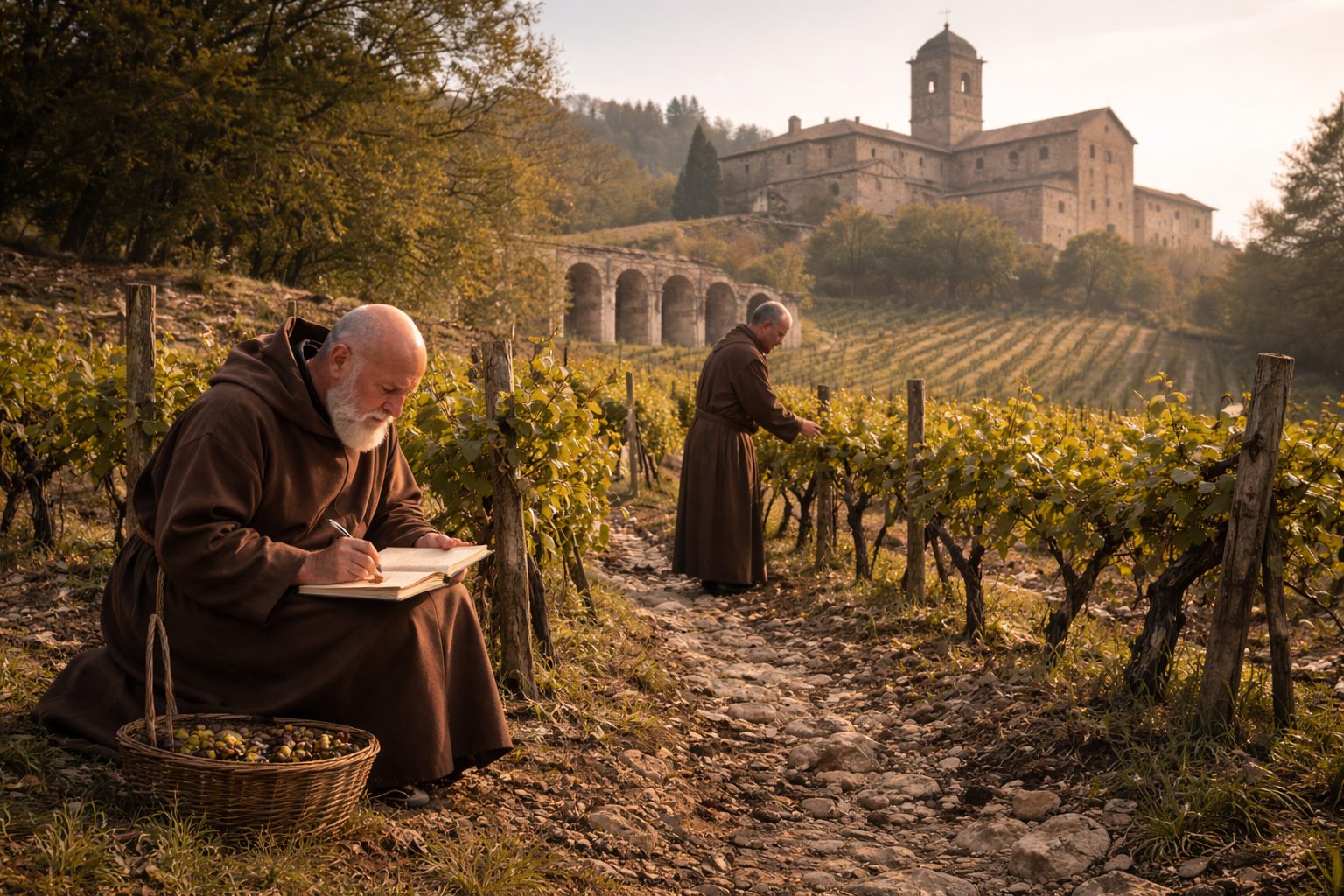
In the centuries following the fall of Rome, as Europe searched for stability amid political fragmentation and social reorganization, monasteries became centers of continuity.
Between manuscripts copied by candlelight and fields cultivated in disciplined silence, Benedictine monks — and later the Cistercians — assumed a fundamental role: they became guardians of the vine.
They cultivated, studied, and recorded differences in soils, climates, and grape varieties — centuries before any formal concept of “designation of origin” existed.
What drove this work was not commercial ambition, but spiritual rigor and patient observation.
The monasteries laid the foundations of scientific viticulture and anticipated the future concept of terroir.
—
Ora et Labora: The Vineyard as Discipline
The Rule of Saint Benedict, formulated in the 6th century, established a balance between prayer and work — ora et labora.
Agricultural labor was not merely an economic necessity; it was also a spiritual exercise. The vineyard fit perfectly within this vision.
It required constancy, attention to detail, and respect for the rhythm of the seasons. It allowed neither haste nor negligence.
The monk who tended the vine learned humility before the climate, patience before slow growth, and responsibility toward the community.
Thus, viticulture became an integral part of monastic life.
—
The Benedictines: Organization and Stability
From the 7th century onward, Benedictine monasteries spread throughout Europe. In regions such as Burgundy, Alsace, northern Italy, and the Rhine Valley, they established vineyards on the most favorable slopes.
Their contribution was primarily organizational. They created defined parcels, established work calendars, and maintained production records.
Accumulated observation began to reveal something essential: not all parcels produced the same wine. Some plots offered greater concentration; others more freshness.
Sun exposure influenced ripening and acidity. Altitude altered balance.
Without using the modern term, the Benedictines began to understand that wine was profoundly shaped by place.
—
The Cistercians: Rigor and Precision
In the 12th century, the Cistercians took this observation even further.
Guided by an austere and methodical spirituality, they sought remote and demanding lands — often forested areas or stony slopes.
It was particularly in Burgundy that their impact became decisive. There, they carefully divided the territory into smaller parcels, recognizing subtle differences between adjacent plots.
They observed:
– soil depth;
– limestone or clay composition;
– drainage;
– exposure to the rising or setting sun;
– the influence of wind.
Over time, they realized that these variables produced wines with distinct character. A refined territorial awareness was emerging.
—
Recording to Understand
The monks possessed a crucial advantage: they could write. They recorded harvest dates, weather conditions, and the quality of wine produced in each parcel. These records allowed comparisons across years, the identification of patterns, and the adjustment of practices.
Viticulture no longer relied solely on oral tradition; it was supported by written memory.
This method of systematic observation marked one of the first steps toward scientific viticulture.
Knowledge was no longer merely empirical — it became cumulative.
—
Selection and Adaptation
Over the centuries, monks began selecting vines best suited to each soil. They chose cuttings from plants that were more balanced, more resilient, or more expressive.
Without formal genetics, they practiced massal selection. They understood that the vineyard was not uniform and that small differences could profoundly alter the final wine.
This silent work shaped grape varieties and profiles that still define historic regions today.
—
The Vineyard as Spiritual Cartography
For the monks, the vineyard was more than an economic resource. It was part of the spiritual landscape.
Certain parcels were considered especially noble — not out of ostentation, but because of the harmony between soil, climate, and result. Identifying these plots required decades of observation.
In Burgundy, many of today’s prestigious vineyard boundaries coincide with demarcations established by medieval monastic communities.
What we now call a “cru” had one of its earliest outlines there.
—
Wine as an Expression of Place
The greatest monastic legacy was not scale, but depth.
While Rome had expanded the vine across territory, the monks deepened the relationship with the soil. They shifted the question from “Where can we plant?” to “Where does the vine express itself best?”
This shift is essential. It marks the transition from survival viticulture to identity-driven viticulture.
Wine ceased to be merely production; it became expression.
—
Stability and Continuity
Monasteries provided something rare in the Middle Ages: continuity.
While kingdoms fragmented and borders shifted, monastic communities maintained consistent practices. This stability allowed methods to be refined across generations.
The vineyard benefited from this long-term vision. Planting a vineyard was an act that extended beyond individual life. It was both spiritual and agricultural inheritance.
—
The Seed of the Appellation System
Long before formal regulations existed, monks already distinguished wines by their specific origin.
It was not merely “wine from Burgundy” or “wine from the Rhine.” They spoke of concrete parcels, specific slopes, clearly delimited lands.
This territorial awareness was the embryo of what, centuries later, would become the system of appellations of origin.
The modern concept was born from medieval observation.
—
Science and Contemplation
Monastic viticulture united science and contemplation. Rigorous observation coexisted with spiritual vision.
The vineyard was studied, yet also respected as part of creation. Wine was analyzed, yet also consecrated.
This integration may explain the durability of the monastic legacy. It was not only technique; it was an integrated worldview.
—
From Cloister to Future
When commerce regained strength in later centuries, the vineyards cultivated by monks already possessed defined identity.
The market encountered differentiated territories ready to assert themselves.
Without the monks, many regions celebrated today might never have achieved recognition. Their work was silent — but decisive.
—
The Vineyard as European Memory
The vineyards of the monks are an essential part of Europe’s agricultural memory. They were cultivated in times of uncertainty, studied in silence, and transmitted with discipline.
Medieval wine was more than survival; it was refinement.
From that refinement emerged an idea that continues to guide contemporary viticulture: wine is inseparable from the place that gives it birth.
—
The Enduring Legacy
Today, when we speak of terroir, soil identity, and parcel expression, we are — even unconsciously — repeating the monastic lesson.
The vineyard is not uniform. Each slope tells its own story. Each soil imprints character.
The monks did not use these words. But they lived them.
And thanks to them, European wine was not merely preserved after Rome — it was deepened, understood, and prepared for a new flowering.