Wine Stories · Part I · Chapter 10
The Symposium: Drinking, Thinking, Existing
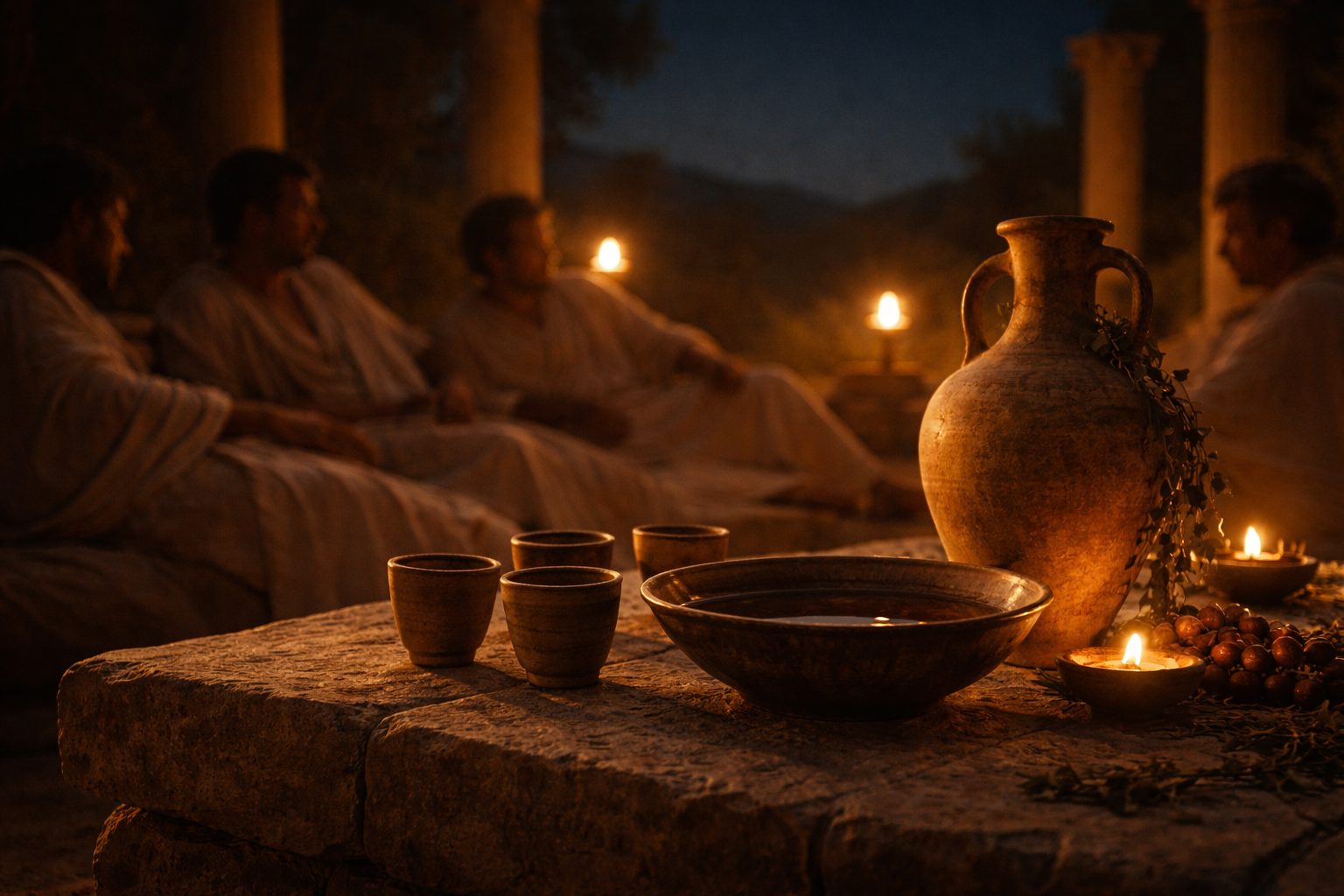
The symposion was the heart of Greek culture. More than a social gathering, it was a ritualized space where wine inspired reason, poetry, and critical thought. There, ideas were discussed, arguments tested, and emotions explored, always under the watchful presence of measure — an essential principle that ensured wine opened the mind without clouding it, and that pleasure served clarity rather than destroying it.
Pleasure was not an end in itself; it was a means to achieve inner clarity and connection with others. In the symposium, drinking was a deliberate act. Nothing was improvised.
The host defined the rules, the rhythm, and the mixture of wine and water. The goal was to preserve lucidity — an essential condition for dialogue to exist.
Between excess and abstinence, the Greeks chose balance.
—
The Architecture of the Gathering
The symposium took place after the main meal, in spaces prepared specifically for this purpose. Guests reclined on couches arranged around the room, creating a geometry that favored eye contact, listening, and speech.
At the center, wine — served in simple cups — circulated from hand to hand, accompanying the conversation. The physical arrangement was not neutral. It promoted equality among participants and prevented rigid hierarchies.
In the symposium, all were called to think, to speak, to listen. The presence of wine did not dissolve order; it humanized it.
—
The Role of the Host
A central figure of the symposium, the host was not merely the one who offered wine. He was the guardian of rhythm. It was his responsibility to decide the proportion of water and wine, the cadence of the toasts, and the moment to begin or end the gathering.
This role was not merely practical; it was ethical. The host ensured that wine fulfilled its function: opening the spirit without confusing it, freeing speech without emptying it of meaning.
A well-conducted symposium elevated its participants; a poorly conducted one degraded the encounter.
Thus, wine did not impose limits — it revealed the need for them.
—
Mixing in Order to Understand
Unlike other cultures, the Greeks rarely drank wine undiluted. Mixing it with water was not a sign of weakness, but of cultural intelligence. The mixture allowed conversation to be prolonged, torpor avoided, and thought kept active.
This practice reveals a deep understanding of wine as a mediator, not a protagonist. Wine did not dominate the gathering; it served it.
It was an instrument in the service of shared reason.
To mix wine was, symbolically, to mix emotion and logic — two forces that, when separated, impoverish human experience.
—
Drinking and Thinking
In the symposium, thought was not solitary abstraction. It was living dialogue. Participants discussed themes ranging from politics to ethics, from love to destiny, from the city to the soul.
Wine helped dissolve rigidity, make speech more sincere, and allow divergent ideas to coexist without violence.
A space of trust was created where disagreement did not break the bond. Drinking, thinking, and existing became inseparable gestures.
Wine taught that truth is not imposed; it is built in common.
—
Poetry, Music, and Silence
The symposium was not purely rational. There was room for poetry, music, and silence. Verses were recited, songs sung, stories shared. These moments did not interrupt thought — they deepened it.
Poetry allowed the unsayable to be spoken; music created communion without words; silence consolidated what had been said.
Wine circulated as a guiding thread between these languages. It did not accelerate; it harmonized.
—
Learning Measure
The culture of the symposium rested on a fundamental idea: sophrosyne — conscious moderation. It was not about repressing pleasure, but about guiding it.
True freedom, for the Greeks, did not lie in excess, but in the ability to choose. Wine was the test of that freedom.
Those who knew how to drink demonstrated self-mastery. Those who did not revealed inner disorder.
Thus, the symposium was also a space of ethical learning. It taught how to manage desire, respect others, and listen before speaking.
—
Inner Citizenship
Although restricted to free men, the symposium served a purpose beyond social privilege: it formed citizens.
Those who learned to participate in a symposium learned to participate in the city. Attentive listening, clear argumentation, respect for difference — all of this was trained around wine.
The symposium prepared individuals for public life, teaching them that coexistence requires inner discipline.
Wine, in this context, became a tool of self-government.
—
The Risk of Excess
The Greeks were well aware of the danger of excess. Texts and images warn against uncontrolled drunkenness as a loss of dignity and meaning.
When wine surpasses measure, it ceases to liberate and begins to dominate. For this reason, the symposium had clear rules.
Pleasure without limits was seen as regression, not freedom. True elevation lay in knowing when to stop.
This awareness distinguishes Greek culture from other, more permissive or more repressive approaches.
Here, wine is integrated — neither glorified nor denied.
—
A Lasting Legacy
The idea of drinking with awareness, born in the symposium, crossed centuries.
It influenced Rome, shaped medieval practices, echoed at Renaissance tables, and reached modernity.
Whenever wine accompanies conversation, reflection, and sharing — rather than forgetfulness — the legacy of the symposium is present.
Whenever pleasure is moderated by respect and listening, this ancient gesture is repeated.
The symposium was not merely a social habit; it was a way of thinking about the world.
—
Drinking in Order to Exist
At its core, the symposium teaches that drinking is an existential act. Not in the sense of excess, but of presence — drinking in order to be there, to listen, to understand.
Wine, when integrated into life with intention, becomes a mirror of the human condition:
we are beings of desire, but also of reason;
of emotion, but also of word;
of individuality, but also of community.
Drinking, thinking, existing — in the symposium, these verbs align.
And perhaps that is why, even today, we seek tables where wine does not distance us from ourselves, but brings us closer to others.