Wine Stories · Part I · Chapter 11
The Vineyards of Crete and the Trade of the Aegean Sea
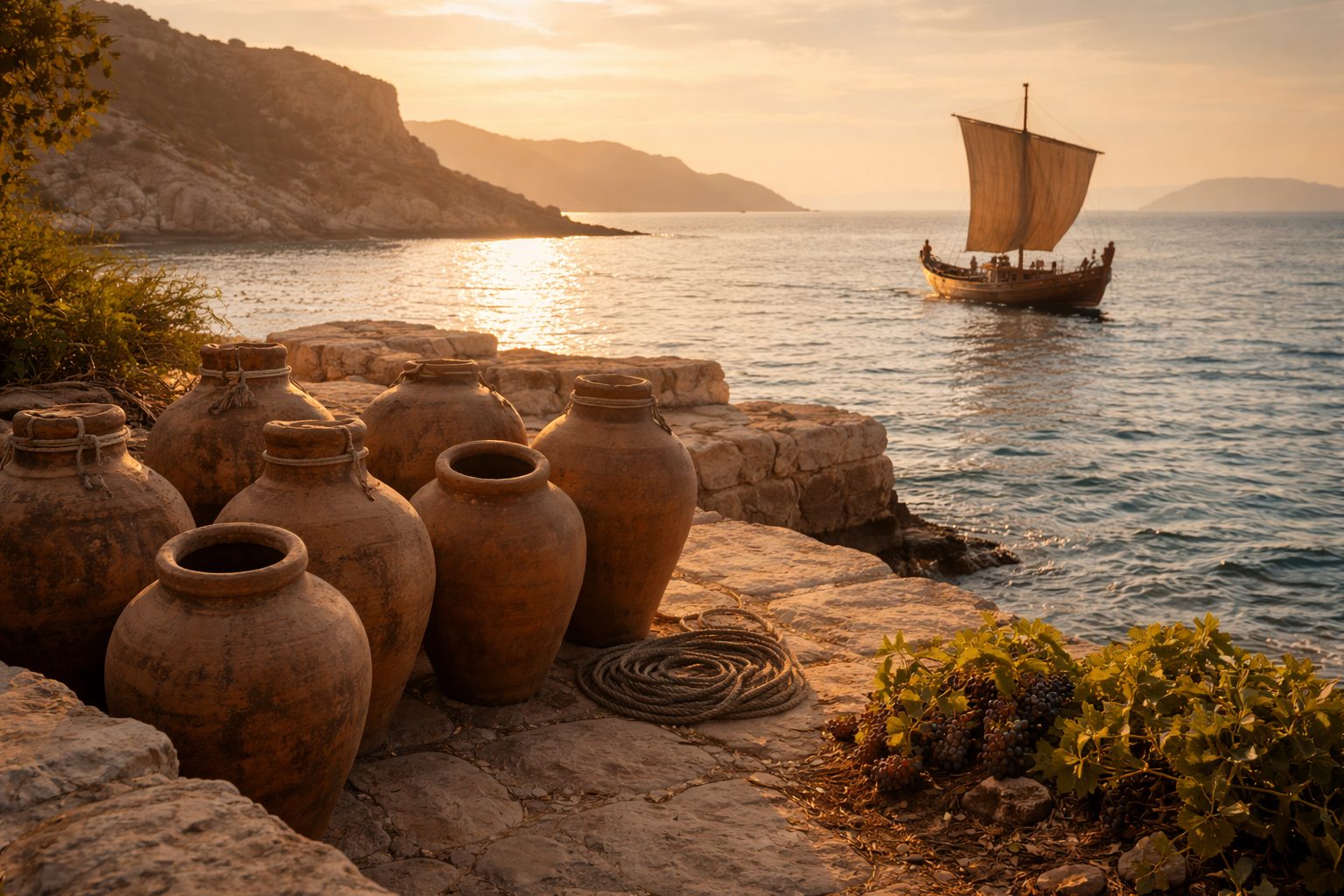
Long before classical Greece consolidated its influence over the Mediterranean, the island of Crete already played a central role in the history of wine.
Situated at the natural crossroads between Europe, Asia, and North Africa, Crete was one of the first territories where viticulture became structurally linked to maritime trade.
Here, wine ceased to be merely a local expression and became a commodity of exchange, a navigable product, and an instrument of connection between distant cultures.
The sea was wine’s first great pathway. And Crete, surrounded by water and shaped by wind, was one of its earliest schools.
—
The Minoan Civilization and Wine
The Minoan civilization, which flourished on Crete between approximately 3000 and 1400 BCE, is often remembered for its advanced architecture, the palaces of Knossos, Phaistos, and Malia, and its intimate relationship with the sea.
Less evident, but equally central, was the role of wine in its economy and culture.
Archaeological excavations have revealed stone presses, large storage vessels — pithoi — and countless fragments of amphorae, indicating significant wine production.
The vine found ideal conditions in Crete: well-drained slopes, abundant sunlight, maritime breezes that tempered the heat, and limestone and clay soils capable of retaining moisture.
Minoan viticulture was neither residual nor occasional. It was planned, integrated into the landscape, and directly connected to external trade.
—
Wine as a Maritime Commodity
The Minoans were accomplished sailors.
Their vessels regularly crossed the Aegean Sea, linking Crete to the Cyclades, mainland Greece, Anatolia, the Levant, and Egypt.
Along these routes traveled metals, ceramics, textiles, olive oil — and wine.
Cretan amphorae, recognizable by their shape and the clay used, have been found at Egyptian and Levantine archaeological sites, bearing witness to the regular export of wine.
These were not sporadic exchanges, but an organized commercial system based on trust, repetition, and reputation.
Cretan wine gained status.
Drinking Cretan wine signified access to sophisticated trade networks and to an advanced maritime culture.
—
- ### The Sea as Cultural Space
- For the Minoans, the sea was not a boundary — it was a space of continuity.
- Aegean routes functioned as cultural corridors through which agricultural techniques, artistic styles, religious beliefs, and habits of consumption circulated.
–
- Wine was one of the main vehicles of this circulation. Each amphora carried more than liquid: it carried a way of producing, storing, and drinking.
- When wine reached foreign ports, it was integrated into local rituals, banquets, and offerings, adapting without losing its identity.
–
- This movement anticipated what would later become a defining feature of Mediterranean wine:
- the ability to travel without dilution, to connect cultures without homogenizing them.
—
Storage, Scale, and Innovation
The scale of wine production in Crete required technical solutions.
Large pithoi, often partially buried within palace complexes, were used to store wine, olive oil, and grain.
These vessels allowed surplus to be accumulated and reserves to be secured for trade and periods of scarcity. Their presence shows that wine was part of a planned economy. It was not merely a product of internal consumption; it was a strategic asset.
Moreover, control over storage implied empirical knowledge of preservation, oxidation, and stability.
Even without understanding chemical mechanisms, the Minoans knew that wine required protection, shade, and time.
—
Crete as a Bridge Between Worlds
Crete occupied a unique position. It was not only a producer; it was an intermediary.
Wine passing through Crete could originate in other regions and be destined for even more distant lands. The island functioned as a logistical hub of the Aegean world.
This role reinforced maritime specialization and consolidated Crete’s reputation as a center of refined trade.
Minoan palaces, far from being merely royal residences, were administrative centers where the movement of goods — including wine — was recorded.
The wine trade contributed to the island’s prosperity and stability for centuries.
—
From Ritual Wine to Economic Wine
As in other ancient civilizations, wine in Crete also had a ritual dimension. It was present in offerings, religious ceremonies, and festivals linked to fertility and the agricultural cycle.
However, Crete’s great innovation was integrating this symbolic dimension into a broad economic logic.
Wine became simultaneously sacred and commercial. It was respected, but also negotiated.
This dual nature prepared the ground for the Greek and later Roman approaches, in which wine would be at once culture, commerce, and power.
—
The Legacy for the Greek World
When the Minoan civilization declined, much of its knowledge did not disappear.
It was absorbed by the Mycenaeans and later by classical Greece.
Maritime routes endured, amphora shapes evolved, but the underlying logic remained.
The wine trade of the Aegean Sea, initiated and structured by Crete, became the foundation of the Greek wine economy.
The city-states inherited this maritime vocation and expanded it.
Crete taught that wine could exist at scale — not merely as a local expression.
—
Anticipating Rome
Much of what Rome would later master centuries afterward had already been rehearsed in the Aegean Sea:
stable maritime routes, standardized containers, wines identifiable by origin, regular trade, and cultural integration.
Rome would inherit these practices and amplify them on an imperial scale.
But the logic — transporting wine by sea as a civilizational good — was born here, among the islands and winds of the Aegean.
Crete was the laboratory. Rome would be the empire.
—
Wine Learns to Sail
By following the vineyards of Crete and the routes of the Aegean Sea, we see that wine became truly Mediterranean when it learned to sail.
The sea taught it distance, adaptation, and permanence. Each crossing reinforced its value. Each port added meaning.
Wine ceased to be merely a product of the land and became the expression of an interconnected world.
—
A Silent Heritage
Today, when we think of ancient wine trade, we recall Rome, Greece, and Egypt.
But before all of them, Crete had already understood something essential:
for wine to survive and prosper, it had to circulate.
The vineyards of Crete and the trade of the Aegean Sea laid the foundations of a system that would shape the history of wine for millennia.
It was there that wine learned to travel without losing its soul.
And perhaps that is why, even today, the Mediterranean remains wine’s great stage — because it was there, among islands and amphorae, that wine became sea, commerce, and culture at once.