Wine Stories · Part I · Chapter 9
The Gift of Dionysus
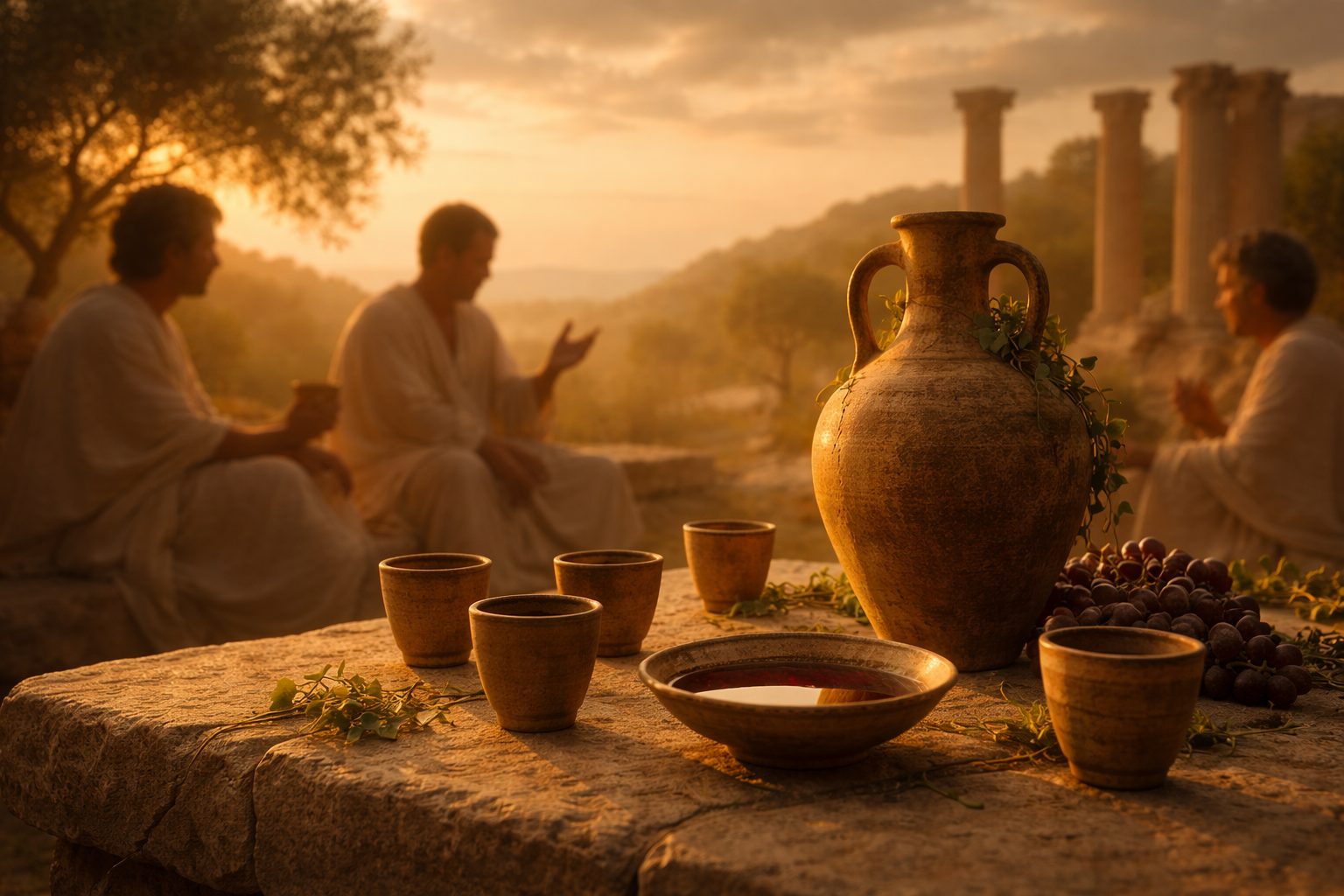
In Ancient Greece, wine ceased to be merely an agricultural product and became a way of thinking about life.
It was there that wine freed itself from exclusively ritual and economic functions and entered the realms of philosophy, art, and individual consciousness. Drinking was no longer just a functional or symbolic act: it became an act of dialogue, a cultural practice in which body and spirit met.
At the center of this transformation stands Dionysus — god of wine, the vine, and metamorphosis. His figure embodies an apparent contradiction: joy and excess, but also introspection and mystery; celebration and disorder, yet equally inner truth.
Dionysus does not merely represent wine; he represents what wine can awaken when drunk with intention: the suspension of masks, access to deeper layers of human experience.
—
Dionysus: More Than a God of Wine
Dionysus is one of the most complex gods of the Greek pantheon.
Unlike other Olympian deities, associated with order, reason, or hierarchy, Dionysus moves along boundaries: between the human and the divine, between lucidity and ecstasy, between form and dissolution.
His cult spread rapidly throughout mainland Greece and the islands, bringing with it nocturnal rituals, music, dance, and wine.
But Dionysus is not merely the god of intoxication. He is the god of transformation. Just as grapes turn into wine, human beings are transformed when they drink. This is not about losing consciousness, but about passing through it.
Dionysian wine does not cancel thought — it expands it, displaces it, challenges it. For this reason, Dionysus was often regarded with suspicion. He represented that which escapes the absolute control of reason.
Yet it was precisely this dimension that made him central to Greek culture: a reminder that life is not exhausted by order, nor knowledge confined to logic.
—
Wine and the Greek Soul
For the Greeks, the human soul was not a fixed entity. It was mobile, malleable, open to education (paideia) and experience.
Wine, when integrated into a social and intellectual context, became an instrument of this formation. Drinking wine was never an isolated act, but one governed by rules: it was mixed with water, drunk slowly, accompanied by music, poetry, and conversation.
Crude excess was condemned; conscious, reflective excess was tolerated — and sometimes valued. Wine helped suspend rigidity, free speech, and bring people closer together.
It created a space in which truth could emerge without violence. In this sense, wine functioned as a catalyst of the soul.
—
The Symposium: Drinking to Dialogue
The great stage of this culture was the symposium. More than a banquet, the symposium was a social and intellectual institution. It took place after the meal, in a reserved setting, where only invited guests participated.
Participants reclined on low couches, drank wine mixed with water, and followed a rhythm controlled by the symposiarchēs, who decided the proportions of the mixture and the pace of drinking.
Nothing was left to chance. At the symposium, one drank in order to converse. Ideas were debated, poems recited, verses sung, reflections shared on politics, ethics, love, and destiny.
Wine acted as mediator between thought and emotion, between word and silence. It was believed that wine opened the spirit to truth — but only if consumed with measure.
Without wine, conversation was rigid; with excess, it became chaotic. Between the two lay the fertile space of dialogue.
—
Measure and Freedom
Greek wine culture rests on a permanent tension between measure and freedom.
Dionysus does not eliminate Apollo — the god of reason and form — but challenges him. True wisdom, for the Greeks, is born from the balance between the two.
Wine teaches this lesson. When drunk with awareness, it liberates without destroying, brings people together without confusion, reveals without wounding. It is an experience of inner freedom, not abandonment.
This vision profoundly distinguishes Greece from other ancient civilizations. Here, wine is not merely ritual nor merely prestige: it is an exercise in inner citizenship.
—
Theatre and Wine
It is no coincidence that Greek theatre was born from Dionysian rituals. The earliest tragedies were performed during festivals in honor of Dionysus.
Theatre, like wine, allowed human beings to confront their emotions, limits, and conflicts. Both operate in the same way: they create a safe space for confronting tragedy, desire, fear, and death.
Wine prepares the spirit; theatre gives it form.
Thus, Dionysus also becomes the god of dramatic consciousness — one that accepts the complexity of existence without reducing it.
—
Wine and the Education of the Free Man
In Greece, only free men participated in symposia. This does not imply gratuitous exclusion, but rather reveals the role wine played in the formation of the citizen.
Drinking wine implied responsibility. It required knowing how to listen, speak, remain silent, and respect the collective rhythm. Wine thus became an instrument of ethical and social education.
He who did not know how to drink did not know how to govern himself — and he who cannot govern himself cannot govern the city.
—
Wine as Revealed Truth
In many Greek texts, wine is associated with truth — not objective truth, but inner truth.
Drinking revealed character: who someone was when defenses fell. For this reason, wine was not seen merely as pleasure, but as a test.
A test of the soul. Dionysus offers wine as a gift, but also as a challenge: the challenge of facing who we are when we stop pretending.
—
From Vine to Thought
Greece transformed wine into liquid thought. The vineyard ceased to be merely a field; it became a symbol. Wine ceased to be merely a drink; it became language.
This legacy would endure for centuries. Rome would inherit Greek wine and give it scale. Christianity would inherit the symbol and give it transcendence. Europe would inherit both and make wine part of its cultural identity.
But it was in Greece that wine definitively broke free from function and entered the realm of consciousness.
—
The Gift That Endures
The gift of Dionysus is not uncontrolled excess. It is the possibility of accessing a deeper dimension of human experience.
It is the inner freedom that arises when reason agrees to dialogue with emotion.
By elevating wine to a symbol of the soul, Greece taught us that drinking can be a cultural, philosophical, and profoundly human act.
That wine, when integrated into life with respect and intention, does not distance us from ourselves — it brings us closer.
And perhaps that is why, even today, when we drink in good company and good conversation, we unknowingly repeat the Dionysian gesture: to drink in order to understand, to toast in order to connect, to share in order to exist.