Wine Stories · Part I · Chapter 8
The First Wine Routes
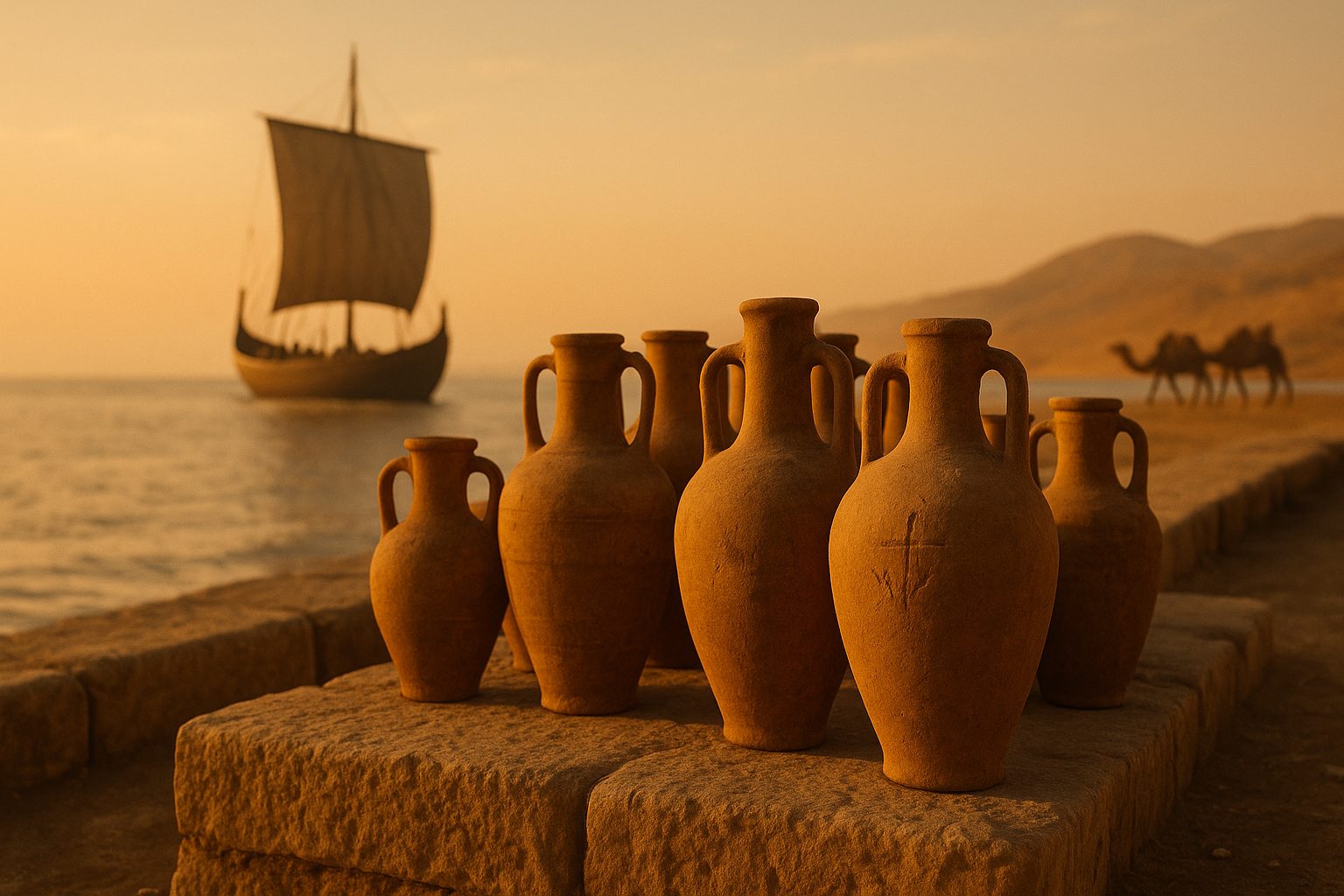
As civilizations advanced, wine began to travel. It ceased to be merely the expression of a specific territory and became a coveted good beyond its natural borders.
Clay amphorae started to move along maritime routes and land caravans, linking the East to the Mediterranean, the fertile inland valleys to coastal cities, producers to centers of power.
Through this movement, wine became a commodity of exchange, a culture of prestige, and a symbol of authority. From very early on, the history of wine is also the history of the routes that carried it.
And these routes did not transport only wine: they carried ideas, rituals, agricultural techniques, and worldviews.
—
When Wine Leaves Its Origin
Wine is always born in a specific place. It depends on soil, climate, sun exposure, and accumulated human knowledge. But at a certain point in history, it ceased to be consumed only where it was produced.
Communities began to recognize the value of wine as a transportable, durable, and symbolic good.
Unlike fresh fruit, wine could be stored for months or years. Unlike cereals, it carried prestige and cultural identity. Unlike water, it could be offered as a gift of honor. These characteristics made it ideal for circulation among peoples, cities, and empires.
Wine thus became a messenger of the land.
—
The Amphora: The World’s First Container
The great enabler of the wine routes was the amphora. Far more than a simple vessel, the amphora was a true logistical revolution. Its shape — elongated, with a narrow neck and two handles — allowed efficient transport, stacking in ship holds, and relatively safe preservation of wine.
From the Caucasus to Mesopotamia, from the Levant to the Eastern Mediterranean, the amphora became the universal standard for transporting valuable liquids.
It was sealed with clay, resin, or wax, protecting the wine from excessive contact with air. Some bore marks, symbols, or inscriptions indicating origin, destination, producer, or purpose.
It can be said that with the amphora, organized wine trade was born.
—
Land Routes: Caravans and Rivers
Before maritime dominance, the first wine routes developed over land. Caravans of donkeys, mules, and camels crossed plateaus and deserts, linking producing regions to consuming cities.
In Mesopotamia, wine produced or acquired in the mountainous regions of the Zagros and the Caucasus traveled south, following the courses of the Tigris and Euphrates rivers.
Rivers functioned as natural commercial corridors, allowing amphorae to be transported on riverboats.
These routes were long, dangerous, and costly. As a result, wine that reached the cities was valued not only for its quality, but for the effort required to transport it.
Each amphora represented human labor, risk, and time. To drink imported wine was to drink distance.
—
The Mediterranean as the Great Liquid Highway
With the development of navigation, the Mediterranean became the greatest commercial route of the ancient world.
The sea began to unite cultures rather than separate them. Phoenicians, Mycenaeans, Egyptians, Greeks, and later Romans used the sea as a privileged route for wine transport.
The Phoenicians played a decisive role. Exceptional sailors and traders, they established trading posts from the Levant to North Africa, Sicily, Sardinia, and the Iberian Peninsula.
With them traveled the vine, wine, and technical knowledge of winemaking.
Each port was a point of exchange: wine for metals, olive oil for textiles, ceramics for spices.
Wine circulated as a prestige good, offered to local elites, rulers, and priests. Through these routes, wine began to globalize within the ancient world.
—
Wine as Symbolic Currency
In the first complex economies, wine did not function merely as merchandise — it functioned as symbolic currency. It was used to pay for services, seal alliances, honor gods, and legitimize power.
Kings offered foreign wine at banquets to demonstrate political reach. Temples accumulated amphorae as signs of prosperity. Cities took pride in the wines they could import.
Wine thus became a language of power. Whoever controlled the routes controlled prestige.
—
Standardization and the Birth of Identity
As trade intensified, the need arose to recognize origins and qualities. Some amphorae began to be associated with specific regions.
Shape, clay, inscription — everything served to identify provenance.
Slowly, the notion of wine of origin was born. It was not yet a formal denomination, but there was already a perception that certain wines were “better,” “nobler,” or “more desirable” because they came from specific places.
This recognition reshaped the agricultural landscape. Regions planted more vines because they knew their wine was sought after. Trade influenced viticulture, and viticulture reinforced trade.
—
Wine as a Cultural Vehicle
Each amphora carried more than wine. It carried drinking habits, ways of consumption, rituals, and ideas. When wine arrived in a new city, it brought with it how it was served, mixed, offered, or celebrated.
This is how practices spread:
– the use of individual cups;
– the mixing of wine with water or spices;
– ritual toasts;
– shared meals accompanied by wine.
The wine routes were, in truth, cultural routes.
—
Risk, Value, and Trust
Transporting wine was risky. Amphorae could break, wine could spoil, ships could sink. These risks increased the final value of the product.
For this reason, wine trade required trust. Contracts, seals, marks, and witnesses became common. Clay tablets record agreements, quantities, debts, and deliveries.
Wine contributed to the development of commercial writing, accounting, and the notion of deferred value.
It was one of the products that helped structure the ancient economy.
—
Impact on Civilizations
As routes became established, wine became an essential part of urban life. Cities began to define themselves also by the wines they consumed and traded.
Wine ceased to be merely agricultural and became urban. This transformation had profound consequences:
– it encouraged agricultural specialization;
– reinforced social hierarchies;
– created networks of interdependence between regions;
– and helped spread the idea of shared culture.
The ancient world began to feel smaller, more connected, and more aware of diversity.
—
The Beginning of a Global System
The first wine routes laid the foundations of the wine trade that would shape the ancient world — and, by extension, the modern one.
What began with a few amphorae transported by rivers and seas became a complex system of production, transport, consumption, and prestige.
Wine taught humanity to think in terms of origin, quality, distance, and time. And in doing so, it helped build one of the first truly interconnected economies in history.
—
When Wine Begins to Connect Worlds
By following the wine routes, we realize that this drink was one of the first to connect cultures without erasing them. Each people retained its identity, yet recognized in wine a shared value.
To drink foreign wine was to acknowledge the other — their land, their knowledge, their time.
The first wine routes did not carry only amphorae. They carried the idea that civilization is built through relationship, not isolation.
And perhaps that is why, even today, opening a bottle from far away remains a gesture of curiosity, respect, and connection with the world.