Wine Stories · Part I · Chapter 7
The Myth of Noah and the First Vineyard
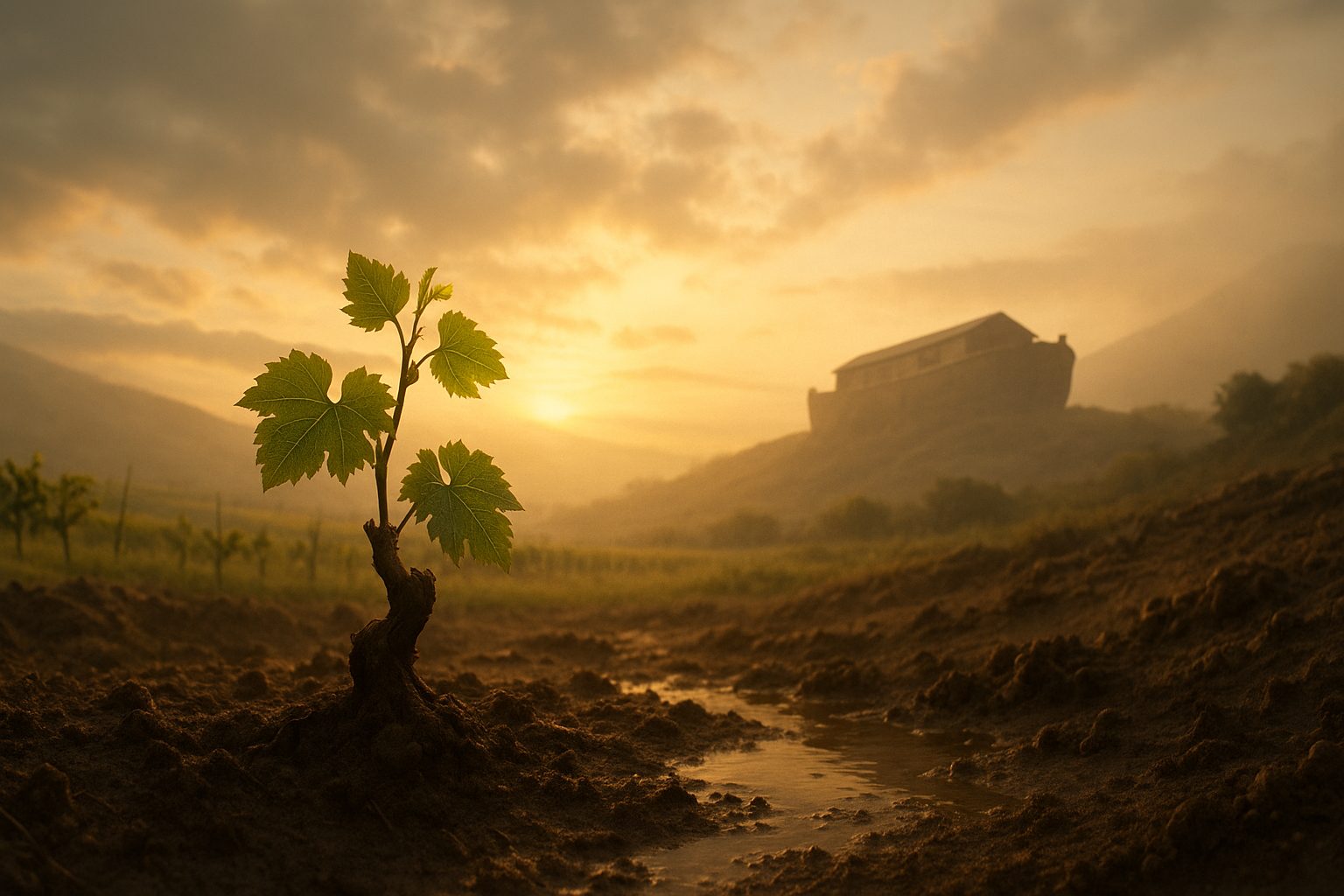
In the biblical tradition, Noah is presented as the first viticulturist of humankind. After the Flood, when the waters recede and the earth once again reveals its fertility, Noah plants a vineyard, harvests the grapes, and tastes the wine.
The gesture is simple, yet it carries immense symbolic weight: it represents reconciliation between humanity and the land, a new covenant between human life and natural cycles. Wine emerges as a sign of rebirth — not only agricultural, but spiritual.
This narrative is not merely a religious myth; it is a profound image of the eternal cycle of destruction and renewal, so deeply marked in human history and in the very nature of the vine.
—
The World After the Waters
The Flood is a recurring motif in many ancient cultures: it appears in Sumer, Babylon, Greece, and, of course, in the Hebrew tradition. It always represents the same movement — a force that destroys in order to purify, followed by a rebirth that restores order and meaning.
In the biblical account, Noah and his family are the survivors destined to restart human life on earth.
As soon as the waters subside, Noah leaves the ark, contemplates the transformed world, and even before building houses or cultivating cereals, decides to plant a vineyard. This seemingly modest detail reveals the primordial importance the vine already held in the agricultural imagination of the Ancient Near East.
The vineyard does not provide immediate nourishment, shelter, or protection. It takes time to grow. Yet it is planted first because it symbolizes continuity, care, and hope.
In a world newly saved from chaos, the vineyard becomes humanity’s first gesture of order upon the land.
—
The Vineyard as Promise
The vine is a plant profoundly tied to time. While wheat grows in months, the vine requires years to bear fruit consistently. To plant it is therefore an act of trust in the future.
When Noah plants the first vineyard, he is affirming that the land is once again worthy of care and that natural cycles can be resumed.
It is a deeply human gesture: to begin rebuilding not with urgency, but with hope.
If the Flood represents rupture, the vineyard represents reconciliation. It is the symbol of the earth’s return to balance and of human life returning to agricultural work. It is the first chapter of post-diluvian agriculture.
—
Wine as Revelation
The biblical narrative continues with a lesser-known yet revealing episode. After planting the vineyard and producing wine, Noah drinks and becomes intoxicated.
The description is brief but rich in meaning. It is not a moral condemnation; it is an observation of the human condition. Wine appears here not only as a gift, but as a force that reveals fragility, intimacy, and vulnerability.
By drinking wine, Noah experiences not only pleasure, but exposure and loss of control. This is the first moment in religious history in which wine appears as an element of inner truth: what is hidden becomes visible.
In many ancient cultures, intoxication held precisely this symbolic function — distancing one from the everyday in order to reveal the inner self.
The episode of Noah does not condemn wine; it reveals that humanity, in receiving it, must seek balance between celebration and awareness.
—
Historical Roots of the Myth
Modern scholars believe that the myth of Noah reflects far older traditions from the Caucasus and Mesopotamia. The mountain where the ark comes to rest — Ararat — lies close to the regions where the earliest archaeological evidence of wine production has been found, dating to around 6000 BC.
It is therefore plausible that the biblical narrative was shaped by the cultural memory of populations who had cultivated vines and revered wine for millennia.
The idea of a civilizing hero who plants the first vineyard is a recurring archetype:
– In Georgia, there is a myth of a farmer who receives the vine from the gods.
– In Greece, Dionysus teaches humankind to cultivate the vine in order to discover joy.
– In Armenia, local legends speak of families who saved vines during great floods and replanted them afterward.
The myth of Noah does not stand alone. It is part of a long tradition that sees the vine as the first plant of human trust — the one that links earth to sky.
—
The Vineyard as Spiritual Symbol
Throughout ancient religions, the vineyard became a powerful metaphor. It was not merely an agricultural crop; it was a way of interpreting the world.
In the Hebrew tradition, Israel is often compared to a vineyard planted by God — cared for, pruned, and at times punished for its unfaithfulness. The vineyard is a symbol of belonging, identity, and divine care.
In Greece, the vine is associated with rebirth, metamorphosis, and contact with the spiritual world. Wine is seen as a bridge between the human and the divine, allowing humanity to partake temporarily in a higher joy.
In Egypt, wine was a ceremonial drink, offered to the gods as a symbol of light, blood, and fertility.
Across all these symbols, the vine consistently appears as a link between:
– human labor and natural gift;
– earthly time and celestial time;
– body and spirit;
– the visible and the invisible.
The myth of Noah fits within this broader tradition, in which the vineyard becomes a kind of vegetal temple.
—
The Eternal Cycle of the Vine
The vine possesses a unique characteristic that makes it particularly symbolic: it is reborn every year. It sheds its leaves in autumn, sleeps through winter, awakens in spring, and bears fruit in summer.
It repeats this cycle with a precision that has fascinated humanity for millennia.
After the Flood, when everything seems lost, the vine represents this same movement: to die in order to be reborn, to lose in order to recover, to disappear in order to return stronger.
Noah plants a vineyard because the vineyard itself is the perfect image of the cycle of life. There is no ancient culture that has not seen in it a reflection of human destiny: to fall, to rise, to learn, to mature, and to begin again.
—
Wine in Ancient Religions
Over the centuries, wine became a bridge between the human and the sacred — a simple gesture that, in every civilization, carried the weight of mystery:
– In Judaism, the cup raised during Kiddush is not merely a drink: it is light kindled at the beginning of Shabbat, a symbol of joy, life, and gratitude.
– In Christianity, wine becomes the most intimate metaphor of faith — the sap of the true vine, the promise of a spiritual bond that transcends generations.
– In Zoroastrianism, ancient ritual drinks — fermented, aromatic, luminous — purified the spirit and reminded humanity of its place in the cosmic order.
– In the Dionysian cults, wine was liberation: it descended into bodies like living fire, dissolved boundaries, awakened the instinct for celebration and inner rebirth.
– In Eastern traditions, from the imperial courts of China to Japanese sanctuaries, cups were raised in search of balance — harmony between earth, sky, and the human heart.
The near-universal presence of wine in ancient rituals shows that, for humankind, wine was never merely nourishment — it was a means of spiritual understanding.
—
Noah as an Agricultural Archetype
The figure of Noah can be seen as an archetype of transition — between chaos and order, destruction and construction. He represents the primordial farmer: the one who, faced with emptiness, has the courage to plant.
Before any other action, he plants a vineyard.
The world is reborn from this gesture.
Noah does not harvest first; he plants.
He does not keep for himself; he cultivates for the future.
He does not merely survive; he rebuilds the bond with the land.
This is the gesture the myth preserves: the idea that agriculture — and especially viticulture — is the first sign of civilization after catastrophe.
—
A Myth That Still Speaks
Today, when we look at the history of wine, we realize that the myth of Noah is not just a religious account, but a profound metaphor for the role of the vine in human life. The vineyard is a symbol of trust, continuity, and rebirth.
Wine, its transformed fruit, is liquid memory of time — a bridge between generations and a testimony to human labor. The myth endures because it contains a truth greater than facts:
when everything seems lost, to plant is to believe.
And to plant a vineyard is to believe in time, in the land, and in the future.