Wine Stories · Part I · Chapter 3
From Chance to Cultivation
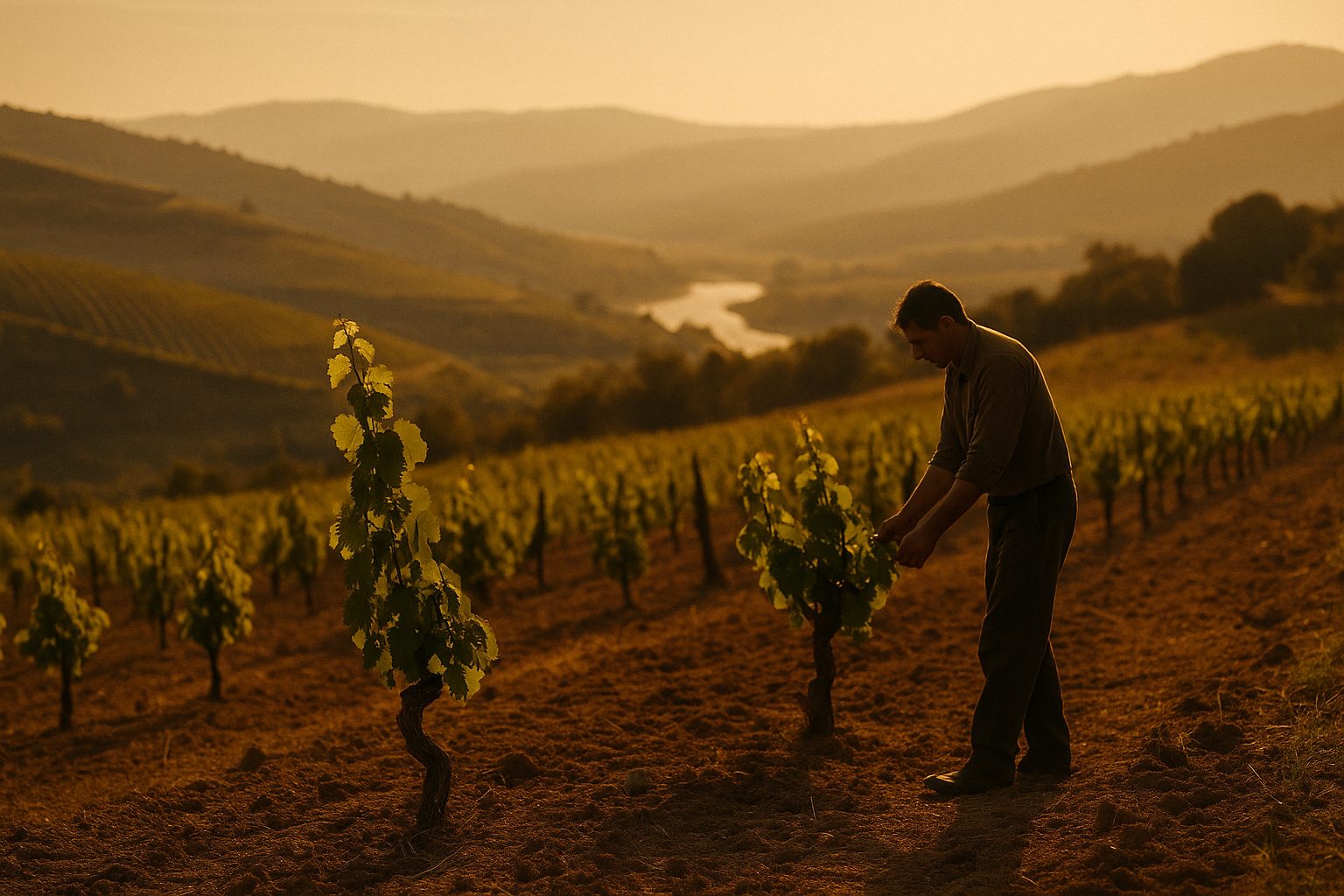
The true civilizational leap occurred when humanity moved from chance to intention — when people stopped waiting for fruit by accident and began tending the vine, pruning it, and choosing the best places to plant it. That was the moment when nature ceased to be merely observed and began to be accompanied.
The vine, which for millennia had grown freely along the rivers and forests of the Mediterranean and the Caucasus, finally became part of a plan. And with it, wine ceased to be an unpredictable gift of nature and became a shared creation between humankind and time.
—
The Beginning of Intention
The gesture that changed everything was simple: selecting a cutting and transplanting it to a sheltered place. This act marked the beginning of vine cultivation — the first sign of conscious intention over a natural process. From that moment on, humanity no longer depended on the randomness of wild vines but began shaping the environment to its will.
They cleared spaces, removed shrubs, guided the plants toward the light, and realized that soil and sun exposure affected the taste of the fruit. The first vineyards emerged on the fertile slopes of the Caucasus and Mesopotamia, regions whose soil and climate favored the balanced ripening of grapes.
Stony, well-drained soils prevented excess water, concentrating flavor and sweetness in the berries. Abundant sunlight and steady winds created ideal conditions for healthy plants.
The vine thrived in those challenging environments where other crops struggled to survive. Perhaps that is why, from the beginning, wine was seen as the fruit of well-guided adversity — a balance between endurance and care.
Over time, these early vineyards multiplied and spread along the valleys of the Tigris and Euphrates, following trade routes and migration flows.
The domesticated vine traveled with humans and adapted to place. Each new territory gave it a distinct character, and man, ever curious, learned to recognize it. Thus was born the idea of origin — the principle of what we now call terroir.
—
The First Techniques
Ancient depictions show that early viticulturists already practiced rudimentary cultivation techniques. The vines were trained on wooden stakes, reeds, or trees, allowing the plant to receive more sunlight and air.
Humans discovered pruning — realizing that cutting excess shoots gave more strength to the clusters. They learned to remove leaves to aid ripening and to protect vineyards with hedges or low stone walls.
All of this came from observation: viticulture was, from the start, a school of patience and repetition.
Pruning, in particular, marked a new relationship with time. Cutting the vine might have seemed, at first, an act of aggression — but it soon became clear that the gesture, far from destroying, renewed the plant and ensured the next harvest. Thus, pruning became an act of faith: humanity learned that one must sacrifice excess to reach the essential.
Nature taught, and man learned — not by imposition, but by coexistence. With the gradual mastery of these practices, vineyards began producing sweeter, more consistent, and concentrated grapes. Wine became more predictable, more stable, closer to what we know today. It ceased to be an occasional miracle and became a craft.
—
The Transformation of the Landscape
The cultivation of the vine profoundly changed the landscape of early agricultural communities. On the arid slopes of the Caucasus and Mesopotamia, where there had once been scrubland and forest, orderly bands of climbing plants began to appear. The vineyards became part of the land’s architecture: shaping hillsides, tracing the curves of valleys, and bringing color and texture to the horizon.
By planting, humankind was drawing — and the territory became an extension of human vision. These vineyards were small, family-run, and usually close to villages. They were tended with simple tools — stone hoes, sticks, wicker baskets. Work was shared among families and neighbors, and the harvest was a time of unity, when the reward for a year of waiting was gathered.
The wine, a collective fruit, was divided and stored in common amphorae, sealed and marked with symbols. Each community had its own wine, its own flavor, its own identity. Over time, vineyards became economic reference points. Wine began to be traded for grain, oil, salt, and metals.
Trade routes gradually formed around the producing regions, and wine, because of its durability and symbolic value, became one of the first currencies of exchange in Antiquity. In many ways, it was the first cultural export: it carried the memory of the land and the knowledge of those who cultivated it.
—
Viticulture as Knowledge
The domestication of the vine coincided with the birth of technical knowledge. To care for the vineyard, humans had to learn to read nature’s signs: the color of the leaves, the texture of the soil, the rhythm of the rain. They understood that each plant had its own cycle and that every year brought new lessons.
Viticulture thus became a form of empirical science — knowledge accumulated through experience, passed by word of mouth, from father to son, from village to village.
Clay tablets from Mesopotamia contain inscriptions mentioning vineyards, wine taxes, and even harvest regulations. These records show that, more than five thousand years ago, viticulture was already recognized as an essential activity, with its own rules and economic value.
There was born the concept of agricultural management, which would later evolve into the first appellations of origin and production standards. Wine ceased to be merely a beverage — it became a cultivated heritage.
With that, humanity began to perceive time differently: not only as a succession of days but as a cyclical line where each season had its role.
The vineyard became the natural calendar of civilizations. The vine’s cycle taught humans to organize labor and measure the year: pruning in winter, budburst in spring, ripening in summer, harvest in autumn.
It was a new way of understanding time — not as an enemy, but as an ally.
—
The Economy of Wine
As vine cultivation spread, its social importance grew. Kings and priests began demanding wine as tribute. Surpluses were stored in amphorae and transported by boat along rivers, connecting regions and cultures.
Wine became a symbol of wealth and prestige.
Elites offered it at banquets and rituals, and temples received it as offerings to the gods. Producing wine became a mark of civilization: where there were vineyards, there was order, permanence, and culture.
The wine trade spurred the creation of new tools — wooden presses, stone vats, drainage systems, and decanting methods. Each technical innovation arose from the need to make the process more efficient and the product more stable.
These discoveries spread from region to region, carrying with them the idea of regional identity. Each people developed its own style, its own way of interpreting the land — and thus, wine began to express not just a place, but a culture.
—
The Meaning of Cultivation
By transforming chance into cultivation, humanity also transformed its own nature. The vine ceased to be a mere source of nourishment and became a mirror of values: patience, discipline, care, and respect for natural cycles.
Viticulture taught that reward comes with time, and that daily, almost invisible work is what sustains the beauty of the final result. In every planted vine, there was a gesture of hope — the belief that the future can be cared for.
That gesture still echoes in contemporary viticulture.
Technology has evolved, vessels have changed, but the principle remains: wine is born from the interaction between humans and the earth, mediated by time. Every harvest is, in essence, a repetition of the first — a reunion between intention and nature. And in that balance lies the distinction of wine among all human creations: it still depends on human presence, yet also on the freedom of life itself.
Thus, the cultivation of the vine was more than an agricultural achievement — it was a civilizational act. Humanity learned that true power lies not in dominating nature, but in dialoguing with it.
And the vine, offering its fruit year after year, responded with an eternal lesson: that time, when cared for, returns in beauty everything it was given in attention.