Wine Stories · Part I · Chapter 4
The Caucasus: The Cradle of Wine
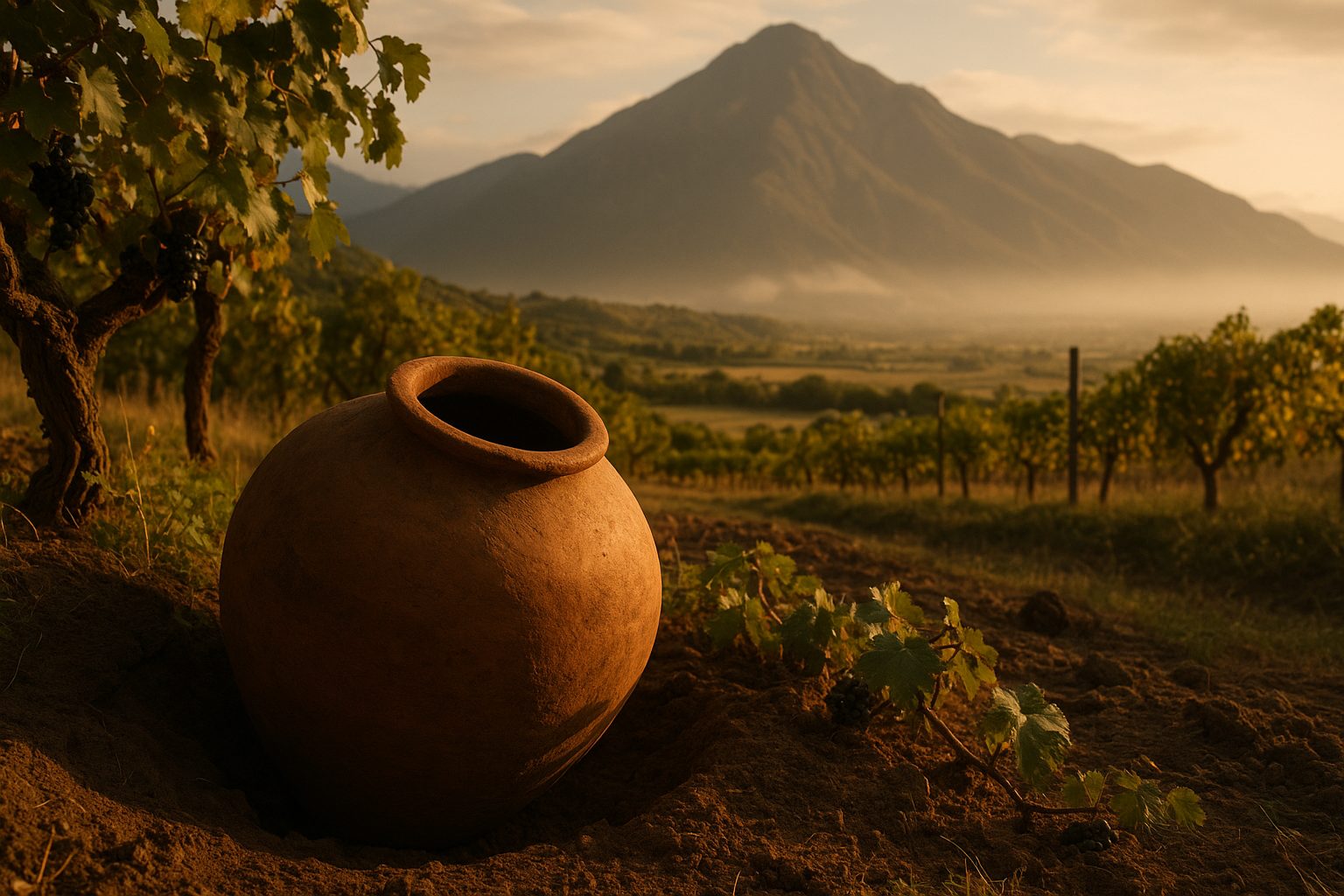
Between steep mountains and fertile valleys, between the Black Sea and the great Caucasus ranges, lies one of the world’s oldest cultural landscapes.
It is here, in Georgia, that the story of wine gains depth and silence — and where time seems to guard, with almost ritual fidelity, the memory of the first human fermentations.
Long before Greece sang its myths, Rome wrote its laws, and Europe turned wine into heritage, it was born here, in the heart of the Caucasus, as a natural discovery that humanity not only recognized but, above all, chose to preserve.
—
The Earliest Origins
The archaeological evidence is unequivocal: fragments of amphorae found in the Kvemo Kartli region, in central Georgia, revealed wine residues dated to around 6,000 BC.
These fragments contained tartaric acid, crystallized bitartrate, and fossilized grape pollen — chemical and botanical proof that wine was being produced there more than 8,000 years ago.
On the historical timeline, this is a period when humans were just beginning to build permanent villages, domesticate cereals, and raise the first herds. The fact that vine cultivation and the intentional production of wine were already part of these early agricultural practices shows how deeply this drink became intertwined with human daily life from the very beginning.
It was not simply a matter of crushing grapes: there was already awareness, method, and repetition. Amphorae were partially buried in the ground to allow fermentation at a stable temperature; their interiors were coated with beeswax to prevent leakage; and the clay or wooden lids were carefully adjusted to allow only minimal air exchange.
This combination of materials and technique reveals an advanced form of prehistoric biotechnology — a technology born from observation, not calculation.
—
The Qvevri: Keeping Time Inside the Earth
Among all the wine traditions in the world, few are as ancient and as continuous as the use of the qvevri — large clay amphorae buried in the ground, where wine ferments, rests, and ages. This method is not a modern re-creation; it is not a tribute to the past. It is the past, alive.
The qvevri is both vessel and philosophy. Its oval shape allows the lees to settle naturally at the bottom, creating spontaneous clarification. Being buried, it maintains an almost constant temperature throughout the year, favoring slow, stable fermentations. There is no metal, no wood, no technology: only earth, grape, and time.
In Georgia, the qvevri is not something you see — it is something you feel.
Family homes, even the simplest, still have an underground room, the marani, where these vessels live half-hidden, like roots preserving memory. It is in this space that families gather during vinification, taste the new wine, and celebrate the ritual of harvest.
The qvevri is not just an agricultural instrument: it is the spiritual heart of the Georgian home.
—
Wine as Cultural Expression
In Georgia, wine does not merely belong to daily life — it belongs to the soul. It is a central element of national identity and accompanies people from birth rituals to farewell ceremonies.
There is a traditional figure, the tamada, master of ceremonies at Georgian tables, responsible for leading the toasts and giving meaning to the words that accompany the wine.
Each toast is not just a social gesture; it is a symbolic act: honoring ancestors, thanking for the harvest, wishing peace and longevity. This deeply spiritual way of drinking shows how wine has become a language. There is no Georgian table without wine, just as there is no Georgian wine without story.
The vine, according to tradition, is not merely a plant: it is a being that shares the fate of the people.
Some say that when Georgia faced invasions, it was wine — hidden in buried qvevri — that preserved the culture. And there are those who believe that the Georgian people, more than producing wine, were shaped by it.
—
Ancestral Grape Varieties
Georgia has preserved more than 500 native grape varieties — a genetic heritage of incalculable value. Among them stand out Rkatsiteli, with its vibrant acidity, and Saperavi, a dark-fleshed red capable of producing intense, long-lived wines.
These varieties survived phylloxera, empires, and wars thanks to family viticulture and small-plot cultivation. The genetic diversity of the Georgian vineyard is today one of the most important in the world — not only for its quantity, but for its preserved authenticity. Each variety has its story and its place.
In Kakheti, the most emblematic region, vineyards grow in clay and stony soils shaped by heat and dry winds. There, qvevri wine is not an exception: it is the dominant tradition, practiced both by small families and by modern producers who wish to keep their bond with the past alive.
—
The Spirituality of the Vine
Georgian viticulture developed in an environment where religion, nature, and community were deeply interconnected. Long before Christianity, the peoples of the Caucasus practiced agricultural rituals that included wine offerings to the sun, the earth, and fertility spirits.
When Georgia became one of the first Christian countries in the world, in the 4th century, wine gained new meaning: it became a sacred symbol, part of the liturgy, a metaphor for life and resurrection.
It is no coincidence that many of the oldest Georgian churches have vine motifs carved into their façades. The vine became both a symbol of protection and of identity.
The Georgian people do not see themselves as separate from their land, and that bond finds its deepest expression in wine.
—
The Role of Family and Time
In rural Georgia, vineyards are worked in community. Families take part in pruning, harvest, and vinification. Harvest time is a moment of unity, where generations cross paths and cultural continuity is renewed. Knowledge is transmitted orally, practically, in lived experience: one learns from the father, the mother, the grandfather, the neighbor.
The time of the qvevri is human time: slow, silent, trusting. There, the wine rests for months, sometimes years, in contact with the earth and its lees. It is a method that demands trust in nature and humility before time.
The producer does not impose — they accompany. Their role is not to control, but to listen.
This philosophy is inseparable from the character of Georgian wine: a drink that carries, in its texture, aroma, and structure, the memory of a culture that never allowed the past to be forgotten.
—
A Bridge Between Past and Future
Today, Georgia is experiencing a wine renaissance. Modern producers reinterpret age-old traditions, combining scientific knowledge with ancestral methods.
The qvevri, once confined to domestic use, has become an international symbol of authenticity. UNESCO recognized qvevri winemaking as Intangible Cultural Heritage of Humanity in 2013, helping to safeguard a practice that unites technique, culture, and spirituality.
The modern world has discovered in Georgia a wine that is more than a drink: it is a living document, proof that time can be kept in the earth and that a people’s identity can survive in silence for millennia.
—
The Cradle That Still Teaches
By studying the Caucasus, we realize that wine was not born by chance — it was born in a place where the relationship between humans and nature was one of mutual respect. There, the vine was not merely domesticated: it was welcomed, woven into the rhythm of the seasons, and made part of spiritual life.
Georgia did not only preserve wine as origin; it preserved it as essence. And perhaps that is why, when we taste a Georgian qvevri wine, we feel something more than the flavor of the grape: we feel the flavor of time.
The time the earth keeps. The time the family passes on. The time no modernity can replace.