Wine Stories · Part I · Chapter 2
The Miracle of Fermentation
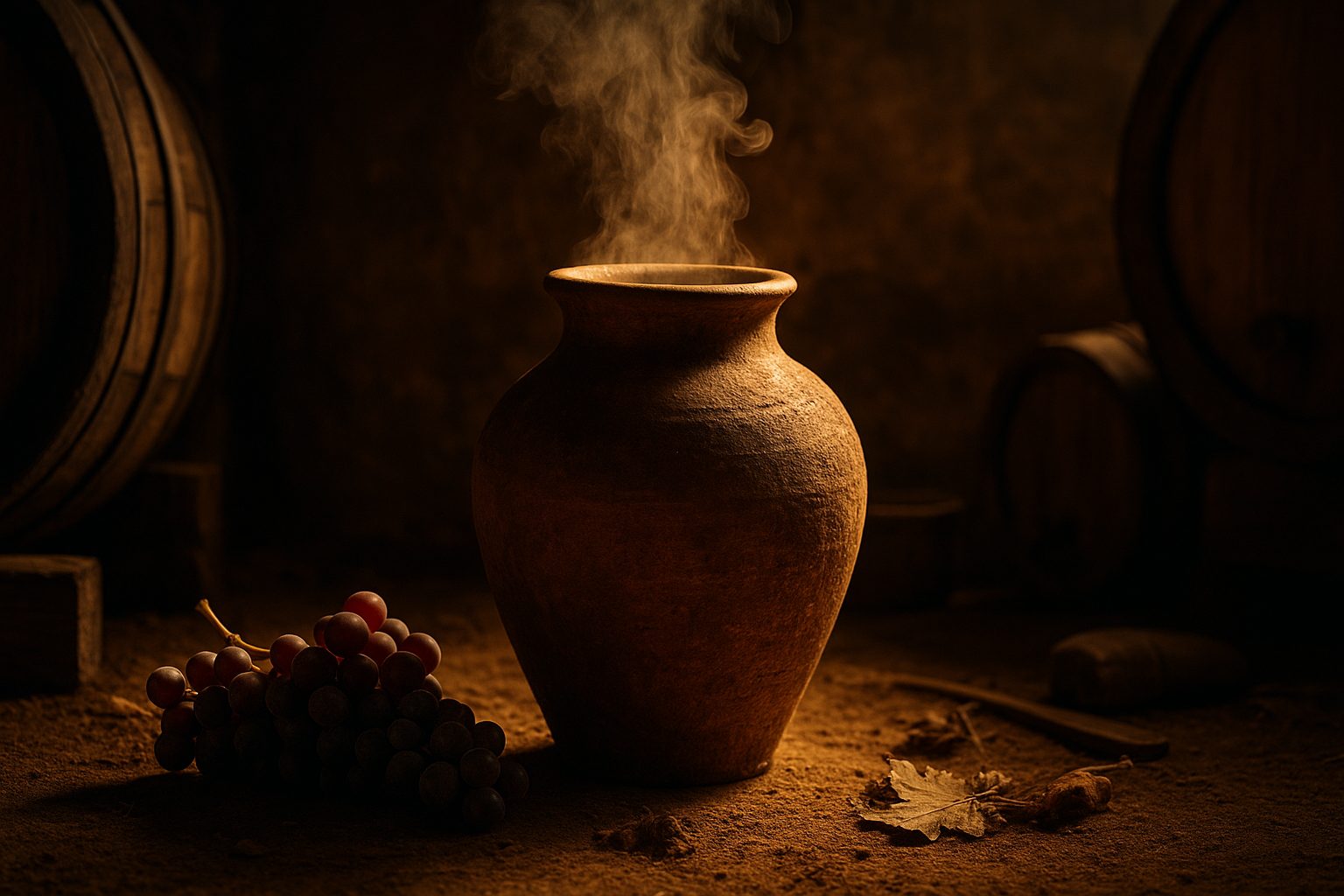
Fermentation is one of nature’s greatest miracles — the spontaneous transformation of grape juice, guided by invisible organisms that turn it into wine.
Long before humans understood chemistry, biology, or the role of yeast, fermentation was already working in silence, driven by the warmth of the sun and the patience of time. It was one of the first natural processes that humankind not only observed but learned to respect.
Among all the foods nature offers, none expresses the mystery of transformation as profoundly as wine.
Archaeologists have found traces of wine in amphorae from Georgia and Iran dating back to around 6,000 BC, revealing that humans quickly learned to observe and repeat this natural phenomenon.
Wine is therefore one of humanity’s oldest creations — not in the sense of invention, but of shared discovery: man did not invent it; he merely allowed it to happen again. That is why fermentation can be seen as the first form of biotechnology — a technology born of patient observation and respect for the invisible rhythms of life.
—
Chance and Curiosity
It all began with chance. Early humans, hunters and gatherers, collected wild fruits — among them, small and tart grapes.
When left in a natural container — perhaps a hollow in the ground, an animal skin, or a clay jar — the sun’s warmth and moisture created the perfect environment for a quiet miracle: the juice began to “boil.” It was not fire, but microscopic life in action.
Yeasts, invisible to the eye, fed on the sugar in the grapes and released alcohol and carbon dioxide. The liquid bubbled, gave off new aromas, and deepened in color. The first spontaneous fermentation was underway.
When someone tasted that liquid, they found something extraordinary: the flavor was intense, the body warmer, and the effect mysterious. The drink brought joy and lightness, dispelled fear, sharpened appetite, and seemed to suspend time.
Humans had discovered, unknowingly, a natural form of alchemy — the passage from sweet to spirited, from perishable to lasting. And for the first time, chance became knowledge.
—
Curiosity did the rest.
Humans began repeating the phenomenon, trying to understand what caused it. They stored the must in similar containers, observed its behavior, experimented with harvest times. They discovered that the result changed depending on temperature, grape ripeness, and the type of vessel. Thus was born the first laboratory: the amphora.
Inside it, time and nature worked together. Man watched, attentive, as the must bubbled and the sound of fermentation seemed to breathe. He learned there was a right moment to fill the vessel and another to seal it, and that light and heat could ruin what time sought to perfect.
Without realizing it, he was developing the first notions of natural control — temperature, hygiene, and skin contact time.
Those amphorae, often buried partly in the earth, were not mere utensils; they were instruments of observation. Each held a fragment of experience, a piece of memory. Some families marked them with symbols — a circle, a cross, a spiral — to distinguish harvests or origins. The amphora became an extension of human curiosity: a clay womb where one could watch the invisible turn into something new.
There, man learned to wait — perhaps the greatest lesson in winemaking. He understood that wine cannot be forced: it must be accompanied. That time, if given space, returns something purer and truer. Each fermentation was both an experiment and a promise — and without realizing it, man was founding one of the oldest forms of culture: patience turned into art.
—
The Role of Yeasts
For millennia, humankind produced wine without knowing that fermentation depended on a living, microscopic being: yeast.
These unicellular organisms, belonging to the Saccharomyces genus, live naturally on the surface of grapes, hidden in their skins, waiting for the right moment to act. They feed on sugars and multiply when temperature, oxygen, and humidity align perfectly.
As they transform sugar into alcohol and carbon dioxide, they also release heat, aromas, and compounds that shape the body and character of the wine.
They are invisible but decisive — tiny lives that translate the fruit’s sweetness into structure, perfume, and energy.
Long before Louis Pasteur explained the phenomenon, around 1857, humans had already understood — by instinct, observation, and repetition — that fermentation required harmony among three essential elements:
1. Ripe grapes, rich in sugar and juice, harvested at the moment when nature balances sweetness and acidity;
2. A closed but not hermetic container, protecting from air while preserving heat and humidity without suffocating life’s movement;
3. Time — the invisible, sacred ingredient that allows nature to complete its cycle and reveal what humans can only accompany.
These three factors formed the trinity of ancient winemaking — empirical wisdom born of experience and patience — and, in many ways, they remain the foundation of modern oenology.
Despite all the science we now possess, every fermentation still depends on the same primal balance: fruit, shelter, and time.
What has changed is only humankind’s gaze; the mystery remains the same.
—
Wine as the First Biotechnology
Fermentation was one of the earliest biological technologies created by humans — long before anyone knew what a cell was.
Through it, people learned to preserve food, bake bread, make cheese, beer, and vinegar. But in wine, this technique acquired a different symbolic and social status. While bread fed the body, wine began to feed the collective spirit: it became part of celebrations, religious rites, and trade.
The amphorae found in Georgia and Iran show intention and method. The jars were partially buried to maintain constant temperature, and their interiors coated with beeswax to prevent leakage.
Some had fitted lids and engraved markings — perhaps the first labels in history. These details reveal technical awareness and a desire to repeat the miracle. It wasn’t magic, but observation — the root of all science.
Over time, the practice spread across the Mediterranean. The Egyptians developed true underground cellars, controlling fermentation and storing wine in sealed jars. In Greece, wine became a symbol of culture and civilization; the symposion literally meant “drinking together,” a gathering of ideas, philosophy, and pleasure. The Romans brought wine to every corner of the empire, perfecting presses, vats, and preservation methods.
Fermentation had ceased to be chance; it had become art — a science before science.
—
The Invisible Side of Nature
There is something deeply human about observing the invisible. When people saw must bubbling, they sensed a greater force — a life moving within matter. That perception inspired reverence and wonder.
Wine came to be seen as a divine gift, one that occurred only if conditions were favorable. Hence arose rituals: offerings before harvest, libations to the earth and sun, prayers so fermentation would not be lost. Humans intuitively understood they were dealing with living forces — and treated them with respect.
That ancestral reverence endures. Even with modern technology, fermentation remains an act of trust: no matter how much we control temperature, yeasts, and analysis, there is always something unpredictable in wine.
It is that element of mystery that sets it apart from any other agricultural product. Every fermentation is unique because every harvest, every grape, every moment of sunlight is unique.
Fermentation, ultimately, is the signature of time.
—
The Birth of the Cellar
To protect and control the process, humans began creating spaces dedicated to fermentation: the first cellars.
In the ancient city of Areni, Armenia, archaeologists uncovered a winemaking complex dating back to around 4,100 BC — the oldest known to date. There were stone presses for crushing grapes, drainage channels, and clay vessels for fermenting must.
These places were not merely technical spaces but sacred ones: it was believed that wine was born under the protection of the earth’s spirits. The primitive cellar became a small agricultural cosmos — a space where humans could observe, wait, and participate in the natural cycle of fermentation. There, the concept of craft was born.
Making wine ceased to be a collective accident and became a personal vocation. Someone within the community began to be recognized for their skill in “making wine happen.”
Thus was born the ancestor of the winemaker — the guardian of transformation.
—
The Transformation of Experience
Fermentation taught humankind to wait — but also to believe. Watching juice ferment and transform, humans realized the world was full of invisible processes. They learned that life manifests not only in what can be seen but also in what moves within silence, darkness, and time.
And by turning grape juice into wine, they also learned to transform experience itself: the simple act of drinking became a gesture of contemplation.
Wine became proof that time has flavor — and that waiting can be beautiful.
This transformation was cultural too. Wine created rituals of sharing, elevated meals, and brought people closer together. Drinking wine was not merely quenching thirst but participating in a larger cycle — the same that began in the vine and ended in the glass.
Fermentation thus crossed the boundary of biology and became a symbol of human consciousness itself: the recognition that all living things can transform.
—
The Enduring Miracle
Today, we know almost everything about the chemical process of fermentation: yeasts convert glucose and fructose into ethanol and carbon dioxide; they produce heat and aromatic compounds; each strain creates distinct profiles.
Yet, despite all this knowledge, the enchantment endures. The moment the must begins to bubble still inspires wonder — as if it were the first time.
Wine remains perhaps the oldest and most human product on earth — because within it converge science, art, and mystery. Fermentation is the meeting point between nature and intention. Without humans, the process occurs; but without human presence, wine has no meaning.
It is in presence — in the act of accompanying, tasting, feeling — that wine becomes culture. That is why, even after thousands of years, we still witness the same miracle: the rebirth of fruit into liquid, of time into pleasure, of nature into memory.
And when we raise a glass, we repeat the ancestral gesture of those who first tasted transformation — and recognized in it the very essence of life.