Wine Stories · Part I · Chapter 1
The First Vine
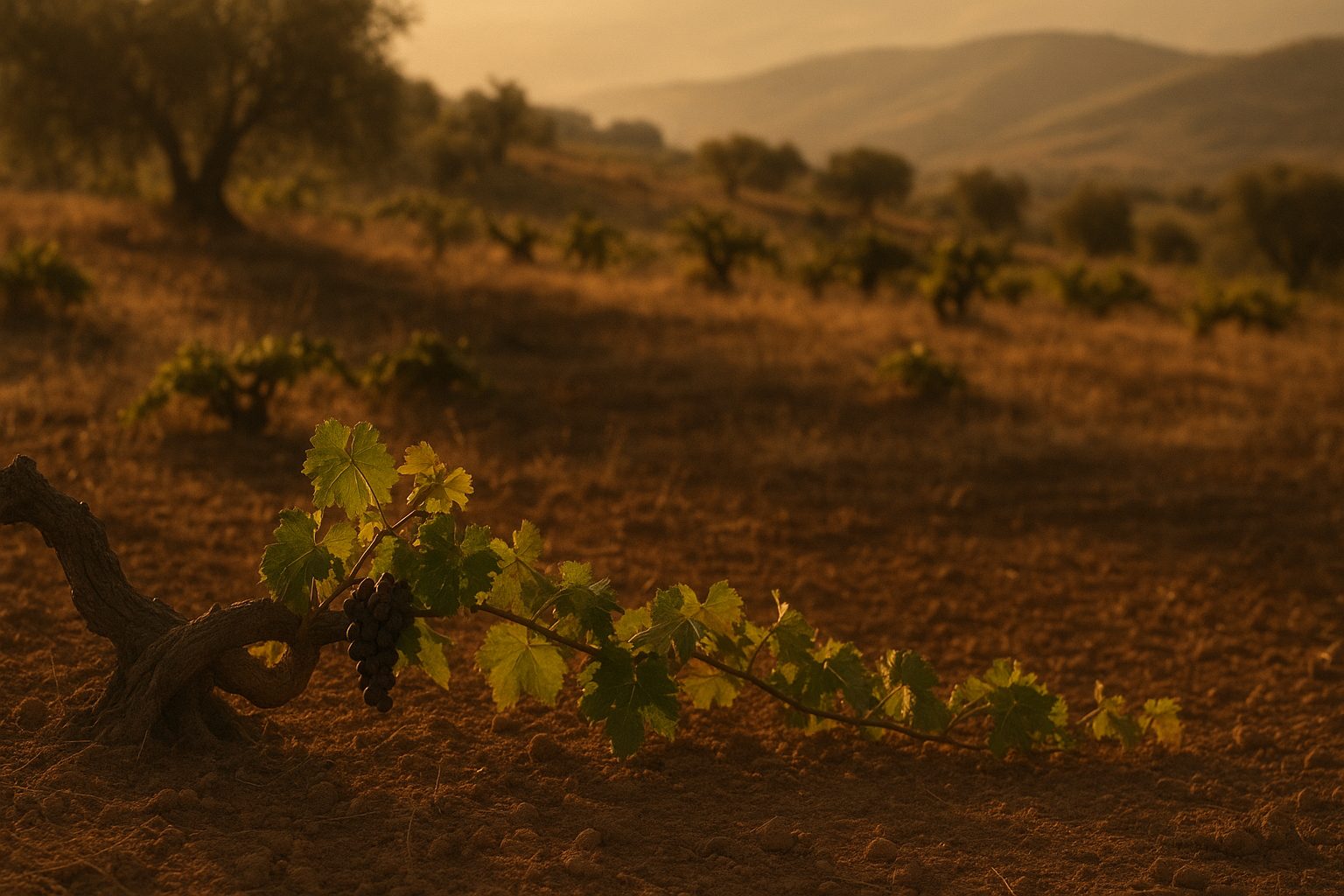
Long before humans planted the first vineyard, the wild vine was already growing freely, spontaneously and untamed along the shores of the Mediterranean, in the forests of the Caucasus and on the sunlit slopes of Asia Minor.
It was a climbing plant, winding itself around trees in search of light, with deep, flexible roots capable of withstanding droughts, winds and winters.
Vitis vinifera sylvestris, the direct ancestor of the cultivated vine, lived in harmony with the rhythm of the sun: it awoke with the warmth, slept with the cold and bore fruit at the height of the light.
Before becoming a symbol of culture and refinement, it was simply a survivor of the forest.
The fruit of this wild vine was small, acidic and deeply coloured. Animals and early humans gathered the grapes by chance, eating them more for the energy of their sugar than for the pleasure of their flavour.
But human curiosity — that quiet force that precedes civilisation — would eventually change the plant’s destiny.
Some of these bunches, forgotten in animal skins or hollows in the rock, began to ferment naturally in the warmth of the sun. The juice changed, the aroma shifted, and the flavour acquired depth and vigour. Wine was born in this way: through observation, rather than invention.
It was the result of time’s patience and humanity’s attentive gaze. The accident of fermentation may have occurred thousands of times before it was understood. But there came a moment, somewhere in the Caucasus or the Levant, when humans realised that this process was more than deterioration — it was transformation. That instant, when the power of the invisible was recognised, marked the beginning of a new relationship between humanity and nature. Spontaneous fermentation revealed a simple and profound truth: within every fruit, life continues, even after it has been picked.
—
Botanical Origins
Vitis vinifera sylvestris belongs to the Vitaceae family, which has existed for around 60 million years. It is dioecious — there are male and female plants — meaning that not every plant bears fruit. This natural characteristic limits its reproduction, but also ensures extraordinary genetic diversity, essential to survival across geological ages.
For thousands of years, wild vines spread across Europe, from the Iberian Peninsula to the Black Sea, following the retreat of the glaciers and the warming of the planet after the last Ice Age.
The transition from Vitis vinifera sylvestris to Vitis vinifera vinifera — the domesticated vine — was not a sudden event, but a slow, dispersed and cumulative process. It is believed to have begun around 8,000 years ago, in the region now encompassing Georgia, Armenia, Iran and eastern Anatolia. The Neolithic populations living there already grew cereals and raised animals; they knew how to observe natural cycles and save seeds. It is natural that, on noticing that certain vines produced sweeter grapes and higher yields, they began transplanting canes from those plants close to their villages. Selection was instinctive at first.
Farmers chose the canes best able to withstand local conditions and propagated them vegetatively — taking and planting cuttings rather than using seeds. Over time, this practice produced hermaphroditic vines, more fertile and predictable.
Without knowing it, humans were practising natural genetic improvement.
The plant that had once depended on chance came to depend on the human hand, and humans, in turn, came to depend on it for nourishment, pleasure and social exchange. This was the beginning of viticulture.
—
The First Signs of Domestication
The earliest evidence of wine production was found in the southern Caucasus. In 2017, archaeologists discovered fragments of amphorae at Gadachrili Gora, in Georgia, containing residues of tartaric acid and wine crystals dating to 6000 BC.
These traces indicate not only fermentation, but also storage and an intention to preserve wine. It was no longer chance: it was culture. Other discoveries, in present-day Iran, reveal clay jars used to ferment grape must in communal houses, showing that wine already played a social and ritual role. Wine quickly became an element of civilisation.
Alongside bread and olive oil, it came to represent human mastery over the cycles of nature — the ability to transform and preserve. The first agricultural villages became communities where wine served as nourishment, but also as a symbol of celebration and unity. To drink was to share time. Wine held the memory of summer within winter, the light of the sun within the amphora.
Vitis vinifera vinifera began spreading from these original centres in several directions: westwards towards the Mediterranean, northwards towards the Black Sea, and eventually into central and western Europe.
With human migration and trade, vines travelled as cuttings or seeds, crossing with local species and creating new varieties. Each encounter between plant and territory generated a different expression — an early intimation of what we would later call terroir.
—
From Forest to Field
To domesticate the vine was more than planting — it was teaching time to repeat itself. Communities realised that by caring for the plant, its fruit became more reliable. This was how the first vineyards emerged: small clearings beside rivers, enclosed with stones to shelter them from the wind, where humans trained the branches and pruned away excess leaves. The simple act of guiding and supporting the vine transformed its behaviour and, with it, the way humans related to nature. They ceased to be mere gatherers and became guardians.
That gesture marked the beginning of a philosophical shift. For the first time, humans understood that nature did not need to be dominated — it only needed to be understood. The vine taught the right rhythm: to grow, bear fruit, rest and be reborn. It mirrored the solar cycle and, in a sense, human existence itself.
Wine, the product of this cycle, began to represent the bond between the visible and the invisible, between the time of the earth and the time of the spirit.
—
The Presence of the Sun
The vine is a plant of the sun.
Its life depends on light, and its cycle follows the movement of the sun throughout the year. In winter, it withdraws; in spring, it awakens; in summer, it offers its fruit; and in autumn, it gives itself back to the earth.
This relationship with the sun — a source of energy, warmth and ripening — explains the almost sacred aura that has always surrounded wine. Light transforms sugar into alcohol; alcohol preserves time; time reveals flavour. It is a deeply symbolic process, echoed in every ancient agricultural tradition.
The peoples who learned to observe the sky — Egyptians, Mesopotamians and Greeks — associated the vine with solar deities. Wine became a symbol of celestial fire captured on earth. In Mediterranean civilisations, the act of drinking was a tribute to the sun: a way of participating in the natural cycle of life and death, from seed to fruit, from fruit to glass.
For this reason, the vine was venerated and depicted in temples, myths and poems. It was a plant that united the human and the divine through light.
—
From Chance to Culture
Wine was born of an accident, but survived through human intelligence. Its history is the history of patient observation: recognising the right moment to harvest, the ideal warmth for fermentation, the kind of vessel that best preserves aroma. This knowledge, passed from generation to generation, laid the foundations of oenology.
Long before science existed, there was already sensitivity — the instinct not to interrupt what nature did well. In learning to transform grape juice into wine, humans realised that they could also transform a moment into memory. With every fermentation, they repeated the original gesture of someone who had once tasted chance and decided to preserve it.
Wine became part of the seasons, celebrations, conversations and memories. Each glass became a small mirror of time, where past and present meet.
And perhaps that is why wine, more than any other nourishment, still carries within it the essence of the earth and of humanity — an ancient communion, born of a simple fermentation in the sun.