Wine Stories · Part I · Chapter 19
Wine as a Symbol of Civilization
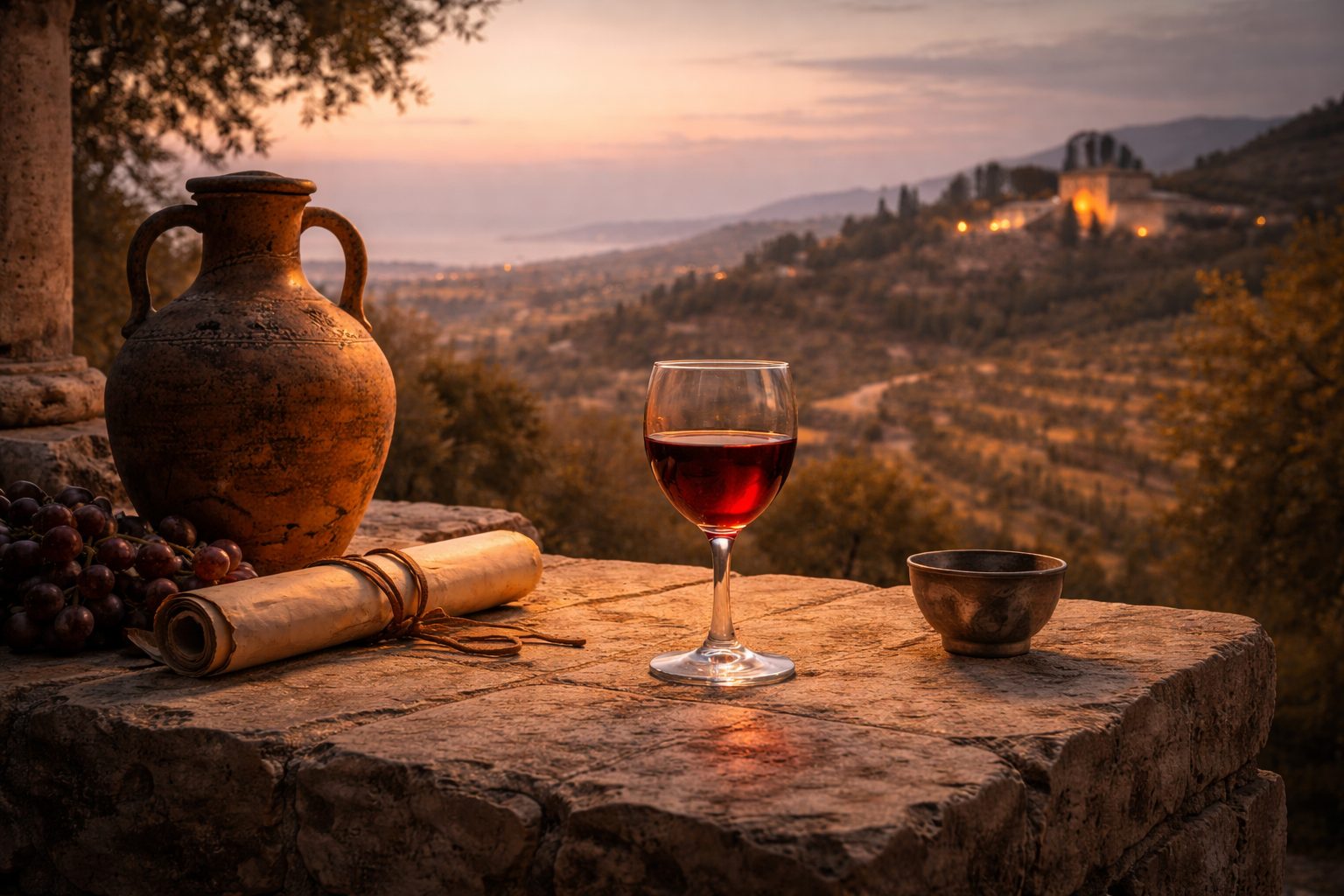
In Late Antiquity, wine was more than a drink. It was a mirror of society.
The way wine was produced, served, and consumed revealed much about who people were and the world to which they belonged. Rich or poor, philosopher or soldier, farmer or priest — all recognized in wine a sign of culture.
Qualities, vessels, and contexts could vary, but wine retained a shared meaning: it represented an organized, agricultural, and conscious way of life.
To drink wine was not merely to quench thirst. It was to participate in a cultural universe that crossed peoples, empires, and beliefs.
—
The Civilization of the Vine
The vine does not grow without care. It requires pruning, vigilance, knowledge of climate, and attention to the soil. Those who cultivate vines learn to observe time and respect the cycles of nature.
For this reason, the regions where wine prospered were also regions where stable forms of human organization developed.
The vine demands continuity. It cannot be abandoned for long periods, nor exploited only occasionally.
The culture of wine is therefore deeply linked to the culture of permanence. When a territory cultivates vines, it implicitly affirms something essential: there exists a community capable of thinking about the future.
—
Wine as a Cultural Marker
In Antiquity, differences between peoples were often described through food and drink.
For the Greeks and Romans, wine was a clear sign of civilization.
Peoples who cultivated vines and drank wine were seen as participants in a shared cultural world. Those who did not were often described as foreigners or barbarians.
This distinction was not merely economic or agricultural — it was symbolic. Wine represented a specific relationship with nature and with time.
To drink wine implied agriculture, storage, technique, and sharing. In other words, it implied society.
—
An Element That Crossed Social Classes
Although differences in quality existed, wine was consumed by many layers of society.
The Roman patrician drank rare and aged wines; the soldier or laborer drank diluted wine or wines of lesser prestige. Yet all drank wine.
This universal presence gave wine a rare role: it was simultaneously a drink of the elite and a drink of the people.
Few products in Antiquity possessed this ability to cross social classes without losing cultural meaning. Wine united what hierarchy separated.
—
Wine as Social Language
Wine was not merely consumed; it was interpreted.
The choice of wine, the moment it was served, the vessel used — all communicated something.
At a Roman banquet, for example, serving a particular wine could signal status, generosity, or refinement. In a religious ritual, wine marked the moment of consecration.
Wine functioned as a silent language. It did not need explanation; it was understood by all who shared the same culture.
—
Between the Everyday and the Sacred
One of the most remarkable characteristics of wine in Antiquity was its ability to exist simultaneously in two worlds: the everyday and the sacred.
It was both a table drink and a ritual substance. It could accompany a simple meal or participate in a religious ceremony.
This duality reinforced its symbolic value. Wine linked the human to the divine while remaining deeply terrestrial.
It was fruit of the earth, yet carried spiritual meaning.
—
Wine and the Memory of Peoples
Ancient civilizations recorded wine in their histories, myths, and sacred texts. The vine appears in stories of fertility, abundance, and promise.
In the Bible, the vineyard symbolizes care and responsibility. In Greek culture, Dionysus represents the transformative power of wine. In Roman tradition, wine accompanies the expansion of empire and the organization of society.
These references show that wine was not only consumed — it was contemplated.
Its presence in literature and religion confirms its profound role in the cultural formation of Mediterranean societies.
—
A Product That Requires Peace
Viticulture flourishes best in times of stability. The vine requires years to reach maturity and demands constant care. For this reason, wine regions are often associated with periods of relative peace and social organization.
When wars persist or political structures collapse, vineyards are abandoned. When order returns, the vine is planted again.
Wine thus becomes an indirect indicator of the state of civilization. Where there is wine, there is usually continuity.
—
The Cultural Network of the Mediterranean
For centuries, wine helped build a cultural network linking distant regions of the Mediterranean.
Amphorae carried wine between ports, cities, and markets. With them traveled ideas, techniques, and habits of consumption.
Wine helped create a shared language among different peoples. They might speak different languages or follow different religions, yet they shared an understanding of wine as a valuable and culturally significant product.
This phenomenon contributed to the formation of a Mediterranean identity.
—
Wine as Civilizational Heritage
When we look at the history of wine, we realize that it does not belong to a single culture. It has been cultivated, transformed, and reinterpreted by many peoples across time.
Each civilization added something: the peoples of the Caucasus discovered fermentation; the Greeks gave wine a philosophical dimension; Rome organized its expansion; medieval monks preserved and deepened the relationship with territory.
Wine thus became a shared inheritance.
—
Identity and Belonging
For many ancient communities, the vineyard symbolized a bond with the land.
Caring for the vine meant caring for the territory and the collective memory. The wine produced in a specific place represented not only the nature of that place but also the work of the generations who had lived there.
This connection between wine and territorial identity remains today. Every wine tells a story of soil, climate, and culture.
—
A Thread That Crosses Empires
Throughout Antiquity, empires rose and fell. Borders changed, cities were destroyed, peoples migrated.
But wine remained.
It changed hands, adapted to new religions, and passed through different political systems. Even when Roman order disappeared, vineyards continued to be cultivated.
This persistence shows that wine does not depend solely on political structures.
It depends on something deeper: the human relationship with land and time.
—
Civilization in the Glass
Wine became a symbol of civilization because it brings together essential elements of human life: nature, labor, technique, time, and sharing.
None of these elements exists in isolation. Wine is the result of their combination.
Throughout history, drinking wine has been a way of recognizing this complexity — a simple gesture that carries centuries of human experience.
—
A Legacy That Crosses Time
Today, when we open a bottle of wine, we participate — often without realizing it — in a millennia-old tradition.
This gesture connects us to ancient farmers, medieval monks, Mediterranean merchants, and communities that found in wine a way to celebrate life.
Wine is not merely a product of the earth. It is also a product of civilization.
And perhaps that is why, despite the passage of centuries, it continues to occupy a special place in human culture: because in every glass echoes a shared history.