Wine Stories · Part I · Chapter 20
Transition — The Legacy of the Ancient World
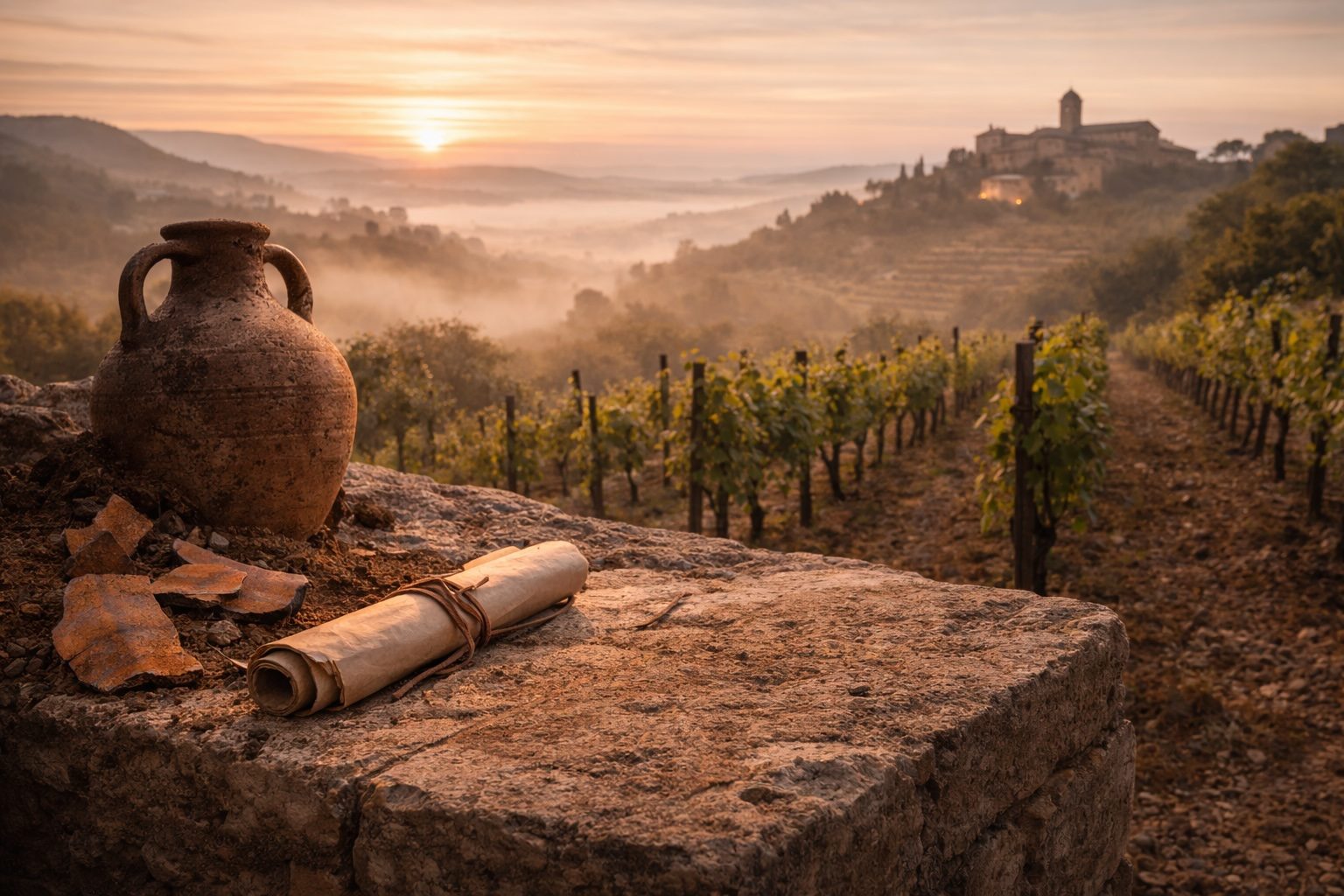
Wine survived the fire of empires and the dust of civilizations. It survived the fall of Rome, the invasions that fragmented Europe, and the long decades when roads were no longer safe and trade lost the scale it once had.
While political structures dissolved, the vine continued to grow silently on slopes tended by persistent communities.
The knowledge accumulated by Greeks, Romans, and monks did not disappear. It was transmitted, adapted, and slowly deepened.
Over the centuries, that knowledge became the seed of what would later be known as the Old World of wine — a mosaic of regions where territory, tradition, and culture would define the identity of each wine.
This chapter marks the transition between two eras: the age of empires and the age of regions.
—
The End of One World, the Beginning of Another
The ancient world was organized around large centralized civilizations.
Wine circulated through empires — first Greek, then Roman — supported by extensive trade networks and complex infrastructure.
With the decline of these structures, the production and consumption of wine returned to a more local scale. The vine ceased to serve an imperial economy and became part of regional communities.
This change profoundly altered the meaning of wine. From a universal product of empire, it became an expression of specific territories.
The identity of wine began to be increasingly linked to the place where it was born.
—
The Technical Heritage
Despite political upheavals, much of the technical knowledge of the ancient world remained.
The Romans had left a solid legacy: efficient presses, preservation techniques, underground cellars, and practical knowledge of vineyard management.
Monasteries preserved this heritage. For centuries, monks copied agricultural treatises, experimented with cultivation methods, and carefully observed differences between soils and slopes.
Thanks to this quiet work, European viticulture did not have to begin from nothing. There was a solid foundation upon which to build. Tradition became continuity.
—
The Birth of Territorial Awareness
As communities stabilized, a new way of looking at the vineyard began to emerge.
Farmers and monks realized that certain parcels produced wines that were more balanced, more enduring, or more expressive. Repeated observation across generations led to the identification of particularly favorable sites.
The vine was no longer planted merely where it was possible to plant. It began to be planted where it was best.
This process marked the birth of territorial awareness that would later be known as terroir.
—
Europe: A Mosaic of Vineyards
Over time, different regions of Europe began to assert their own characteristics.
In the hills of Burgundy, monks delineated parcels that revealed distinct identities. In the Rhine Valley, viticulture adapted to cooler climates and steep slopes. In the Iberian Peninsula, Roman traditions merged with varied climatic conditions and indigenous grape varieties.
Europe’s geographic diversity became an ally of the vine. Instead of imperial uniformity, a regional mosaic emerged.
Each region developed its own way of cultivating, fermenting, and understanding wine.
—
The Vineyard as Cultural Landscape
As vineyards consolidated in specific regions, they also began to shape the landscape.
Stone walls marked parcels. Terraces allowed cultivation on steep hillsides. Villages grew around presses and cellars.
The vineyard ceased to be merely an agricultural crop and became a cultural landscape.
Territory and viticulture became inseparable. To look at a hillside was to recognize centuries of human work.
—
The Return of Trade
With the revival of medieval cities and the gradual return of political stability, trade slowly regained strength.
Wine once again became a commodity, but now with an important difference: it was no longer merely a product transported in bulk.
Certain regions began to be recognized for the particular quality of their wines. Merchants sought wines from specific places, not just wine in general.
Territory began to define value.
—
Laws and Rules
As regional trade grew, the first attempts at regulation appeared. Cities and kingdoms began to protect local wines, control quality, and delimit production areas.
These rules were still far from modern appellations, but they revealed a new awareness: the wine of a place had its own reputation and needed protection.
The vine became part of the political and economic identity of a region.
—
Tradition and Continuity
European wine developed over centuries through a combination of tradition and adaptation.
Farmers transmitted knowledge from generation to generation. Monasteries preserved techniques and observations. Communities created habits and wine styles that became characteristic.
This continuity created something rare: wines that belonged not only to a producer, but to a regional culture.
Wine became the expression of a collective memory.
—
The Birth of the Old World
It was in this context that what we now call the Old World of wine was born — a world where wine is not merely a product, but part of history and landscape.
A world where vineyards have been cultivated on the same slopes for centuries. Where territory defines style as much as technique.
France, Italy, Spain, and Portugal would, over time, become the great pillars of this tradition.
But this identity did not emerge suddenly. It was built slowly, generation after generation.
—
From Tradition to Appellations
With the advance of modernity, the principles established during the Middle Ages would evolve into more formal systems.
Laws protecting origin, the delimitation of regions, and the classification of wines emerged as ways to preserve identity and quality.
These systems were not isolated modern inventions. They were the continuation of a territorial awareness that had been developing for centuries.
European wine thus became deeply linked to the concept of origin.
—
A Legacy That Spans Centuries
When we look at the history of wine, we realize that the ancient world did not end with the fall of Rome. It transformed.
The accumulated knowledge — from the ancestral fermentations of the Caucasus to Roman techniques and monastic observation — formed a continuous heritage.
This heritage allowed wine to evolve without losing its deep connection to land and culture.
Modern European wine is, to a great extent, the fruit of that legacy.
—
The Thread Linking Past and Future
Wine has always been more than a drink. It is an ongoing story.
Every vineyard planted today extends a gesture begun thousands of years ago. Every bottle opened contains echoes of ancient civilizations, silent monasteries, and farmers who learned to work with time.
The legacy of the ancient world did not disappear. It remains in the way we understand wine, territory, and tradition.
—
The Next Stage
From this point onward, wine enters a new phase of its history.
It definitively leaves the world of empires and enters the world of regions, agricultural boundaries, and local identities.
In the hills of France, Italy, Spain, and Portugal — among others — new ways of understanding the vine and the territory will emerge.
Ways based on laws, traditions, and distinct styles.
The next part of this story reveals how wine organized itself into regions, appellations, and styles — gradually becoming a reflection of modern Europe.