Wine Stories · Part I · Chapter 15
Roman Innovations
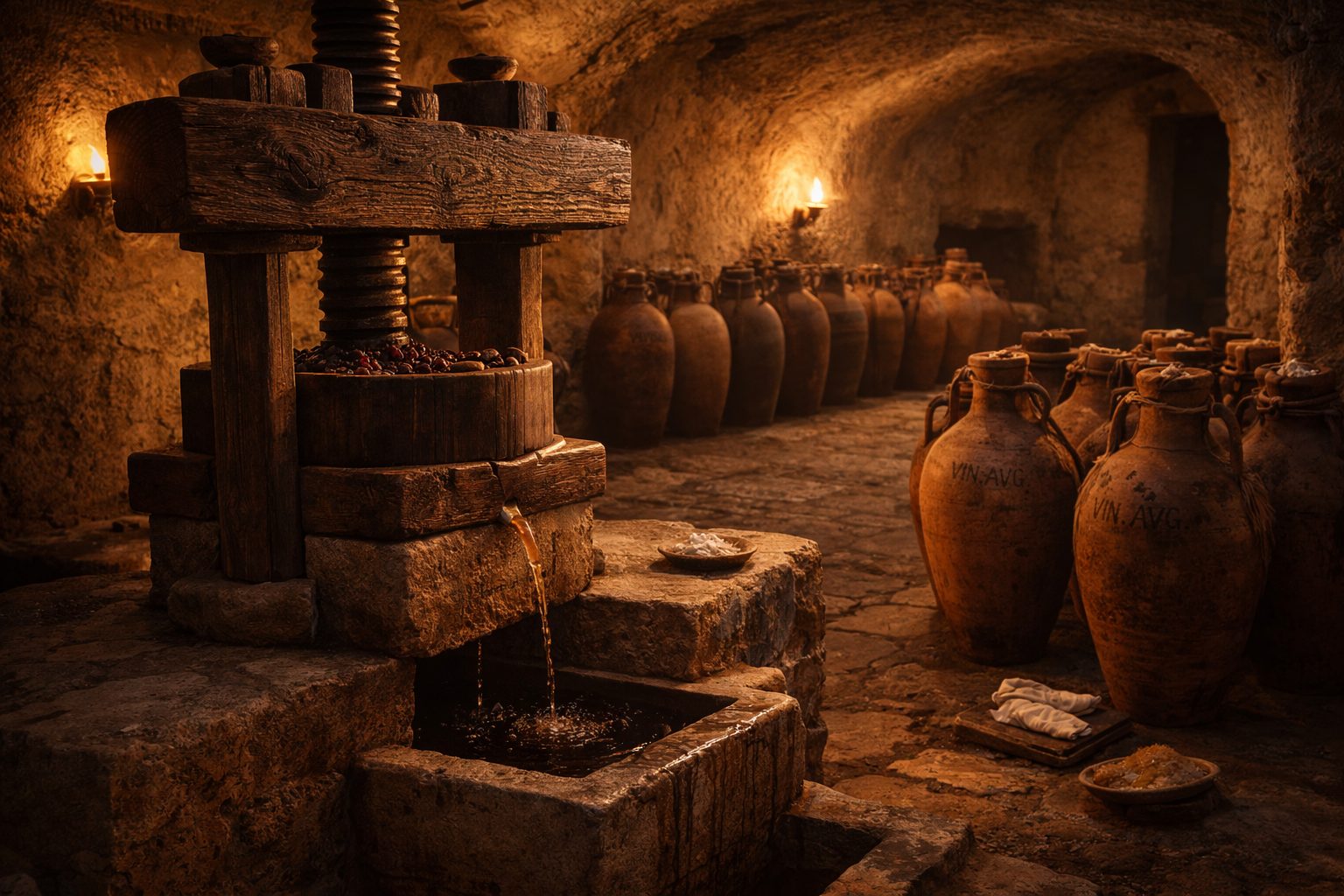
If Rome transformed wine into an imperial force, it was through technique that it made it durable. The Romans possessed an essential virtue: they knew how to observe, adapt, and systematize. They did not invent everything, but they perfected almost everything.
In doing so, they gave wine a solid material foundation, capable of crossing distances, seasons, and generations.
More efficient presses, underground cellars, sealed amphorae, the conscious use of sulfur, and rigorous storage practices: Rome transformed wine with ingenuity and method.
These innovations were not mere technical details; they were the invisible infrastructure that allowed wine to become everyday, commercial, and stable throughout the empire.
—
The Roman Practical Spirit
Unlike the more philosophical Greeks, Rome was essentially pragmatic. The value of a technique was measured by its effectiveness, repeatability, and scale.
If something worked, it was adopted; if it could be improved, it was refined. Wine benefited directly from this mindset.
Rome needed to produce in large quantities, transport over long distances, and preserve wine long enough. Without technique, the empire of wine would not have been possible.
Roman innovation was born of necessity — and became a system.
—
The Press: Efficiency and Control
One of Rome’s major contributions was the development and widespread use of more efficient mechanical presses.
Although traditional foot treading continued to exist, especially for higher-prestige wines, presses allowed more juice to be extracted with less human effort.
Screw and lever presses, built of wood and stone, increased yield and consistency. More importantly, they made it possible to separate musts: the first, more delicate; the later ones, more rustic.
This distinction opened the door to something new: the notion of differentiated quality beginning at vinification.
This was not yet enology in the modern sense, but there was already an awareness that the process influences the final result.
—
Underground Cellars: Mastering Time
The Romans understood something fundamental: wine needs thermal stability.
To achieve this, they developed underground cellars — spaces excavated or partially buried, protected from heat, light, and sudden temperature fluctuations.
These cellars allowed for:
– more stable fermentations;
– better preservation;
– controlled aging;
– and large-scale storage.
Wine ceased to be at the mercy of the climate and began to live in an environment designed for it.
This practice anticipated principles now considered basic in enology: temperature control, protection from light, and extended rest.
By burying wine, Rome learned to work with time rather than against it.
—
Amphorae: Standardization and Security
Rome inherited the amphora but gave it scale and standardization. Shapes became more consistent, adapted to maritime and river transport.
Amphorae were sealed with clay, lime, resins, or wax, reducing oxidation and losses. Many bore inscriptions indicating:
– origin;
– producer;
– capacity;
– contents;
– destination.
This level of information reveals a remarkable concern for control, traceability, and logistics. Without the modern term, Rome was already practicing something close to a system of origin and control.
Roman wine did not circulate randomly; it circulated identified.
—
The Use of Sulfur: Preserving Without Understanding
One of the most surprising practices of Roman enology was the use of sulfur for preservation.
The Romans burned sulfur inside vessels before filling them with wine. They did not understand the chemistry involved, but they knew that wine treated this way kept better.
This simple gesture had profound consequences:
– reduced oxidation;
– greater microbiological stability;
– extended shelf life.
It is one of the rare ancient practices that has survived for millennia with little interruption.
Sulfur remains, even today, a central tool in modern enology. Rome did not understand the mechanism — but it understood the result.
—
Blends, Additions, and Style
The Romans did not have a “purist” view of wine. They mixed it with water, honey, herbs, spices, and resins. Some wines were concentrated by partial boiling of the must; others were deliberately aromatized.
These practices were not seen as adulteration, but as style.
Wine was adjusted to taste, climate, and social context. This approach reveals something essential: for the Romans, wine was a cultural construction, not merely an expression of the grape.
Even so, they recognized differences in quality and valued more “natural” wines when prestige was the goal.
—
Empirical Classification and Experience
Roman authors such as Cato, Columella, and Pliny the Elder wrote extensively about viticulture and winemaking.
They described soils, grape varieties, planting methods, pruning, harvest, and preservation. These texts reveal an empirical enology, based on accumulated observation.
There were no universal formulas, but practical recommendations: what works here may not work there. This recognition of regional diversity was both technical and cultural.
It anticipated the idea of local adaptation, central to later European viticulture.
—
Scale and Specialization
Rome took wine to the industrial scale of Antiquity. Some regions specialized almost exclusively in wine production.
Complete chains were created: vineyard → cellar → transport → distribution → consumption.
This specialization required labor organization, scheduling, storage, and planning. Wine ceased to be merely a seasonal agricultural product and became a continuous activity.
Technique sustained that continuity.
—
Impact on Medieval Europe
With the fall of the Roman Empire, many political structures disappeared. But wine techniques remained.
Monasteries, feudal estates, and rural communities inherited:
– presses;
– cellars;
– storage vessels;
– the use of sulfur;
– technical texts.
Medieval viticulture is, to a large extent, Roman viticulture adapted. Without Rome, Europe would have lost the technical thread that allowed wine to survive political fragmentation.
—
Technique in the Service of Culture
Roman genius lay not in inventing wine, but in creating the conditions for it to be stable, reproducible, and transmissible.
Technique did not replace culture; it sustained it.
By making wine reliable, Rome made it permanent. By making it permanent, it allowed wine to become symbol, ritual, and identity.
—
The Invisible Legacy
Today, when we speak of modern enology, we rarely think of Rome.
Yet many fundamental principles — preservation, control, separation of musts, aging, logistics — have Roman roots.
Stainless steel has replaced the amphora. Refrigeration has replaced the underground cellar. Science has explained what was once empirical.
But the logic remains.
—
Rome and the Future of Wine
Roman innovations show that wine has always advanced when technique and culture walked together.
Neither nature alone, nor engineering alone, but a balanced relationship between the two.
Rome taught us that caring for wine is caring for time. And that technique, when well used, does not impoverish wine — it protects it.
—
Wine as a Durable Work
As this chapter concludes, we realize that Rome’s true legacy was not merely the expansion of wine, but its historical durability.
Rome created the conditions for wine to survive empires, religions, and centuries. It transformed wine into a human work robust enough to endure time.
And that is why, even today, every European cellar holds — unknowingly — a little of Roman ingenuity.