Wine Stories · Part I · Chapter 14
The Vineyards of Latium and the Prestige of the Patricians
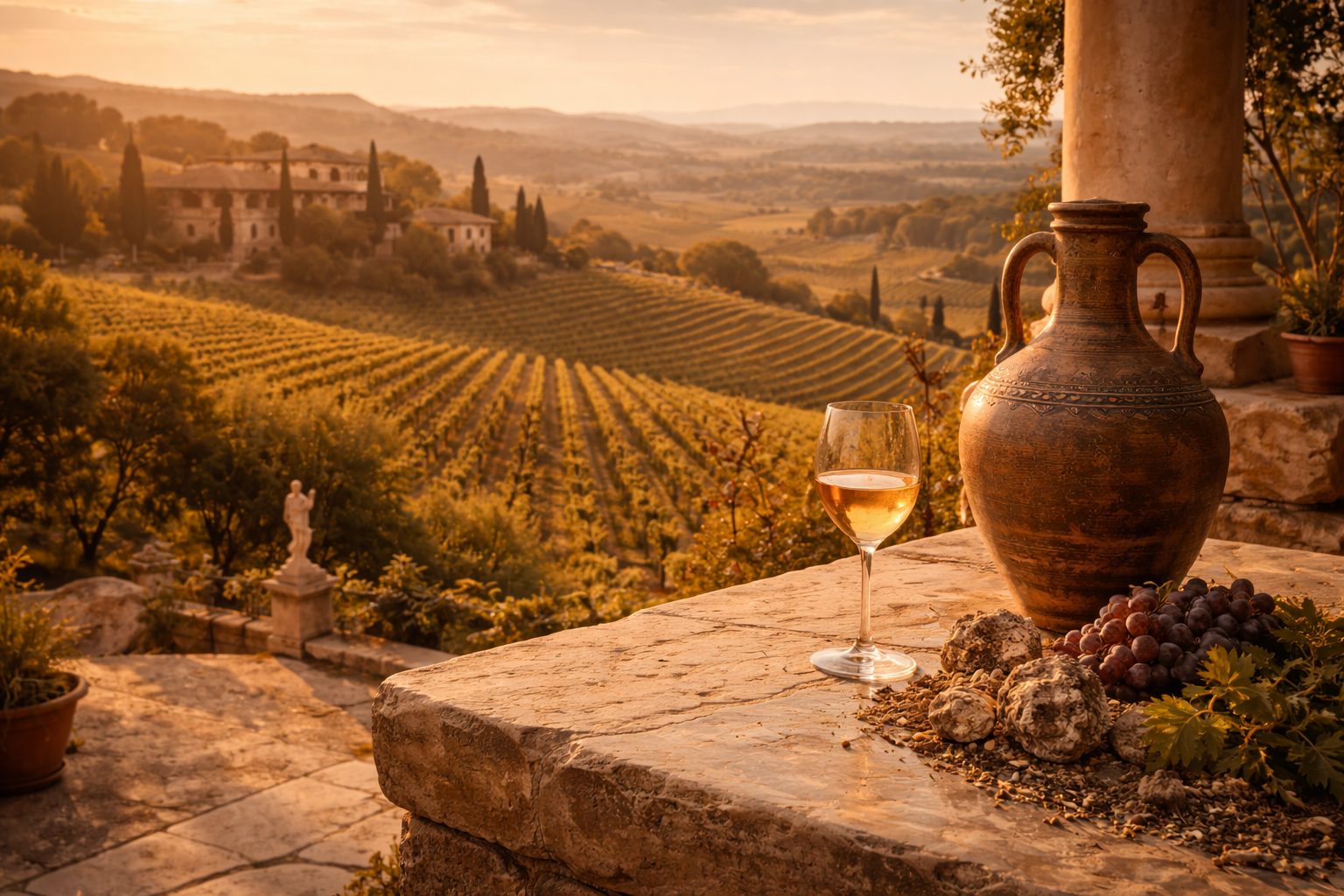
In the hills of Latium, wine became a mirror of power.
There, the proximity to Rome, the quality of the soils, and political influence created a setting in which wine ceased to be merely an agricultural product and became a symbol of social prestige.
The patricians — Rome’s elite — competed for the finest slopes, the best-exposed vineyards, and the rarest wines.
The reputation of a wine came to reflect the reputation of the person who produced and served it.
It is in this context that something new emerged in the history of wine:
a clear awareness that each place produces a different wine — and that this difference can be ranked, desired, and valued.
—
Latium: Power, Proximity, and Influence
Latium was not merely an agricultural region.
It was the political heart of the empire.
The hills surrounding Rome benefited from volcanic soils, good drainage, balanced sun exposure, and immediate proximity to centers of decision-making.
Producing wine in Latium meant producing close to power.
This had direct consequences:
wines were more closely observed, more frequently discussed, more readily compared.
Proximity to official banquets, patrician households, and intellectual circles transformed wine into an extension of political life.
Here, wine did not need to travel to gain reputation.
Reputation was born at the right table.
—
The Patricians and the Pursuit of Excellence
The Roman elite quickly understood that wine could function as a social marker.
Serving a certain wine, from a specific vineyard, at a particular moment, was a gesture laden with meaning.
Patricians invested in vineyards as they invested in architecture, art, or political alliances.
The vineyard became a sign of refinement and foresight.
It was not enough to produce wine — one had to produce the best wine, in the best place.
The competition was not merely economic.
It was symbolic.
Those who controlled the most reputed vineyards asserted cultural and social superiority.
Thus, wine definitively entered the realm of aristocratic competition.
—
The Birth of Reputation
It was during this period that wines began to be known by the name of a place, a hillside, or an estate.
Roman authors described wines associated with specific slopes, soil types, and solar exposures.
Wine was no longer judged simply as good or bad.
It was spoken of as superior, noble, worthy of aging.
Exceptional years were noted, wines that improved with time were prized, while others were meant to be consumed young.
Reputation began to precede the wine itself.
Before drinking, one already knew what to expect.
This was a decisive step:
wine ceased to be evaluated only in the cup and began to be evaluated by its origin.
—
Land, Climate, and Intention
Without using the modern term, the Romans began to think in terms of terroir.
They understood that vines could not be planted just anywhere.
The slope of the hillside, the nature of the soil, proximity to the sea or mountains, air circulation — all influenced the final result.
Certain hills in Latium became famous precisely because of this rare combination of factors.
The wine produced there stood out not through innovative technique, but through the natural harmony between land and climate.
This awareness changed the relationship with the vineyard.
The land ceased to be merely a support and became an identity.
—
Wine as Social Discourse
At patrician banquets, wine was language.
Choosing a particular wine communicated status, knowledge, and taste.
A host revealed himself as much through the wine he served as through the words he spoke.
A common wine on a noble table signaled negligence;
a rare wine, served with intention, elevated the gathering.
Wine became a silent discourse.
It required no explanation — its presence spoke for itself.
Here, wine draws close to art.
Like a sculpture or a poem, it demands context, sensitivity, and interpretation.
—
Distinction Within Abundance
Rome produced wine in abundance.
Yet paradoxically, it was within this abundance that distinction emerged.
The Roman elite did not reject everyday wine — they simply created a higher tier, reserved for specific moments, specific guests, specific occasions.
This hierarchy did not weaken wine culture; it refined it.
It created categories, references, and expectations.
Wine acquired social layers, just like Roman society itself.
—
The Role of Writing and Critique
Roman authors described wines with remarkable detail.
They commented on aromas, texture, aging potential, and effects on the body.
There were praises, comparisons, and criticisms.
Some wines were considered excessively heavy, others too light.
There were discussions about when to drink, how to serve, and what to pair.
This writing created something new:
wine as an object of reflection and public opinion.
Thus emerged an early form of wine criticism — limited to the elite, but highly influential.
—
The Vineyard as Family Legacy
For patricians, the vineyard was not merely an investment; it was an inheritance.
It was passed down from generation to generation.
To care for the vineyard was to care for the family name.
Some wine estates became almost mythical, associated with specific lineages and histories.
Wine carried memory, continuity, and identity.
The vineyard demanded time — and that reinforced its symbolic value.
Those who planted vines were thinking beyond their own lifetime.
—
Prestige and Exclusivity
Rarity became a virtue.
Certain wines were produced in limited quantities, destined only for restricted circles.
Exclusivity increased desire.
Wine became an object of waiting, anticipation, and privilege.
This logic — producing less, but better; serving fewer, but with intention — is one of the most enduring legacies of the Roman elite in the world of wine.
—
From Power to Taste
Over time, prestige ceased to be purely political and became aesthetic as well.
The Roman elite began to value wine not only for its name, but for the pleasure it provided.
Taste became a criterion.
And taste, when cultivated, becomes culture.
This may be the greatest legacy of the vineyards of Latium:
the transition from wine as a symbol of power to wine as an expression of sensitivity.
—
The Embryo of the Modern System
By competing for vineyards, classifying wines, and valuing origin and reputation, Roman patricians laid the foundations of the modern system of wine prestige.
Without formal regulations or legal denominations, they established something essential:
the idea that wine can — and should — be distinguished by its origin and by the care devoted to it.
This way of thinking would cross centuries, survive the fall of Rome, and re-emerge later in medieval and modern Europe.
—
When Wine Becomes Identity
In the hills of Latium, wine definitively ceased to be merely a drink.
It became identity, affirmation, and inheritance.
The Roman elite understood that wine could tell stories without words.
That a well-chosen vineyard could speak as powerfully as a political speech.
That serving a great wine was an act of silent authority.
And thus, from patrician competition, something was born that still accompanies us today:
the conviction that every soil, every climate, every place produces a unique wine —
and that recognizing this singularity is one of the highest acts of wine culture.