Wine Stories · Part I · Chapter 13
Rome: The Empire of Wine
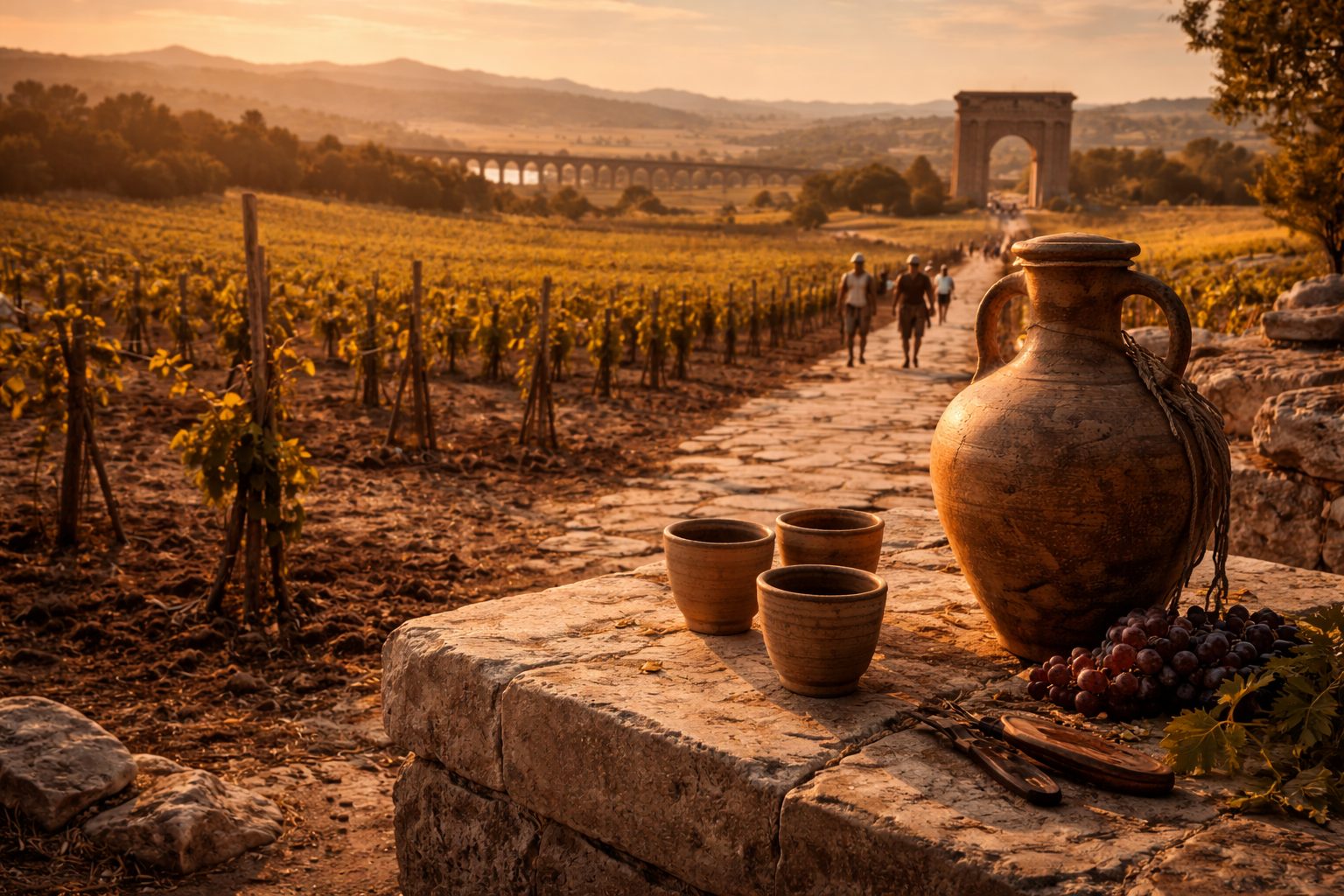
With Rome, wine became universal. What had until then been the privilege of regions, courts, or elites became part of the daily life of an entire empire.
Wine no longer belonged only to the land where it was born; it began to accompany Roman expansion as a sign of order, belonging, and cultural integration.
Roman legions did not carry only weapons, roads, and laws. They also carried vines. In every conquered territory, vineyards were planted, presses were built, and production was organized.
Where Rome arrived, wine arrived — not as an occasional luxury, but as daily sustenance and a structuring element of social life.
—
From Greek Wine to Roman Wine
Rome did not invent wine. It inherited it from the Etruscans and, above all, from the Greeks. But it did something no previous civilization had achieved: it democratized it.
While in Greece wine was moderated by philosophy and framed within the symposium, in Rome it became part of everyday life. It was drunk at the table, at work, in barracks, and in taverns. Quality varied, but wine was present at every social level.
This transformation marks a decisive rupture: wine ceased to be a cultural exception and became a civilizational norm.
—
Wine as Food
For the common Roman, wine was not only pleasure. It was food. Mixed with water, sweetened, aromatized, or diluted, it formed part of the daily diet.
Soldiers received wine as part of their rations. Urban and rural workers were entitled to lower-quality wine. Elites consumed aged, aromatic, or imported wines.
This differentiation did not diminish the value of wine — it reinforced it. Wine became a common language, even if spoken at different levels. To drink wine was a clear sign: I belong to Rome.
—
Viticulture as Imperial Policy
Rome quickly understood that to control wine was to control territory. The expansion of viticulture followed the expansion of the empire. In conquered provinces, the planting of vineyards was encouraged:
– in Gaul, along the Rhône and the Rhine;
– in Hispania, in Baetica and Tarraconensis;
– in northern Italy;
– along the banks of the Danube;
– later, even in Roman Britain.
These regions were not chosen at random. Rome recognized favorable soils, exposures, and climates. The vine became an instrument of Romanization.
To produce wine meant to integrate into the imperial economy, adopt Roman methods, pay taxes, and participate in the system.
—
Infrastructure: Roads, Amphorae, and Ports
Roman wine only became universal because Rome built the infrastructure to sustain it. Paved roads linked vineyards to cities and ports. Navigable rivers were used as logistical corridors. Ports such as Ostia, Massilia, or Carthage became centers of wine redistribution.
Roman amphorae were standardized. Each shape corresponded to a region, a type of product, or a specific function. Inscriptions indicated origin, producer, capacity, and destination.
For the first time in history, wine circulated within an organized, continuous, and predictable system.
—
Wine as Currency and Tax
Wine was not only consumed — it was accounted for. Taxes were paid in wine. Wages were received in wine. Amphorae were offered as payment for services or loyalty.
Some provinces specialized almost exclusively in wine production, supplying distant urban centers. Wine became one of the pillars of the Roman economy, alongside wheat and olive oil.
This economic role reinforced wine’s status as a political force. To control wine was to guarantee social stability.
—
Taverns, Baths, and Urban Life
Unlike the Greek symposium, restricted and ritualized, Roman wine expanded into public space. Taverns and wine shops served wine at any hour of the day. The baths, centers of Roman social life, often included wine consumption.
Wine accompanied informal conversation, quick business, and rest after work. It was less philosophical, more practical — but no less cultural.
Rome transformed wine into an urban element, inseparable from city life.
—
Quality, Prestige, and Classification
Despite democratization, Rome also developed a strong culture of prestige around wine. Certain regions became famous:
– Falernian
– Caecuban
– Alban
– Massic
These wines were mentioned by authors such as Pliny, Virgil, and Horace. Their age, origin, and character were known. Some were aged for decades.
Rome developed one of the earliest forms of wine criticism. Defects, virtues, and exceptional vintages were discussed.
Wine became an object of conscious appreciation.
—
Wine and Roman Identity
For Rome, wine was more than a habit: it was identity.
Romans distinguished themselves from “barbarians” also by the way they drank wine. Peoples who drank wine undiluted were seen as excessive; those who did not drink it at all were considered uncivilized.
The Roman way — mixed, regular, everyday — was presented as a model of balance and order.
Thus, wine functioned as a cultural marker: whoever drank like Rome, thought like Rome.
—
Wine and Religion
Wine was present in Roman rituals, offerings to the gods, and domestic cults.
But the decisive moment would come with Christianity. When wine was integrated into Christian liturgy as a central symbol, it directly inherited Roman infrastructure: vineyards, routes, production, and distribution.
Without Rome, wine would not have achieved such symbolic universality. The empire provided the body; religion would give it transcendence.
—
The European Wine Map
Perhaps Rome’s greatest legacy is this: today’s European wine map largely follows the Roman design.
Burgundy, Bordeaux, the Rhine Valley, the Douro, Rioja, Piedmont — all these regions received decisive impetus during the Roman period.
Rome did not merely create wines; it created wine territories. It planted vineyards that survived empires, wars, and centuries.
—
Wine as a Planted Civilization
When a Roman legion planted a vineyard, it did not plant only grapes. It planted permanence. The vine demands years, care, and relative peace. It is a gesture toward the future.
By spreading the vine, Rome spread a way of being in the world: organized, agricultural, integrated, enduring.
Wine became the symbol of this civilization built slowly, just as the vine grows.
—
The End of Rome, the Beginning of Another Story
The Roman Empire would fall. But wine would remain.
Vineyards survived in monasteries, villages, and along riverbanks. The structure created by Rome allowed wine to cross the Middle Ages and reach us today.
Rome was not only the empire of wine. It was the empire that made wine indestructible.
—
Wine as Imperial Legacy
Looking at the history of wine, we realize that Rome was not just another chapter. It was the moment when wine ceased to depend on isolated cultures and became part of the world.
Wine became universal because Rome made it everyday, organized, and transportable. It transformed it into a political, economic, and cultural force.
And that is why, even today, when we drink European wine, we also drink a little of Rome: in the vineyard, on the road, at the table, and in the idea that wine is part of civilization.