Wine Stories · Part I · Chapter 12
Wine in Persia and the East
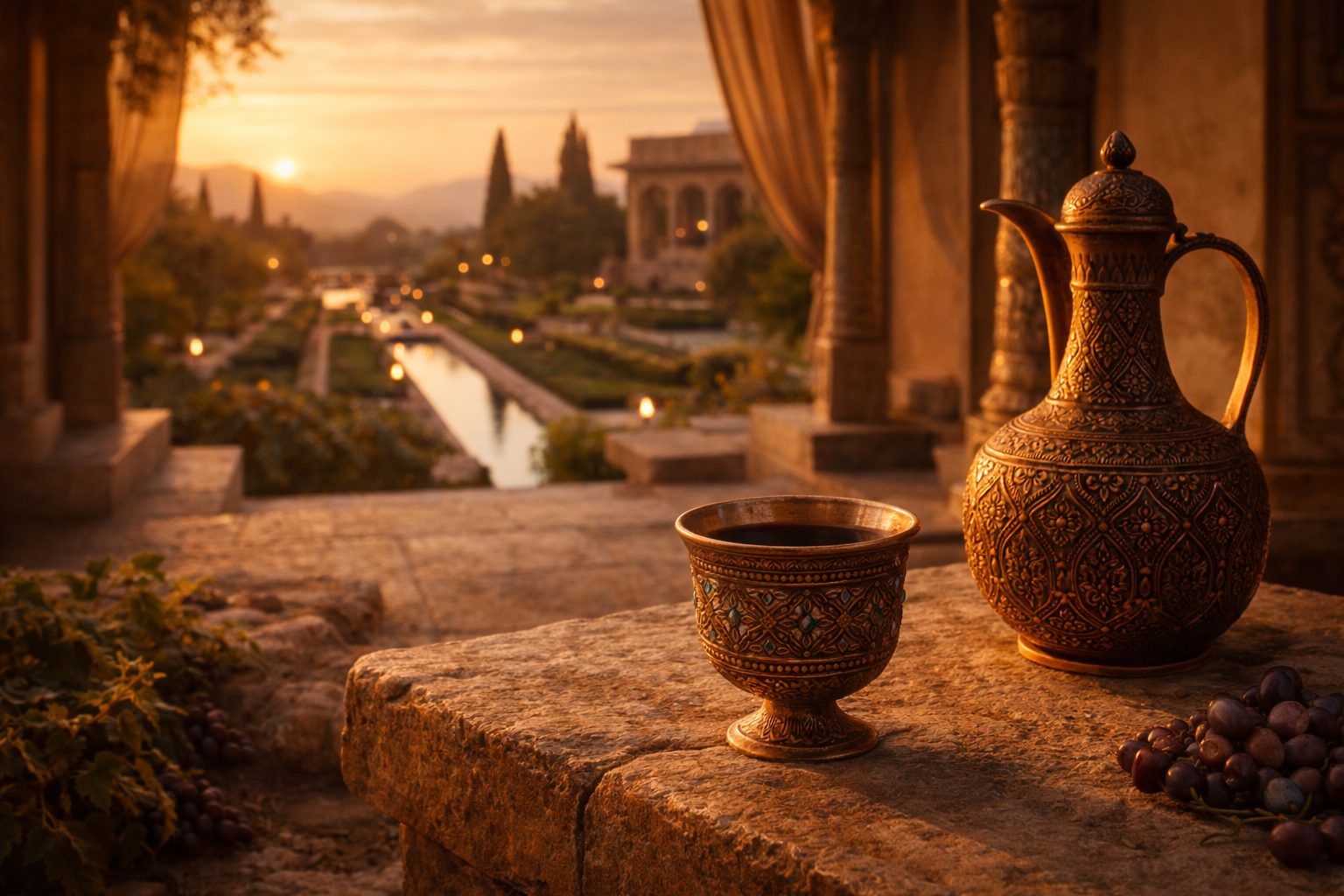
In the vast Persian Empire, wine was enveloped in an aura of luxury, power, and knowledge. Served at the courts of kings, strategists, and sages, it was a marker of social distinction and an instrument of political conviviality.
More than a drink, wine was part of a sophisticated system of material culture, irrigation, trade, and the representation of power.
If the Greek world gave wine philosophy and form, the East gave it scale, technique, and refinement. The role of Persia and the ancient East shaped the Mediterranean world in consolidating wine as a prestige good.
—
Persia as a Civilizational Bridge
The Persian Empire, especially under the Achaemenid and Sasanian dynasties, stretched from the Indus Valley to the eastern Mediterranean. It was an empire of roads, couriers, markets, and advanced administrative systems.
Within this vast territory, wine circulated as an elite product, associated with the court, diplomacy, and intellectual life.
Unlike Greece, where wine was relatively widespread among free citizens, in Persia wine was primarily a symbol of status.
Its production, preservation, and consumption were closely tied to imperial power. Drinking wine at the Persian court was not merely pleasure: it was a sign of proximity to the center of the empire.
—
Viticulture at the Edge of the Desert
Persia developed one of the most ingenious agricultural solutions of Antiquity: the qanats. These underground channel systems captured water from the mountains and carried it over long distances to arid zones.
Thanks to them, it became possible to cultivate vines in regions that, on the surface, would seem impossible. This innovation had profound consequences for Eastern viticulture.
Persian vineyards did not depend solely on rainfall; they depended on hydraulic engineering. Control of water enabled productive stability, something rare in the ancient world.
Thus, Persian wine was born already associated with planning, technology, and territorial mastery.
—
Wine and the Court
Historical accounts, iconography, and classical texts describe Persian banquets where wine held a central place. Cups of precious metal, finely worked amphorae, and ornate vessels reveal a mode of consumption marked by display and order.
Court banquets were not moments of chaotic excess. They were rituals of power. Wine served to mark hierarchies, reinforce alliances, and celebrate political decisions.
Herodotus recounts that the Persians made important decisions twice: once sober, once under the influence of wine. If both decisions coincided, the choice was considered just.
This detail reveals a profound conception: wine did not negate reason, but was seen as a way to test the truth of a decision.
—
Wine and Eastern Wisdom
In the Persian world, wine was associated not only with royalty but also with reflection. Poets, physicians, and philosophers of the ancient East saw wine as an ambiguous substance: capable of elevating the spirit or confusing it, depending on its use.
This ambiguity would endure for centuries and reach medieval Persian literature, where wine appears as a metaphor for inner freedom, knowledge, and transcendence.
Even in more restrictive religious contexts, wine retained a powerful symbolic place. The East taught that wine could be luxury and thought, pleasure and metaphor.
—
Preservation and Sophistication
Persia also stood out for its preservation techniques. Sealed amphorae, the use of resins, storage in cool and subterranean spaces — all were part of Eastern empirical knowledge.
The Persians understood that wine needed protection from heat and time. They knew how to choose locations, containers, and methods that ensured greater stability.
This technical knowledge would directly influence the Hellenic world, especially after the campaigns of Alexander the Great, which brought Greek and Persian cultures into direct contact.
—
Eastern Routes of Wine
Persian wine did not remain confined to the empire. It circulated along the great trade routes of Antiquity:
to the west, reaching the Mediterranean via Anatolia and the Levant;
to the east, following routes later known as part of the Silk Road, reaching the Indus Valley.
In these exchanges, wine competed with spices, textiles, and precious metals. It was a prestige commodity, not a mass product.
The circulation of Eastern wine contributed to the idea that certain wines had noble origins, linked to empires and sophisticated cultures.
—
Encounter with the Greek World
Contact between Persia and Greece was, for centuries, marked by conflict. But it was also deeply cultural.
The Greeks encountered Eastern wines, irrigation techniques, banquet forms, and objects related to wine consumption. Some elements of the Greek symposium — such as the importance of ritual, rhythm, and reflection — have clear parallels in Persian culture.
The difference lay in access: in Greece, wine educated the citizen; in Persia, it affirmed power.
This contrast enriched both worlds.
—
Wine and Eastern Religion
In Zoroastrianism, wine held an ambiguous yet significant place. It was associated with purification rituals and symbolic practices linked to truth and cosmic order (asha).
Once again, wine appears as a substance of transition between the material and the spiritual.
Even when, later, certain religious traditions limited the consumption of wine, its symbolic role did not disappear. It transformed, adapted, and survived in language and imagination.
In the East, wine was never merely a drink: it was a sign.
—
Luxury, Power, and Distance
Eastern wine taught the ancient world an essential lesson:
the value of wine depends not only on the land, but also on distance, access, and rarity.
To drink Persian wine was to drink empire. It was to participate, even symbolically, in a network of power spanning continents.
This association between wine and luxury would endure for centuries and re-emerge later in wines reserved for European courts.
—
A Silent but Decisive Influence
The history of wine is often told from Greece and Rome. But without the East — without Persia, Anatolia, and late Mesopotamia — that history would be incomplete.
The East brought:
water engineering;
imperial organization;
banquet sophistication;
long-distance routes;
and a vision of wine as a global prestige good.
This heritage reached the Greek world and, through it, the Roman and European worlds.
—
Wine as Imperial Language
By examining wine in Persia and the East, we see that it ceased to be merely agricultural or communal. It became a language of power, a sign of advanced civilization, and an instrument of cultural assertion.
Eastern wine spoke not only of pleasure; it spoke of order, reach, and knowledge.
And in doing so, it prepared the ground for the greatest wine system of Antiquity: Rome.
—
Between East and West
Wine was one of the rare elements capable of crossing religious, linguistic, and political boundaries.
Between East and West, it functioned as a point of contact, exchange, and learning.
By integrating Eastern refinement, the Greek and Roman worlds inherited not only techniques, but a broader vision of wine as a civilizational phenomenon.
And it is in this confluence — between Persian mountains, irrigated deserts, and Mediterranean seas — that wine definitively asserts itself as the drink of the ancient world.