Wine Stories · Part I · Chapter 6
Between Rivers and Cups: Sumerian Wine
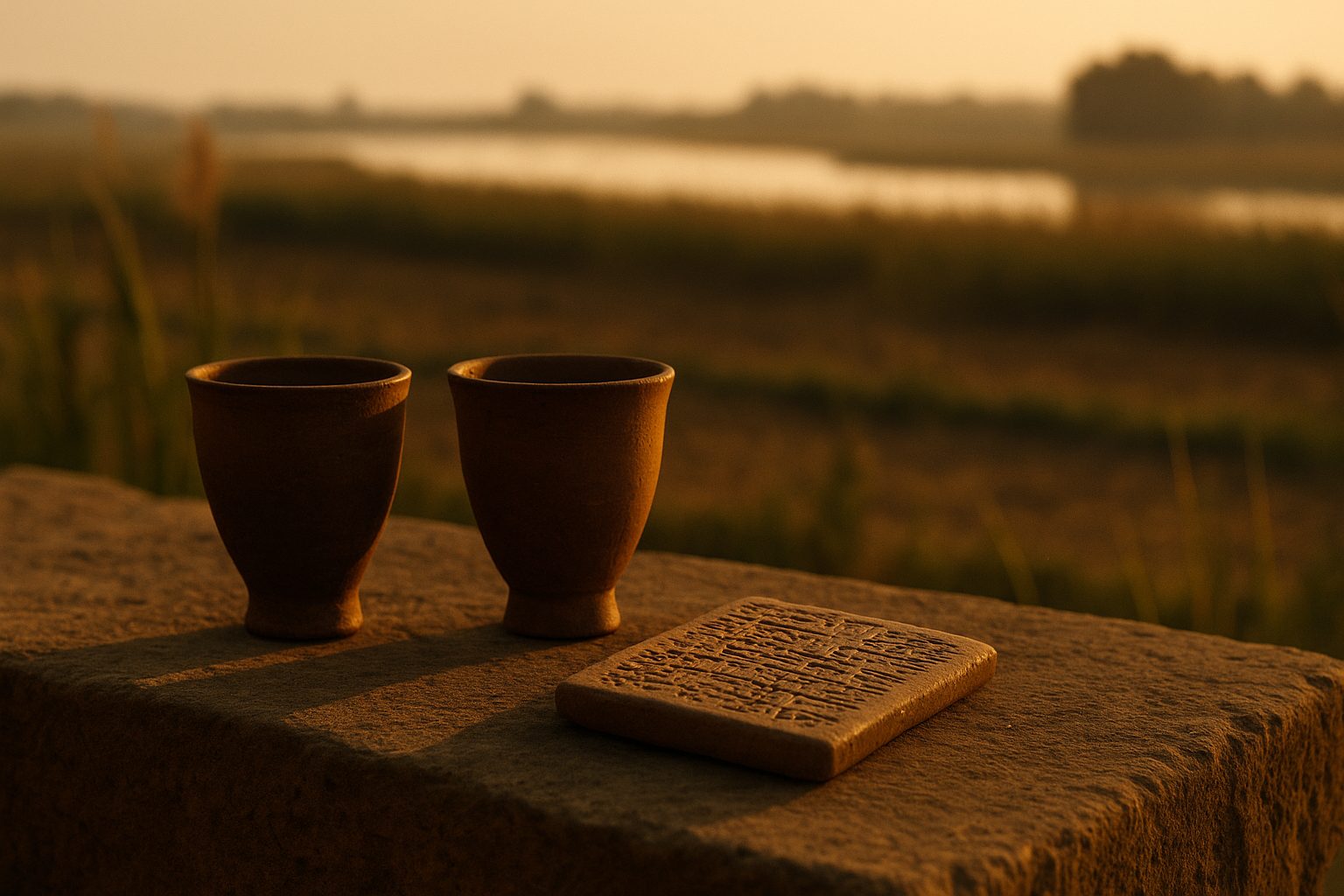
Between the slow waters of the Tigris and Euphrates — where the first cities emerged — the Sumerians were pioneers not only in writing, accounting, and social organization, but also in the convivial culture of wine.
If the Caucasus gave birth to the domesticated vine and Egypt consecrated wine to the gods, in Sumer wine found its first truly human stage — a space where sharing, dining, and celebration became part of daily life.
In clay tablets that survived more than four millennia, we find descriptions of taverns, clay drinking vessels, wine deliveries, and records of communal consumption. Sumerian wine was more than nourishment: it was a social alliance, a prestige currency, and a symbol of prosperity.
—
The Land Where It All Began
Sumer, located in southern Mesopotamia between the Tigris and Euphrates, was one of the first urban societies in history. Cities like Uruk, Ur, Lagash, and Eridu flourished between 3500 and 2000 BC, supported by a sophisticated agricultural system based on irrigation canals.
The region was not naturally suitable for grapevines — too hot, too flat, too exposed — but this did not stop the Sumerians from integrating wine into their culture.
The vine was cultivated in higher northern regions (such as Assyria or the Zagros foothills), and wine reached Sumerian cities through trade.
Thus, the Sumerians were among the first wine importers in history.
This status shaped its value: wine was precious, rare, associated with prestige and communal unity.
—
Clay Tablets That Speak of Wine
Sumerian clay tablets are among archaeology’s greatest treasures. In them we find distribution lists for wine, payments, purchase contracts, and administrative records that reveal the drink’s importance in the economy and in daily life.
One of the most fascinating tablets describes a tavern run by a woman — something common at the time — where fermented beverages, bread, simple meals, and wine were served. The establishment functioned as a meeting point: a place for conversation, agreements, and celebration.
Other tablets mention:
– quantities of wine delivered as temple tribute;
– wine rations for skilled workers;
– inscriptions distinguishing wines from different origins;
– ceremonial wine offerings to the gods;
– and descriptions of early community gatherings.
These inscriptions are not just economic documents — they are clues to the world’s first drinking culture.
—
Wine as a Symbol of Prosperity
In Sumer, wine was not accessible to all, but it was not reserved exclusively for kings and priests either. It belonged to the realm of hospitality, sharing, and alliance-building.
Offering wine was a sign of respect, power, and generosity.
Elites used wine to seal agreements, receive foreign envoys, and celebrate victories. For common people, wine was associated with special moments: festivals, religious ceremonies, weddings, and community renewal rituals.
In Sumerian poems, drinking wine is described as part of the pleasures of civilized life. Wine held a dual presence: economic and symbolic.
In one of the oldest myths, Inanna — goddess of love, fertility, and civilization — intoxicates Enki, the god of wisdom, with wine in order to obtain from him the secrets of human culture.
Wine thus appears as an agent of transformation — a revealer of knowledge and a creator of relationships.
—
The First Taverns in History
Sumer created something no earlier civilization had recorded: the tavern as a social space. Temples were religious centers; palaces were political hubs; taverns became community hubs.
They were modest spaces, often owned by women, where fermented beverages were served — barley and wheat beers, imported wines, and aromatic mixtures. Patrons sat on low clay benches, drinking from simple cups, sharing food, conversations, and decisions.
The tavern was a meeting place for different social classes. Merchants, artisans, farmers, and travelers could sit side by side. In this environment, wine acted as a social mediator.
Some tablets even contain rules on behavior and payment inside taverns — the first “codes of conduct” for urban conviviality.
—
The Culture of the Cup and of Sharing
If in Egypt wine was mostly ritual, in Georgia spiritual, and in the Caucasus ancestral, in Sumer wine found its first communal territory.
Drinking wine in a group was not just enjoyment: it was a gesture of collective identity. The cup served as a tool for union and openness.
The Sumerians believed that good social harmony — šulmu, domestic peace — was as important as the harvest itself. And it was around the cup that these bonds were strengthened.
To drink together meant to trust, to honor, and to share time.
This is perhaps the earliest manifestation of what we now associate with Western wine culture: sitting together, talking, toasting, celebrating.
—
Economy: Wine as a Prestige Commodity
Sumer was one of the first societies to understand wine’s economic value. Because wine was not produced in large quantities locally, it had to be imported.
This trade required:
– secure routes;
– proper storage;
– price tables;
– specialized merchants and intermediaries.
Tablets found in ancient Uruk mention the transport of wine in amphorae coming from the north — likely from the mountainous regions of Iran and the Caucasus. This exchange reinforced Sumer’s role as a crossroads of cultures, where wine served as both a luxury good and a diplomatic tool.
—
Wine in Sumerian Religion
As in other ancient cultures, wine also had a religious role in Sumer. It was offered to deities such as Inanna, Utu, and Enlil. These offerings followed calendars and carefully recorded quantities on clay tablets.
Libations were important in purification and thanksgiving rituals. Wine was poured on altars or on the earth before harvests or major festivals.
This symbolic gesture connected human labor to the divine realm, creating continuity between the visible and the invisible.
—
Wine and Literature: The Intoxication That Reveals
One of humanity’s oldest literary works, The Epic of Gilgamesh, mentions wine as an element of inner transformation. Enkidu — wild and far from civilized life — becomes human after drinking wine shared with other men:
“He drinks seven cups of wine and his spirit becomes bright.”
The beverage is not portrayed as excess but as a tool of social discovery. In Sumerian literature, drinking wine signals that a man has entered the world of community, language, and shared life.
It symbolizes the passage from instinct to culture.
—
Continuity Through Time
After the fall of Sumer, wine did not disappear.
Successor peoples — Akkadians, Assyrians, and Babylonians — inherited and expanded this drinking culture. They added new techniques, new vessels, new rituals.
Wine became a constant presence in palace celebrations, temples, and elite households.
Sumer therefore left us not only records of wine as a product, but above all its social dimension — perhaps its most enduring legacy.
—
Sumerian Legacy: The Birth of Social Wine
Sumer’s great contribution to the history of wine lies not in technique, viticulture, or spirituality — but in community. Here, wine became a bridge between people.
It was in Sumerian taverns that the first notion of:
– drinking together;
– celebrating together;
– creating bonds around a cup;
– using wine as a tool of unity and conviviality
was born.
This is why we can say that between rivers and cups emerged one of the fundamental pillars of wine culture: the pleasure of sharing.