Wine Stories · Part I · Chapter 5
Egypt and the Wine of the Pharaohs
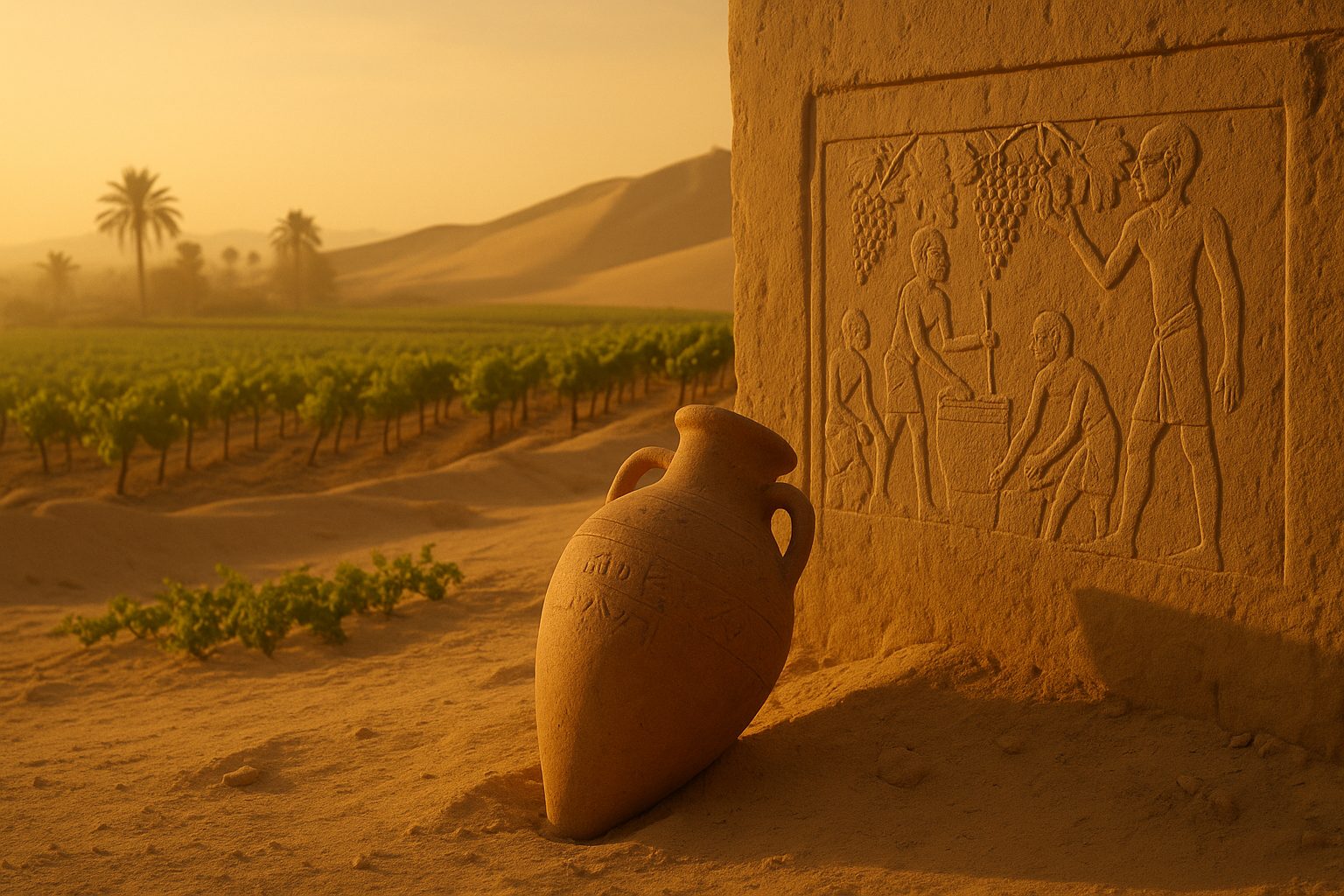
In Ancient Egypt, wine was more than a beverage — it was a sacred gift reserved for the gods, the pharaohs, and the elites who served the State. In a land where life depended on the rhythm of the Nile and obedience to the seasons, wine carried symbolic and spiritual meaning that went far beyond pleasure.
It represented order, continuity, and divine protection.
Along the fertile banks of the Nile Valley arose some of the earliest vineyards cultivated with ritual purpose, bearing witness to how wine became an integral part of Egypt’s religious and political life.
—
The Nile: The Lifeline Where Wine Found Its Place
To understand Egypt’s bond with wine, one must first grasp the geography that shaped the country. Egypt was a narrow corridor of fertile land surrounded by desert. Life concentrated along the Nile, which flooded annually and deposited a layer of mineral-rich sediment.
These dark, fertile, humid soils were ideal for cereals and vegetables — but also, surprisingly, for small vineyards.
The vine did not thrive in large expanses, as it later would around the Mediterranean; it required constant care, irrigation, and protection. Egyptian vineyards were small, often planted inside the walled gardens of temples or aristocratic estates.
They were vineyards surrounded by intention: they were not planted simply to nourish, but to honour.
Egyptian wine was therefore scarce and precious. Its rarity shaped its status.
Beer was the drink of the people; wine was the drink of the gods.
—
Wine as a Divine Gift
The Egyptians believed wine had celestial origins. According to some myths, it was the “blood of Ra,” the sun transformed into liquid. Other traditions claimed wine was offered by the gods as a symbol of rebirth and protection.
Unsurprisingly, many religious ceremonies included wine libations and offerings.
In temples, priests poured wine before divine statues, giving thanks for the fertility of the land and asking for protection over the crops. These rituals were repeated throughout the agricultural year, marking the link between the natural and spiritual cycles.
To drink wine in Egypt was not an everyday gesture — it was a sacred act.
—
The Vineyards of the Pharaoh
The earliest written references to royal vineyards date from the Old Kingdom, but it was during the New Kingdom, from around 1550 BC onwards, that Egyptian wine production truly flourished.
The pharaohs maintained vast agricultural estates, and among them were vineyards cultivated under the direct supervision of palace administrators. These vineyards produced wine destined for court banquets, temple offerings, and occasionally foreign trade.
Tutankhamun’s burial treasures included dozens of wine amphorae, carefully sealed and labelled with the producer’s name, the region, and the harvest year — a primitive yet remarkably advanced form of labelling and origin control.
This practice shows the care with which wine was treated and the importance placed on preserving its identity.
—
The First “Documented Winemaking” in History
No civilization left records as clear and detailed on viticulture and winemaking as Egypt did.
On the walls of tombs belonging to high officials — especially in Beni Hassan, Saqqara, and Thebes — one finds magnificent paintings depicting every stage of the process:
– harvesting clusters into wicker baskets;
– grape treading by workers holding ropes for balance;
– pressing using cloth bags twisted between wooden poles;
– decanting the must into jars;
– sealing amphorae with wax and clay;
– wine offerings presented to the gods or the deceased.
These scenes are not merely art: they are technical documents.
They show that the Egyptians had a deep understanding of winemaking and mastered techniques of pressing, preservation, and storage. Amphorae were often kept in underground rooms, protected from the desert heat.
It is safe to say that Egypt was the first civilization to deliberately document the winemaking process, transforming it into transmissible knowledge and a practice managed by the State.
—
Wine Types and Producing Regions
Hieroglyphic texts and inscriptions found on amphorae mention several Egyptian wine-growing regions, such as the Nile Delta, Fayum, and the Mendes area. Each produced wines with distinct characteristics, depending on soil and technique.
The inscriptions refer to different types of wine, including:
– Red wine, the most valued and associated with the sacred;
– Sweet or naturally concentrated wines, from very ripe grapes;
– Aromatic wines, sometimes infused with resins or herbs;
– And possibly early forms of late-harvest wines.
Some amphorae even listed wine “quality”: common, good, superior, very superior.
This rudimentary classification system shows that Egyptians already valued origin and quality.
—
Wine in Rituals and the Afterlife
The spiritual importance of wine was most evident in funerary rituals. Egyptians believed life continued after death and that the deceased required the same goods in the next world. Thus, royal and noble tombs were filled with carefully selected amphorae of wine — some sealed in the year of death, others chosen from exceptional vintages.
Wine accompanied the dead as a symbol of status, food for the spirit, and a guarantee of abundance in the afterlife. It was believed that wine helped the deceased approach the gods and complete their journey of rebirth.
This is why amphorae found in tombs are so exceptionally preserved: they were treated as sacred objects.
—
Winemaking as State Heritage
Wine was important enough to be managed by the Egyptian State. There were official positions dedicated to viticulture: vineyard supervisors, press masters, amphora counters, and keepers of the royal cellars.
Inscriptions document deliveries of wine as taxes, diplomatic gifts, and tributes from conquered regions.
Pharaohs even established temple-vineyards dedicated to specific deities. The wine produced in these vineyards was used exclusively in religious ceremonies.
Wine thus became a means of maintaining maat, the divine order that governed Egyptian society.
—
Mediterranean Influence
Although Egypt is often remembered as a wine consumer rather than a major producer, there is evidence it also imported wine from neighbouring regions such as Palestine, Lebanon, and Syria.
These foreign wines, packaged in distinctive amphorae, were used by the elite and influenced Egyptian viticulture itself.
This exchange strengthened the idea of wine as a valuable commodity worth transporting across large distances.
—
The Egyptian Legacy
Egypt was not the birthplace of wine — that honour belongs to the Caucasus — but it was undoubtedly the first great stage where wine gained institutional, spiritual, and artistic meaning.
Its legacy includes:
– the first systematic documentation of winemaking;
– the earliest forms of labelling and harvest mention;
– the integration of wine into public administration;
– the use of wine as a divine and funerary symbol;
– and the affirmation of wine as a prestigious cultural asset.
When Greece and Rome later became the dominant wine civilizations, they inherited many practices first tested in Egypt: classification, origin control, ritual use, and symbolic appreciation.
Egyptian wine may have been consumed mainly by pharaohs and priests, but its influence extended far beyond the banks of the Nile.