Wine Stories · Part II · Chapter 36
The Role of the State — When Wine Becomes Politics
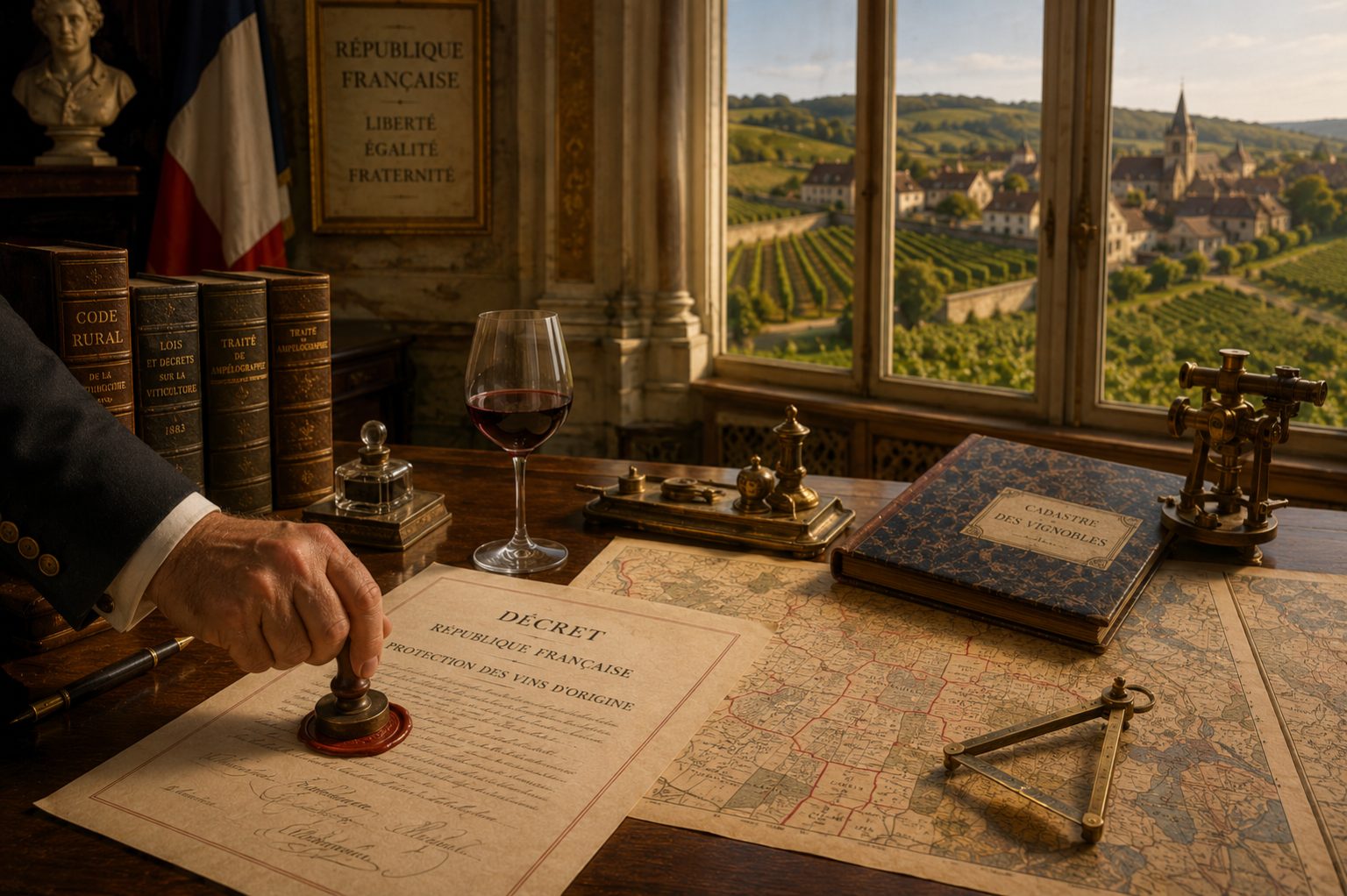
In France, the State has never regarded wine merely as a matter of taste. It has regarded it as a matter of power.
From the Ancien Régime to the Fifth Republic, governments, kings and public institutions understood that wine was far too important to be left solely in the hands of producers. It generated wealth, employed entire populations and projected national prestige abroad. Above all, it was a means of expressing identity—and, in the French tradition, identity is a matter of State.
French political intervention shaped wine into a system, and the decision to govern territory through origin transformed wine into a public policy unlike any other.
The Vineyard as Political Territory
The relationship between political power and viticulture in France did not begin with decrees. It began with the land.
To control the land was to control production. To control production was to control the local economy. In an agrarian society, the logic required little explanation.
Medieval kings did not need to invent the idea of regulating wine. It emerged naturally from the structures of power that already organised every other aspect of society. The vineyard entered this system with one important distinction: it produced something whose value extended beyond necessity—something that could be exported, taxed and celebrated.
Wine thus became a political resource long before it became a political policy.
Bordeaux and the First Model of Protection
The case of Bordeaux is both the earliest and the clearest.
During the twelfth and thirteenth centuries, when the region belonged to the English Crown, Bordeaux merchants secured commercial privileges that protected their wines from competition with those produced further inland.
The wines of the Haut-Pays, produced upstream, could enter the port of Bordeaux only after the local wines had been sold.
It was commercial discrimination.
It was also wine policy.
The distinction between the two is more subtle than it first appears.
This precedent established a fundamental principle: origin can be protected by decree. What the land produces can be defended by the State. And that protection carries measurable economic value.
The Ancien Régime and the Taxation of Pleasure
Under French absolutism, wine also became a fiscal matter.
Taxes on the movement of wine—the aides and other wine-related duties—became a significant source of revenue for the Crown. This created a direct governmental interest in both production and trade.
The more wine was produced, the more it could be taxed.
The more it was exported, the more revenue flowed into the royal treasury.
This relationship between taxation and viticulture had practical consequences.
The State needed to know what constituted quality wine, because different wines were taxed differently. It also needed to ensure that wines sold under the name of a particular region genuinely originated there.
Fraud was an enemy of public revenue long before it became an enemy of consumers.
Phylloxera and the State as Saviour
The second half of the nineteenth century provided the clearest demonstration of the French State’s commitment to wine: the phylloxera crisis.
The pest that devastated Europe’s vineyards from 1863 onwards destroyed within decades what centuries had painstakingly built.
No individual response could solve a problem of such scale.
Resources, coordination and authority were required—resources that only the State could provide.
The French Republic responded.
It funded research, organised the distribution of resistant American rootstocks, established technical commissions and issued regulations.
For the first time, the State explicitly assumed responsibility for protecting viticulture as a strategic sector.
It was not merely an economic issue.
It was national identity under threat.
And when national identity is threatened, the French State intervenes.
Fraud and the Need for Law
Phylloxera produced an unexpected consequence.
As production collapsed while demand remained, fraudulent wines proliferated.
Adulterated wines, undeclared blends and deceptive labels became widespread.
A wine sold as Bordeaux might have come from anywhere.
A Burgundy might contain grapes from Spain or Algeria.
The reputation built over centuries was being squandered within a few years.
The State realised that the only way to protect it was through legislation.
The first laws governing origin soon followed.
The law of 1 August 1905 prohibited fraud involving geographical names.
The law of 6 May 1919 legally recognised the right to a designation of origin for wines produced within a defined region.
These laws became the foundation of what would later evolve into the Appellation d’Origine Contrôlée system.
The Creation of the National Committee for Appellations of Origin
In 1935, the French State took the decisive step.
The decree-law of 30 July 1935 created the Comité National des Appellations d’Origine des Vins et Eaux-de-Vie, which would later become the INAO.
For the first time, a public institution possessed the authority to define, delimit and protect appellations of origin.
The model was innovative precisely because it was not merely administrative.
It involved producers themselves in defining the rules under which they operated.
It was participatory regulation.
The State provided the legal framework.
The producers defined its substance.
The architecture followed a simple logic:
Those who best understand what Chambertin or Muscadet should be are the men and women who have produced them for generations.
The State protects.
The producers define.
The productive tension lies between the two.
The INAO as Applied Philosophy
Over the following decades, the INAO became more than a regulatory institution.
It became a philosophy applied to territory.
Its central premise is simple:
The quality of a wine is inseparable from the place where it is born.
To protect an appellation is to protect terroir.
To protect terroir is to protect identity.
And protecting identity is ultimately a cultural responsibility—not merely an economic one.
This philosophy directly influenced the appellation systems of Portugal, Italy and Spain, and later shaped the entire European framework for protected designations of origin.
France exported not only bottles.
It exported institutions.
The State as Referee Between Tradition and the Market
Government intervention in wine inevitably raises a difficult question:
At what point does regulation protect—and at what point does it constrain?
French history demonstrates both sides.
The protection afforded by the AOC system preserved identities that market forces alone would likely have homogenised.
Yet the rigidity of certain appellations also prevented adaptations that might have proved beneficial—new grape varieties, different techniques and more contemporary styles.
The State excels at preservation.
It is less adept at innovation.
This tension has no simple resolution.
But it is a healthy one.
It forces every generation to ask:
What deserves to be preserved—and what deserves to change?
The Winemaker and the State
As a winemaker, my relationship with the State is an ambivalent one.
On one hand, I recognise the value of the system.
Appellations protect genuine identities, prevent fraud and create confidence in international markets.
Without that framework, conscientious producers would always be at a disadvantage against those willing to adulterate without consequence.
On the other hand, there are times when regulation becomes heavier than necessary.
When a grower tending century-old vineyards cannot use a particular grape variety simply because it is absent from the approved list for the appellation, something has been lost in the balance between regulation and reality.
The State should serve terroir.
When it begins to replace it, the system has failed.
When Politics Serves Culture
The greatest achievement of the French model was to transform political intervention into cultural stewardship.
It was not always so.
Nor did it always succeed.
Yet the central idea—that the State bears responsibility for preserving what time has patiently created—is one worth defending.
Wine is not merely a market commodity.
It is memory.
It is landscape.
It is collective identity.
And when those things are at risk, politics has a role to play—not to dominate, but to protect what the market, left to itself, does not know how to preserve.