Wine Stories · Part II · Chapter 42
Transition — France Teaches the World How to Drink
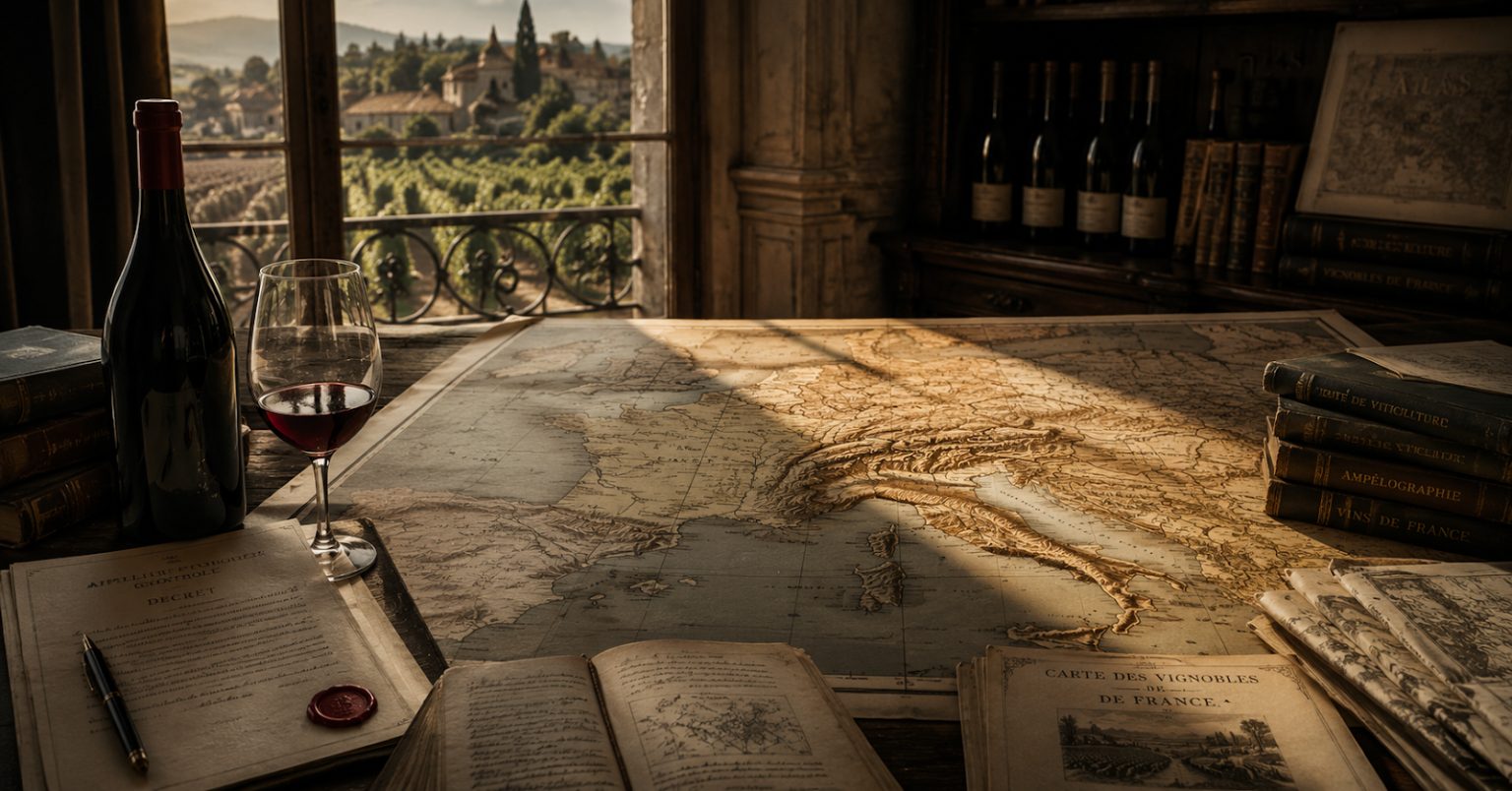
We have reached the end of a long journey.
We began in the silent monasteries of the Middle Ages and arrive at an entire civilisation built around a bottle.
Between those two points, France did something no other country had attempted with such ambition: it turned wine into method. It gave it laws, institutions, a vocabulary and a philosophy. In doing so, it established the rules that the rest of the world would spend more than a century following.
Before continuing our journey, it is worth looking back at what was built.
From Faith to System
It all began with the monks.
Through patient and repeated observation, they began to distinguish one vineyard from another, one soil from another, one parcel from the next.
What began as intuition became record, and what became record would, centuries later, become law.
This is the thread running through this entire section: the slow passage from faith to system.
The Cistercians who mapped the climats of Burgundy did not know they were laying the foundations of a legal architecture that still structures the wine world today.
They did it out of devotion to the land, not out of an ambition for power.
The system came later — and perhaps that is precisely why it endured.
What France Built
The result is remarkable.
The AOCs gave origin a name and a boundary.
The INAO gave it an institution capable of defending it with rigour and continuity.
The concept of terroir gave it a language with which to explain what the law alone could never fully express.
And culture — the table, conversation, philosophy and art — gave all of this a meaning that extends far beyond economics and law.
Few industries in the world have achieved anything comparable: transforming an agricultural product into such a complete expression of civilisation, where law, science and art work together to protect and celebrate the same idea —
that place matters.
The Limits of the Model
But no system is perfect, and it would be dishonest to close this section without acknowledging that.
The French model was created to protect tradition, and at times it protects it too much.
Its hierarchies — particularly the 1855 Classification in Bordeaux — freeze decisions made more than a century and a half ago.
Its rules, designed to guarantee authenticity, can become obstacles for those seeking new ways to interpret a place.
And the culture of taste, which did so much to elevate wine, risks becoming a closed code, more concerned with distinction than inclusion.
None of these limitations diminishes the achievement.
But no achievement should be copied without criticism.
And perhaps this is the most useful lesson France leaves us:
what works in one place does not necessarily work in the same way somewhere else.
One Model, Many Answers
It was precisely this awareness that the rest of Europe carried with it when it looked towards France.
No country copied the French model in every detail.
All understood the same essential truth — that for origin to have value, it requires a name, rules and institutions — but each translated that principle according to its own history and character.
Italy, above all, chose a different path from centralised order.
Instead of one system, it built multiplicity.
Instead of one answer, it preferred many questions.
What We Learn by Travelling South
After the discipline of France, the journey into Italy is almost a contrast in temperament.
Where France organised, Italy multiplied.
Where France created hierarchies, Italy lived with contradiction.
And yet the result is no lesser.
It is simply different.
Italy proves that greatness in wine does not depend on a single system, but on the honesty with which each territory is allowed to become what it truly is.
That is the real lesson of travelling through the wine regions of Europe:
there is no single correct way to express the truth of a place.
There are as many paths as there are peoples who have learned to listen to their land.
France Teaches the World How to Drink
France transformed wine into method and model.
Through the AOCs, the INAO and the power of its great regions, it established the rules that the world came to follow.
But every model generates new interpretations.
It is now time to travel south, where Italy and Spain reinvented their traditions, balancing their Roman inheritance with the richness of regional diversity.